The Strategy of Dispersion: Why the Future of Military Logistics Could Be Brazilian, Not American
Pentagon planners are facing a critical dilemma: can large tanker aircraft survive the opening salvos of a conflict in the Indo-Pacific? In a theater dominated by vast distances and the constant threat of enemy missiles, the reliance on a handful of massive bases, such as those in Guam or Okinawa, is increasingly seen as the Achilles’ heel of American forces.
The Giant Base Trap: When Size Becomes a Liability
The current U.S. refueling fleet, built around the massive KC-135 Stratotanker and KC-46 Pegasus, is a prisoner of large-scale infrastructure. These aircraft require long runways and complex facilities, limiting them to a small number of locations. A Congressional Research Service report warns that if these primary hubs are targeted, refueling operations could be pushed thousands of miles away from the front lines, effectively paralyzing aerial combat capabilities.
The Agile Combat Employment (ACE) concept calls for dispersing forces across a network of smaller, harder-to-target airfields. However, today’s „giants” cannot land on short or damaged runways, leaving a strategic gap that an adversary can easily exploit.
KC-390 Millennium: The Game-Changer Designed for Austere Environments
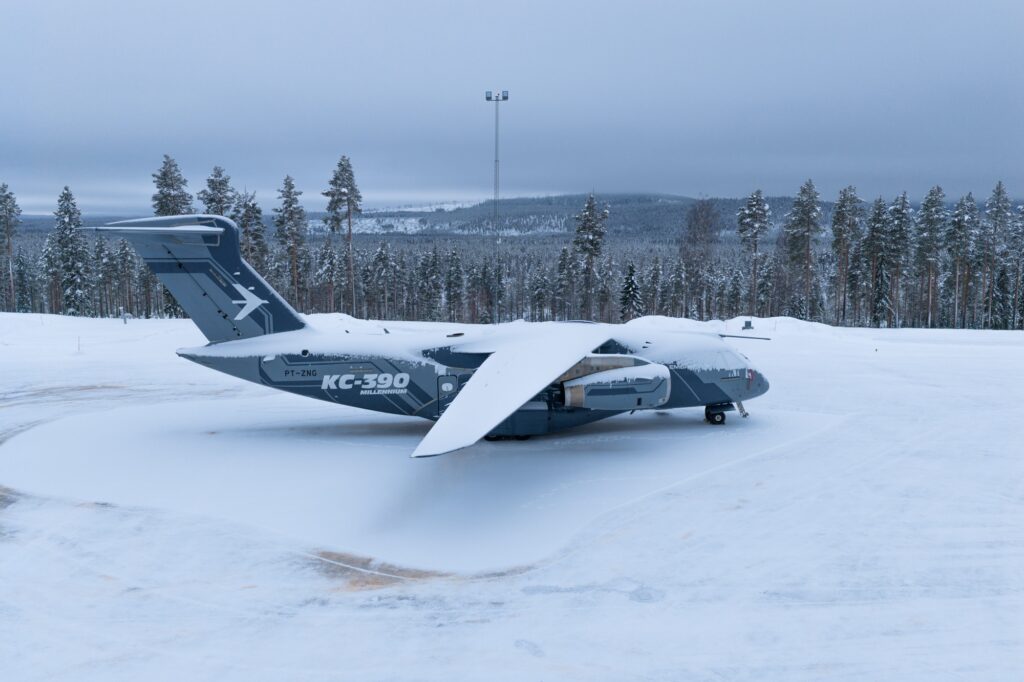
Amidst this tension, the Brazilian Embraer KC-390 Millennium is emerging as both a contingency and a future solution. Unlike its American rivals, which are derivatives of commercial airliners, the KC-390 was designed from the ground up for military service. Featuring rugged landing gear and engines positioned to avoid foreign object debris, it can operate from austere or partially destroyed surfaces that are inaccessible to the current Air Force fleet.
“The best way to protect an asset is by making its destruction strategically irrelevant,” Embraer officials state. By operating from dozens of small airstrips—in locations like the Philippines—the risk that a single enemy strike could cripple refueling operations is drastically reduced.
Beyond Fuel: Versatility Under Pressure
A partnership between Embraer and Northrop Grumman is now working to adapt this aircraft to specific U.S. requirements, including the implementation of boom refueling systems. Yet, its primary strength remains its polyvalence: the KC-390 can be reconfigured in hours from a tanker to a transport for Black Hawk helicopters, HIMARS rocket systems, or a mobile hospital.
While the U.S. continues to rely on veteran KC-135s—some approaching 70 years of age—allies like South Korea, Sweden, and the UAE have already opted for the Brazilian model. For the Air Force, the question is no longer how much fuel a tanker can carry, but whether that tanker can get close enough to the fight to actually matter.