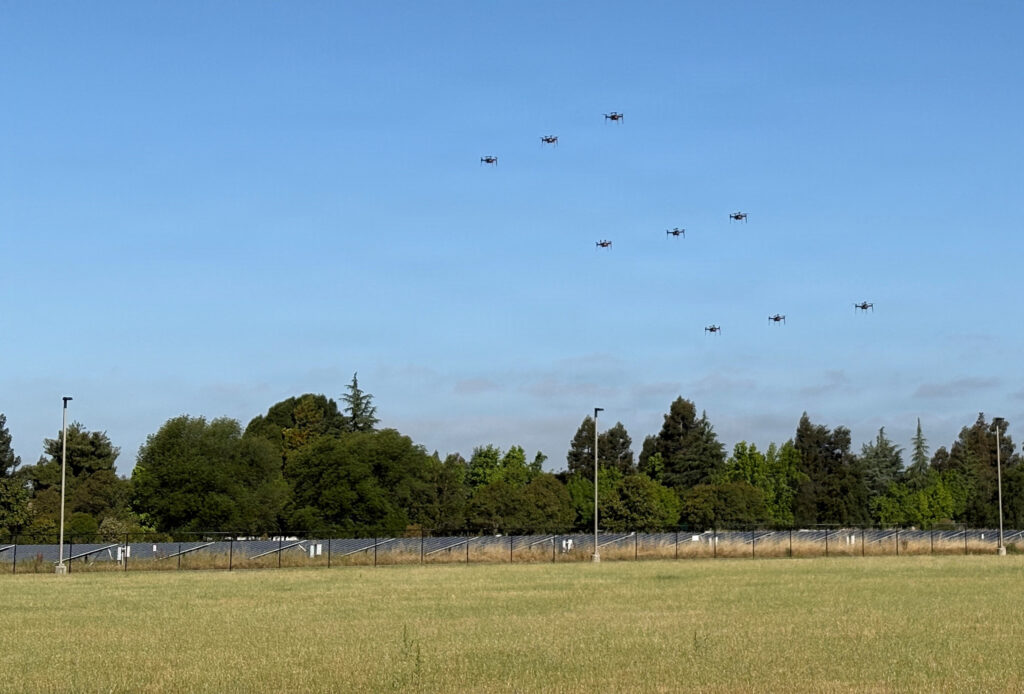
As drones become ubiquitous in modern theaters of operation, the traditional „one operator per drone” model has become a bottleneck for efficiency. The current challenge is no longer just remote flight, but the ability to control entire fleets at industrial scale without overwhelming human resources. The solution lies in a radical paradigm shift: decentralized intelligence that allows every unit in a swarm to „think” and collaborate, inspired by the fundamental mechanisms of nature.
The Great Divide: Why Pre-programmed Flight Is Not True Autonomy
There is a critical distinction between automation and autonomy that many industry players overlook for marketing purposes. Automation boils down to executing predefined instruction sets—collision avoidance, waypoint following, or maintaining a flight path. True autonomy, however, requires the drone to possess onboard artificial intelligence capable of responding in real-time to unforeseen battlefield events without constant human direction.
The difference is stark in tactical scenarios: while an automated drone can be programmed to follow a vehicle, an autonomous drone can decide on its own to break off and follow an individual who exits that vehicle, if they meet priority mission criteria. The machine no longer just follows an instruction set; it adapts the mission based on what it perceives through its own sensors.
Nature’s Blueprint: How „Hive Intelligence” Eliminates Cloud Dependency
Unlike conventional AI systems that rely on massive Cloud processing, new swarm control platforms operate entirely „at the edge” (onboard the drone). In environments where GPS is jammed and communications are contested, dependence on a central server is a recipe for failure.
The inspiration for this decentralized architecture comes directly from biology, specifically from ant and bee colonies. In a hive, the queen does not dictate the movement of every single bee. Instead, there is a collective intelligence where group members transmit essential information—food locations, water sources, or approaching enemies—using minimal bandwidth. By replicating this model, drones can communicate with each other in a mesh network, asking „peers” for data to get a better perspective on a target, all without needing a connection to a central node.
Survival Through Interoperability: One Soldier for an Army of Robots
A major goal for the future of defense is reducing costs and increasing supply chain resilience. Moving toward hardware-agnostic software platforms allows drones from different manufacturers to be integrated into a single, coherent swarm.
Recent demonstrations have confirmed that this future is no longer science fiction: a single soldier successfully managed multiple drones from various manufacturers simultaneously, all collaborating as a unified swarm under a common operating system. This ability to „offload” minor tactical decisions to the machine allows the human operator to focus exclusively on critical decisions, such as authorizing a kinetic strike.
Low-Cost Efficiency: Redefining Precision Strikes
Beyond control software, the new era of autonomy also targets the production of high-precision components at significantly reduced costs. Work is already underway on long-range precision strike platforms intended to cost only a fraction of today’s cruise missiles. By combining the engineering rigor of major defense primes with the agility and risk-taking of tech startups, the industry aims to deliver mass-deployable solutions, fundamentally transforming the nature of electronic and aerial warfare.