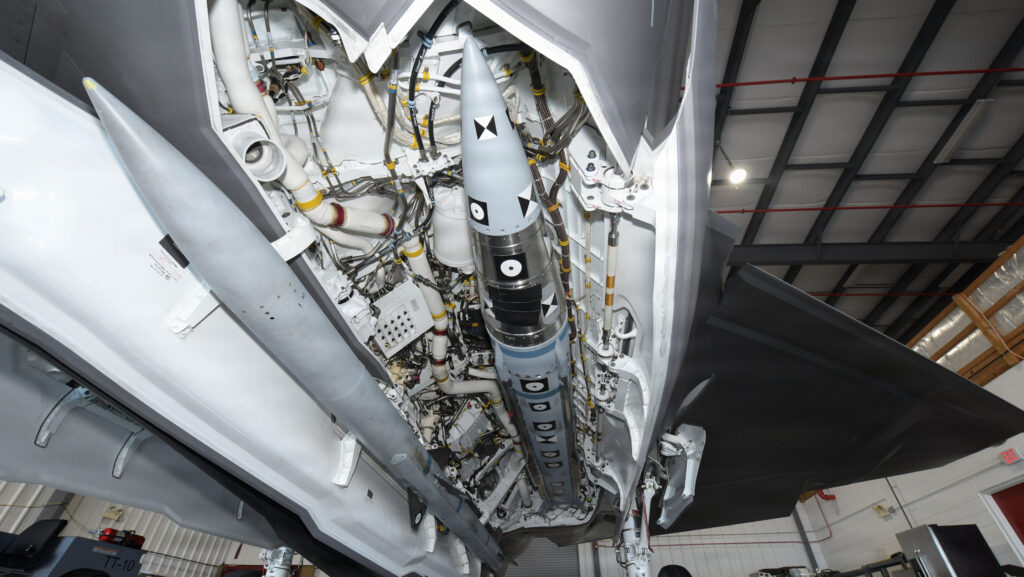
The AIM-424 is designed to dramatically extend the reach of naval aviation
The U.S. Navy is developing a new long-range air-to-air missile known as the AIM-424 Long Range Air-to-Air Missile (LRAAM), or “Malice.” The weapon is expected to engage targets at distances exceeding 250 nautical miles, equivalent to approximately 287.7 statute miles or 463 kilometers.
The missile is intended to strengthen fleet defense and preserve U.S. air superiority against increasingly sophisticated threats.
Missile designed for fourth-, fifth- and sixth-generation aircraft
According to the program’s official description, the AIM-424 will be compatible with fourth-, fifth- and sixth-generation aircraft. The Navy has not released further information about the missile’s precise performance, guidance systems, warhead configuration or operational schedule.
Details concerning its capabilities and expected entry into service remain classified for operational security reasons.
The missile is approximately 13.5 feet long and has a diameter of about 13.5 inches. Its dimensions suggest that it is designed for long-range engagements against aircraft and other high-value airborne targets.
Testing conducted with the Super Hornet and F-35C
The first public indications of the program emerged through official Navy imagery.
In April, four missiles were photographed mounted on an F/A-18E Super Hornet during a test event. Earlier this month, another image showed a missile secured inside the internal weapons bay of an F-35C aircraft.
Integration with the F-35C is particularly significant because internal carriage allows the aircraft to preserve its low-observable characteristics. Compatibility with the Super Hornet could also support the gradual introduction of the missile across naval aviation units.
“Malice” is intended to preserve the first-shot advantage
The Navy says the LRAAM is designed to give aviators greater engagement range, improved survivability and increased tactical flexibility in air-to-air combat.
The operational concept is centered on maintaining a “first look, first shot, first kill” advantage. By engaging opponents from greater distances, U.S. aircraft could spend less time exposed to enemy systems and attack before adversary aircraft enter firing range.
The new missile is being presented as part of the U.S. integrated deterrence strategy, supporting the defense of American fleets, forces, national interests and homeland territory.
Raytheon confirms its role in development
Raytheon has confirmed that it is involved in the development of the AIM-424. The company argues that extending missile range and increasing lethality will be essential to countering emerging air-to-air threats.
The manufacturer describes the program as a generational advance in long-range air combat. Its objective is to provide naval forces with a missile capable of outranging relevant threats.
The Air Force is monitoring the program
The U.S. Navy and Air Force traditionally cooperate on air-to-air missile development. One example is the AIM-260 program, which is intended to improve engagement range and aerial combat capability.
The U.S. Air Force is closely monitoring the AIM-424’s progress. This could eventually lead to closer cooperation between the two services or to the adaptation of the missile for Air Force platforms.