Stockholm prioritizes the integration of Swedish systems aboard the new warships
Sweden will “evaluate and discuss” the possible acquisition of a French long-range naval strike capability, but the immediate priority for Stockholm’s military leadership is integrating the systems already included in the contract for the country’s new frigates.
Swedish Commander-in-Chief Gen. Michael Claesson said the main focus is installing and bringing into service the national weapons and sensor systems that will equip the ships. The French offer involving long-range naval cruise missiles will be assessed at a later stage.
Lessons from Ukraine highlight the value of precision strike
Swedish Defense Minister Pål Jonson said a long-range naval strike capability could become an important next step for the country’s armed forces.
The war in Ukraine has demonstrated the importance of weapons capable of striking distant targets with a high degree of precision. Against that backdrop, Stockholm is keeping open the possibility of developing such a capability for its new frigates.
The ships are primarily being designed for air defense and anti-submarine warfare. Swedish officials are nevertheless considering whether to expand their operational role by adding long-range offensive missiles.
Four frigates covered by a €4.3 billion contract
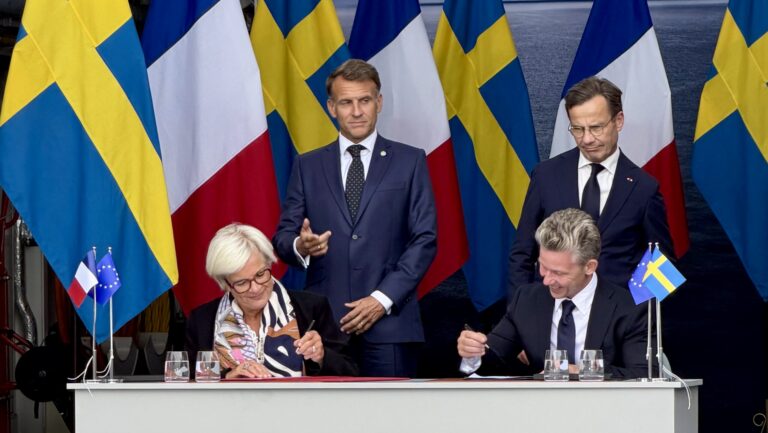
The comments were made during a ceremony marking the signing of a contract between Sweden and France’s Naval Group for four FDI frigates. The agreement is valued at approximately €4.3 billion.
The event took place aboard the French flagship Amiral Ronarc’h and was attended by senior political leaders from both countries. Swedish Prime Minister Ulf Kristersson and French President Emmanuel Macron highlighted the importance of the deal for bilateral defense and industrial cooperation.
On the same day, the Swedish and French defense ministers signed a framework agreement aimed at strengthening cooperation in operations, defense capabilities and military-industrial development.
FDI frigates will carry Aster 30 air-defense missiles
The Swedish prime minister emphasized that the ships will feature air-defense capabilities, including the MBDA-produced Aster 30 missile.
The frigates will serve as mobile platforms capable of protecting Sweden’s maritime approaches and territory against air and ballistic-missile threats. The need for such systems has been repeatedly demonstrated by missile and drone attacks in Ukraine.
President Emmanuel Macron also suggested that the Swedish frigates could eventually be equipped with naval cruise missiles. Such a configuration would give the ships an offensive role, allowing them to strike land targets at long range in addition to performing defensive missions.
MdCN emerges as a possible option
Although the French president did not identify the missile system he had in mind, French media reports indicated that Paris could offer the MdCN, or Missile de Croisière Naval.
Developed for French Navy frigates and attack submarines, the MdCN is designed to conduct precision strikes against distant land targets.
Swedish military officials described the capability as interesting but stressed that integrating Sweden’s own weapons and sensors onto the frigates remains the first priority.
The first of the four ships is scheduled for delivery in 2030.
Swedish weapons and sensors will form a major part of the package
The Swedish FDI frigates are expected to carry several national systems, including Saab’s RBS 15 anti-ship missiles, lightweight torpedoes, Giraffe 1X radars and Trackfire weapon stations.
The ships will also be equipped with BAE Systems Bofors 57 mm and 40 mm naval guns, alongside the Aster air-defense system.
Integrating all of these systems will be one of the program’s main technical challenges before any decision is made on adding naval cruise missiles.
Stockholm is already expanding its deep-strike capabilities
The discussion over arming the frigates comes as Sweden strengthens its long-range strike capacity.
Less than two weeks before the naval contract was signed, a Swedish JAS 39 Gripen launched a Taurus KEPD 350 air-launched cruise missile for the first time. The test took place at the Vidsel Test Range in northern Sweden.
The Taurus missile gives Sweden its first deep-strike capability. Stockholm’s defense minister has nevertheless said the country needs additional options and is examining how to expand its long-range strike capabilities beyond the air-launched system.
No final decision has been made on a naval strike missile
Swedish officials stress that no decision has been made to purchase a French naval strike missile or integrate one aboard the FDI frigates.
Sweden is also participating in the European Long-Range Strike Approach, an initiative launched in 2024 by France, Germany, Italy and Poland and later expanded to include Sweden and the United Kingdom.
Integrating the MdCN would require changes to the frigates’ vertical-launch systems. The current contract provides for Sylver A50 launchers, while the MdCN would require the larger Sylver A70 system.