General warns that the initiative could lose momentum without financial support
Lt. Gen. Steven Marks, one of the senior officials overseeing the US effort to accelerate autonomous drone development, has warned that the program could lose momentum if it does not receive the funding requested by the administration.
Speaking at a conference focused on emerging technologies, Marks said he did not know whether the Defense Autonomous Working Group, or DAWG, would receive the nearly $54 billion requested for fiscal year 2027. He stressed, however, that the initiative needed to receive at least some funding.
According to Marks, a failure to secure financial support could undermine the progress achieved since the group was established more than a year ago.
Administration requests $54.6 billion for DAWG
The administration has requested $54.6 billion for DAWG in the fiscal 2027 budget. Of that amount, $53.6 billion was included in the budget reconciliation process alongside other major priorities, including the Golden Dome missile defense system.
If the reconciliation legislation fails to pass Congress, the program could be left with only the $1 billion included in the base budget request.
Although that figure would represent a substantial increase over the $226 million DAWG received for fiscal year 2026, it would amount to less than 2% of the program’s original funding plan.
Low-cost drones challenge billion-dollar platforms
Marks said that operational developments in Ukraine and the Middle East demonstrate the need to accelerate autonomous systems programs.
He warned that US adversaries may be unable to match the sophistication of American military platforms, but they can use drones costing roughly $100,000 to attack ships and other targets worth billions of dollars.
That imbalance creates a serious cost disadvantage for the United States, which can be forced to use highly expensive systems against comparatively cheap threats.
DAWG absorbs the mission of the Replicator initiative
The Defense Autonomous Working Group is a Trump administration initiative that has effectively absorbed the objectives of the Replicator program launched under the Biden administration.
Replicator sought to rapidly acquire thousands of low-cost, attritable drones designed for high-risk operations and, if necessary, expendable in combat. The initiative was focused particularly on preparing capabilities for potential operations in the Indo-Pacific region.
In its current form, DAWG is intended to expand development investments across multiple autonomous platforms and collaborative systems capable of operating together.
Specific programs remain classified
Marks declined to identify the DAWG programs that could be affected by potential budget cuts. He said the systems involved are classified and could not be discussed publicly.
The general appeared particularly concerned about funding for efforts to standardize autonomous systems, control interfaces and training procedures.
Military units operate too many incompatible systems
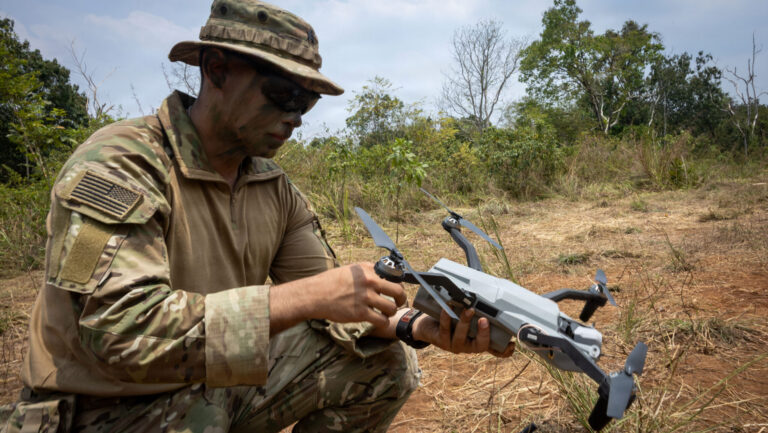
Marks said that during a recent visit to Camp Clark in Alabama, soldiers from the 20th Special Forces Group were operating between six and eight different autonomous systems during an exercise.
In his view, the military must select one or two systems and standardize them across the wider force. Each platform requires different skills and procedures, complicating training and operational use.
Standardization, Marks concluded, will be essential to the future of autonomous warfare and to the effective deployment of unmanned systems in complex combat operations.