Two pilots ejected before the aircraft plunged to the ground near homes
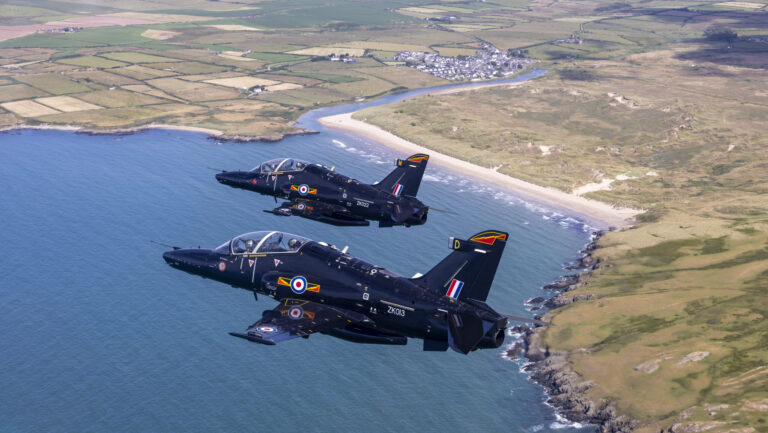
The Royal Air Force has temporarily suspended flight operations involving its entire fleet of Hawk T1 and Hawk T2 training aircraft after one of the jets crashed at RAF Valley in Anglesey, North Wales.
The decision followed an accident involving a Hawk T2 shortly after it took off from the training base. Both crew members ejected from the aircraft before it was seen entering a steep dive and crashing near residential properties.
Formal investigation launched
The RAF said it had “temporarily paused” flying operations involving both Hawk variants and had launched a formal investigation to determine the cause of the crash.
Officials have not disclosed whether a technical failure was involved or provided details about the circumstances that led to the accident.
Both pilots survived and are reported to be in good condition. They are expected to make a full recovery.
“We are investigating how and why this happened,” UK Defence Secretary Wes Streeting said during a conference on British space power.
Aircraft manufacturer declines further comment
BAE Systems, the manufacturer of the Hawk, confirmed that it was aware of the incident at RAF Valley but declined to provide further details before the investigation is completed.
“We are aware of the incident involving a Royal Air Force Hawk T2 aircraft at RAF Valley, however, it would be inappropriate to comment further at this stage,” the company said. Any further enquiries, BAE added, should be directed to the Royal Air Force.
Persistent difficulties surrounding the Hawk T2 programme
The crash has brought renewed attention to long-standing problems affecting the Hawk T2 programme, particularly issues related to its engines and technical support.
In 2025, then-Chief of the Air Staff Richard Knighton said the aircraft was not delivering the level of performance required for military pilot training.
The Hawk T2 represents the final stage of Britain’s fast-jet training pipeline, but the RAF was receiving only about half of the capability it should be getting from the aircraft, according to Knighton’s remarks.
BAE Systems did not comment on those statements at the time. In January 2025, however, the company said it was supporting analysis with customers around the world, including the RAF.
RAF Valley trains the next generation of fighter pilots
RAF Valley is home to No. 4 Flying Training School, which is responsible for preparing Britain’s next generation of fighter pilots.
The Hawk T1 is also flown by the Red Arrows, the RAF’s aerobatic display team. In addition, a fleet of 28 Hawk T2 aircraft supports fast-jet training for the RAF and Royal Navy.
The Hawk T2 fleet was acquired under a £450 million contract, worth approximately $581 million, awarded to BAE Systems in 2006.
London prepares to replace both Hawk variants
The UK Ministry of Defence has already begun preparations to replace the Hawk T1 and T2 fleets. In August, the ministry issued a request for information as the initial stage of a future procurement programme.
Several manufacturers could enter the competition or have already expressed interest. BAE Systems is expected to propose the T-7A in cooperation with Boeing and Saab. Leonardo could offer the M-346, Lockheed Martin may put forward the TF-50, while Turkish Aerospace is positioned with its Hurjet trainer.
The grounding of the fleet and the investigation into the crash could intensify the debate over the future of Britain’s training aircraft and the need to replace platforms that have been in service for many years.