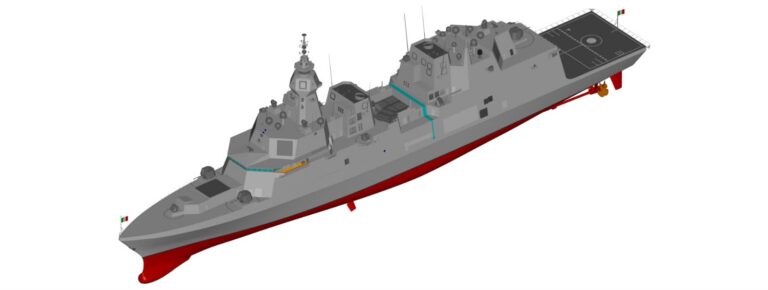
Europe’s Organisation for Joint Armament Cooperation has awarded a €3.7 billion contract for the production of two new DDX destroyers for the Italian Navy.
The contract was granted to Orizzonte Sistemi Navali, a joint venture formed by Italian shipbuilder Fincantieri and defense electronics company Leonardo. The program is intended to deliver a major upgrade in Italy’s naval air and missile defense capabilities.
New Ships to Replace Horizon-Class Destroyers
The DDX vessels will eventually replace Italy’s Horizon-class air-defense destroyers. Deliveries are currently scheduled for 2033 and 2035, although the timetable represents a significant delay compared with Rome’s original plans.
When Italy first revealed the destroyer program in 2020, the first ship was reportedly expected to enter service in 2028. A construction contract was initially anticipated in 2023, subject to the availability of funding.
The program was subsequently delayed by approximately three years, reportedly because of difficulties defining operational requirements and securing the necessary financial resources.
Billions in Industrial Subcontracts
Under the agreement, Orizzonte Sistemi Navali is expected to finalize major subcontracts with its two parent companies in the coming weeks.
Fincantieri’s share is estimated at approximately €1.8 billion, while Leonardo is expected to receive around €1.7 billion in related work. Approximately €1.3 billion of the overall contract is tied to optional elements.
Fincantieri will lead the design and construction of the destroyers. Leonardo will support the development and integration of their combat systems.
Designed for Air, Missile and Hypersonic Defense
The DDX is expected to measure 180 meters in length and displace approximately 13,500 tonnes. The ships will have a range exceeding 4,000 nautical miles.
Their central mission will be integrated air and missile defense. According to the industrial partners, the destroyers are being designed to counter conventional missiles, ballistic weapons and emerging hypersonic threats.
The ships will combine several advanced technologies, including:
- The SADOC 5 command, control, communications, computers and intelligence system
- A digital S-band active electronically scanned array radar
- Missile systems supplied by MBDA
- Integrated air and missile defense capabilities designed to protect both the vessel and accompanying naval forces
The program’s developers describe the architecture as a generational advance for the Italian Navy, both in terms of the ships themselves and their combat systems.
Electronic Warfare Added to the Defensive Shield
Italian electronics specialist ELT Group will equip the destroyers with a new electronic warfare suite.
The system is intended to improve the protection of the DDX vessels and the wider naval formation by detecting, identifying and countering threats across increasingly complex and contested operational environments.
Its inclusion reflects the growing importance of electronic warfare in naval combat, where ships must operate against anti-ship missiles, unmanned systems, surveillance networks and other threats across multiple domains.
DDX Deal Strengthens Fincantieri’s Order Book
The contract is also an important addition to Fincantieri’s near-term business pipeline. In May, the shipbuilder indicated that it expected to secure approximately €5 billion in upcoming orders, including the DDX program.
The company also anticipated contracts for two vessels under the Italian Navy’s Joint Maritime Mission System program.
Fincantieri is simultaneously pursuing international opportunities. The company has said it expects to finalize major agreements with foreign navies for surface ships, including FREMM frigates, as well as naval services in the Middle East and other strategically important markets.
A Long-Term Test for Italy’s Naval Ambitions
The DDX program is designed to give Italy a more capable and survivable air-defense platform at sea. Its combination of advanced radar, command systems, missile defenses and electronic warfare equipment is intended to protect both the ships themselves and the larger naval forces operating alongside them.
However, the delayed delivery schedule highlights the challenges of translating ambitious military requirements into funded and executable shipbuilding programs. If construction proceeds as planned, the first DDX destroyer will enter service in 2033, more than a decade after the program was initially announced.