Secret Agreement with the Space Force Raises Concerns Across the Orbital Surveillance Industry
The U.S. Department of Defense has reportedly entered into an agreement giving SpaceX exclusive access to the government’s most detailed classified data on objects in orbit, according to government and industry sources.
In exchange, the company would provide the U.S. Space Force’s Joint Commercial Operations Cell with data collected by its Stargaze star-tracking cameras.
A Space Force official said SpaceX and the JCO had signed a “contractual agreement” under which the company receives access to the most precise version of the U.S. Space Command’s High Accuracy Catalog. In return, the JCO receives tracking data generated by Stargaze.
The timing of the agreement remains unclear. In recent days, however, the arrangement has reportedly triggered concern among commercial space-surveillance providers.
Questions Over the Use of Classified Information
The Space Force official said the high-fidelity data provided to SpaceX could be used only for “internal use” and could not generate a commercial advantage.
Government and industry sources nevertheless said it was unclear whether the data could indirectly help improve SpaceX products and analysis offered to civilian space operators.
The central concern is that classified information could be incorporated into Stargaze, improving the accuracy of the company’s free services and disadvantaging commercial providers that invest in radars, telescopes and other orbital-tracking systems.
The Space Force and SpaceX did not respond to repeated requests for comment. Barbara Golf, head of the JCO, referred questions to Space Systems Command, which oversees the cell’s acquisition activities.
SpaceX Says Radar Data Is Essential
Jon Herman, SpaceX senior director for Starlink constellation engineering, was asked about the agreement, the value of the data and its terms of use during the Advanced Maui Optical and Space Surveillance Technologies Conference in Hawaii.
He did not directly address the reported deal but explained why radar data is valuable to the company.
Starlink satellites, Herman said, are “bad at seeing the small stuff,” making radar data an extremely valuable supplement to observations collected by Stargaze.
How Stargaze Works
Star trackers are primarily used to determine a spacecraft’s three-dimensional orientation. They enable satellites to aim onboard cameras and intersatellite laser links with high precision.
The systems can also detect and characterize satellites and space debris.
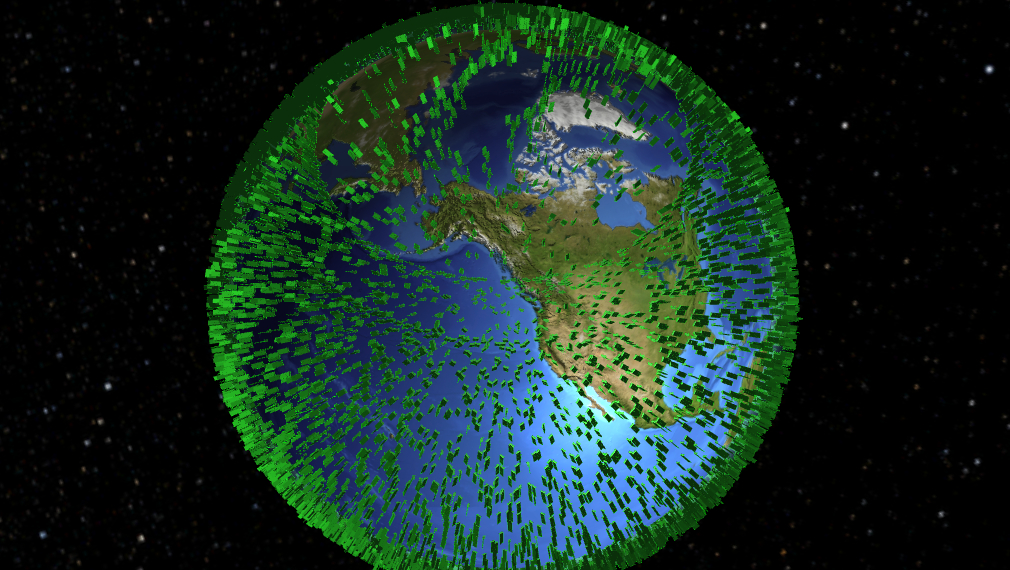
According to Herman, Stargaze currently uses approximately 30,000 cameras mounted on Starlink satellites. The system can detect objects roughly half a meter to one meter in size and observe more than 80% of the Space Force catalog below an altitude of 600 kilometers.
Unlike ground-based radars and telescopes, which can track smaller objects, Stargaze’s advantage lies in the volume of repeated observations. Its cameras can capture tens or hundreds of images of the same object, allowing a more accurate assessment of its orbital path over time.
The observations are entered into an internal catalog showing what objects are in space, where they are located and how they are moving.
For SpaceX, the system is critical to protecting its Starlink and Starshield satellites from collisions. The company operates approximately 11,000 satellites and, according to Herman, conducts around 20,000 maneuvers every day. About 1,000 of those maneuvers are intended to avoid collisions.
Stargaze Catalog Not Publicly Shared
SpaceX does not make its complete Stargaze catalog publicly available. Operators that provide their own orbital data instead receive services such as warnings about potentially dangerous close approaches, known in the industry as conjunctions.
Herman said about 100 operators have already been onboarded to the system.
For the JCO, access to Stargaze data could improve the quality of fused commercial space-surveillance information available through the Unified Data Library.
Three Levels of Tracking Accuracy
The U.S. Space Command maintains several levels of orbital-object catalogs.
The public version, available through Space-Track.org, uses two-line elements that provide a snapshot of an object’s position and velocity at a specific time. It is the least precise of the main reporting formats.
A second version is the Special Perturbations–High Accuracy Catalog. It uses more sophisticated mathematical models to predict orbital trajectories and is made available to selected companies and foreign governments under data-sharing agreements.
The most precise level is represented by Vector Covariance Messages. In addition to the high-fidelity mathematical model, these messages include three-dimensional uncertainty regions, known as covariances, allowing more accurate assessments of potential collisions.
In the past, this information was classified and largely reserved for military use to prevent the reverse engineering of U.S. space-surveillance sensor capabilities.
Industry sources say SpaceX is the first company to receive routine access to this information for uses not directly tied to government operations.
Industry Fears an Unfair Competitive Advantage
Several analysts said using the data to protect Starlink and Starshield satellites could benefit orbital safety, given that SpaceX satellites account for more than half of the traffic in low Earth orbit.
Concerns arise if classified data also influences Stargaze services provided to other operators.
Because Stargaze is free, commercial providers fear SpaceX could draw customers away from companies that cannot match its level of accuracy, even for a fee.
None of the sources cited evidence that the agreement has already influenced Stargaze products. Industry representatives nevertheless warn of a potential feedback loop: the more operators use the service and contribute their own data, the more accurate the catalog becomes, gradually weakening competing providers.
In the worst-case scenario, SpaceX could turn Stargaze into the dominant tracking service and begin charging customers after competitors had been driven out of the market.
“It’s very, very hard to compete with free when you have costs,” said Audrey Schaffer, Slingshot Aerospace’s senior vice president for global policy and government strategy.
One industry analyst alleged that the arrangement gives SpaceX “an unfair market advantage.”
DARPA Funding Helped Develop Stargaze
Industry concerns have been reinforced by an analysis published by Quilty Space, which found that the Defense Advanced Research Projects Agency awarded SpaceX $107.7 million in contracts for work that contributed to Stargaze’s development.
The funding was provided through the Space-WATCH program, launched in 2023 to develop wide-area systems for tracking and characterizing objects in space.
According to Quilty Space, SpaceX is currently the program’s only known supplier.