U.S. and British forces tested long-range maritime strike capabilities
The United States and the United Kingdom conducted a major controlled sinking exercise in the North Atlantic this month, using the decommissioned U.S. guided-missile frigate USS Klakring as a live target.
The operation, known as a SINKEX, was carried out as part of Exercise Atlantic Thunder 2026, held from September 14 to 25. The drill was designed to strengthen the ability to engage a surface target with live weapons while improving cooperation between U.S. and British forces during long-range maritime strike operations.
SM-6 launched to probe the edge of its engagement envelope
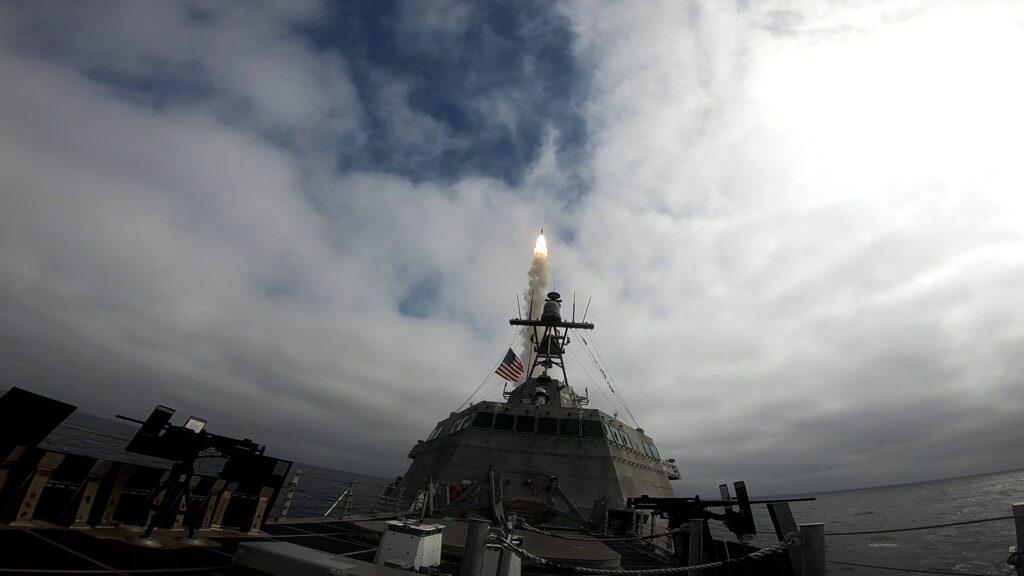
The U.S. Navy destroyer USS Paul Ignatius fired an SM-6 missile during the exercise. The launch was intended to test the weapon’s surface-to-surface engagement capability at the greatest practical distance available during the drill.
U.S. officials did not reveal the precise range used in the test. Public estimates place the missile’s range at nearly 370 kilometers, although its effective reach depends on the missile variant, mission profile and launch conditions.
“We were testing the surface-to-surface engagement ability at the furthest range that we could,” said U.S. Navy Capt. Kelechi Ndukwe, commander of Task Force 65 within the U.S. 6th Fleet.
British forces brought Sea Venom and Naval Strike Missile into the fight
The Royal Navy contributed several advanced anti-ship systems to the operation. A Royal Navy Wildcat helicopter launched the Sea Venom missile, while British forces also employed the Naval Strike Missile.
The weapons were used in sequence according to their engagement ranges. The exercise began with the longest-range system before shifting to weapons designed for shorter-distance attacks.
Mk 48 torpedo delivered the final blow
The final attack on Klakring came from the Virginia-class submarine USS Massachusetts. The submarine fired an Mk 48 Advanced Capability torpedo, completing the sinking of the former frigate.
The combination of ship-launched missiles, air-launched weapons and a submarine torpedo was intended to replicate a complex maritime strike involving multiple platforms and weapon systems.
Sensors collected data for future weapons development
Before the exercise began, U.S. naval research and warfare centers installed a network of sensors aboard Klakring. The equipment recorded the effects of the strikes, the locations of the impacts and the frigate’s response during the sinking.
The data will be processed over the coming months and could influence the design of future weapons. Analysts will use the information to assess the performance of the munitions and refine the technical understanding of how different weapons affect a surface vessel.
Ships, submarines and aircraft operated as one force
Other participants included the Royal Navy frigate HMS Portland, U.S. and British P-8 maritime patrol aircraft, and U.S. Air Force F-15E Strike Eagle fighter aircraft.
Exercise commanders highlighted the importance of maintaining reliable communications throughout the operation. The exchange of information and the joint assessment of battle damage were described as essential to preserving the two navies’ ability to operate as a coordinated and effective fighting force.
Beyond the weapons testing itself, Atlantic Thunder 2026 served as a demonstration of the growing military integration between the United States and the United Kingdom. The exercise showed how allied ships, aircraft and submarines can combine their capabilities in a coordinated maritime strike conducted at extended range and under realistic conditions.