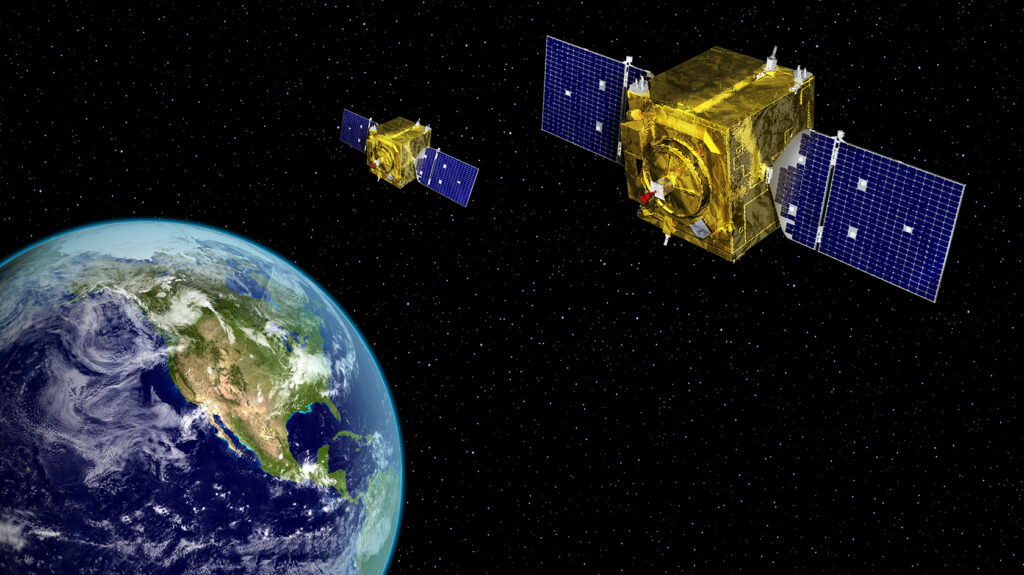
The Pentagon’s Defense Innovation Unit (DIU) and the U.S. Space Force are joining forces to develop and field next-generation, commercially developed satellites for monitoring geosynchronous Earth orbit (GEO) more rapidly.
Under the new effort, DIU’s GHOST-R project — Geosynchronous High-Resolution Optical Space-Based Tactical Reconnaissance — will serve as a feeder for the Space Force’s emerging RG-XX program, which is intended to replace the existing Geosynchronous Space Situational Awareness Program (GSSAP) satellites.
According to a Sept. 18 announcement from Space Systems Command (SSC), cooperation with DIU will allow the Space Force to use rapid prototyping for RG-XX. Northrop Grumman and True Anomaly have been selected to develop and fly prototype systems by 2028.
“This approach burns down technical risk, drives down lifecycle costs, and gets vital capability to the warfighter faster to ensure a more resilient architecture. Successful prototypes will have a direct path to transition into the program of record,” said Col. Bryon McClain, acting portfolio acquisition executive for Space Combat Power at SSC.
Commercial architecture for GEO surveillance
The Space Combat Power office is responsible for acquiring technologies and capabilities related to orbital warfare.
DIU announced GHOST-R in February, while SSC established RG-XX in April as part of a broader GEO-monitoring initiative known as Andromeda. The effort initially created a pool of 14 vendors competing for as much as $1.84 billion over a decade.
In May, SSC added another $4.4 billion to Andromeda’s indefinite-delivery/indefinite-quantity contract vehicle, increasing the potential ceiling for awards to $6.2 billion from $1.8 billion.
Both GHOST-R and RG-XX are designed to use lower-cost commercial technologies to produce reconnaissance satellites offering:
- higher-resolution imagery;
- greater orbital mobility;
- longer on-orbit endurance; and
- lower costs than traditional systems.
The joint effort will use commercially developed spacecraft, buses and electro-optical payloads to provide high-resolution space-to-space imagery for characterizing resident space objects in GEO.
Roles of True Anomaly and Northrop Grumman
True Anomaly said GHOST-R will help develop ground-integration procedures, establish operator training for command and control, and codify tactics, techniques and procedures for rapid response.
The company said the project would build the operational foundation needed to rapidly scale a proliferated GEO reconnaissance layer for the RG-XX program of record.
True Anomaly will provide the latest version of its Jackal spacecraft, which is already being tested under the Victus Haze demonstration managed by McClain’s office. Victus Haze is focused on rendezvous and proximity operations with an uncooperative spacecraft, with Jackal conducting tracking and pursuit activities involving Rocket Lab’s Puma spacecraft.
Initially, True Anomaly will operate Jackal alongside Space Force personnel. If the demonstration succeeds, the spacecraft is expected to transition to government-owned, government-operated status as an orbital asset for RG-XX.
Northrop Grumman will provide ESPASat-L, a small-suitcase-sized spacecraft integrated with the ESPAStar rideshare platform. The company said its GHOST-R operational prototype would provide commercial augmentation for existing space domain awareness systems, allowing the Space Force to operate a hybrid constellation architecture.
RPO technology and orbital warfare
Both companies are already working under Pentagon contracts to demonstrate rendezvous and proximity operations, or RPO, involving close approaches and maneuvering near other spacecraft.
Northrop Grumman is also developing an RPO demonstrator under DARPA’s Robotic Servicing of Geosynchronous Satellites (RSGS) program. The mission launched July 21 aboard a Falcon 9 carrying the company’s Mission Robotic Vehicle and three Mission Extension Pods.
The robotic vehicle includes ports for storing tools and providing power or data connections. It is designed to perform several types of in-orbit servicing missions, including:
- inspecting satellites experiencing anomalies;
- assisting with orbital adjustments;
- correcting mechanical problems; and
- installing new payloads to upgrade capabilities.
The extension pods function as propulsion modules designed to extend the service lives of satellites that have exhausted their own maneuvering capability.
Although Victus Haze and RSGS do not have stated goals of contributing to orbital warfare, the RPO capabilities being demonstrated could also support on-orbit weapons. The U.S. Space Force has raised concerns about similar Chinese programs.
The announcement comes only weeks after the United States publicly acknowledged that it has stationed weapons in space, while providing no details about their capabilities.
The value of the two GHOST-R prototype contracts has not been disclosed. SSC also did not specify whether the funding came from DIU or the Space Force, although the command confirmed that the money was not provided through the Andromeda contract vehicle.