The US company is promoting a model built around distributed manufacturing and faster weapons development. Its strategy centers on the GRAIL software platform and two programmes in development: the SCEPTRE artillery round and the modular Invictus missile.
Conflicts in Ukraine and the Middle East have strained munitions stockpiles and exposed vulnerabilities in defence supply chains. Tiberius Aerospace argues that the answer is not simply to produce more weapons, but to change how they are designed, manufactured and delivered.
Chad Steelberg, the company’s co-founder and chief executive, calls the approach “Defense-as-a-Service.” It is intended to combine continuous product development, scalable production and industrial partners across multiple countries. Steelberg argues that the pace of battlefield adaptation has compressed traditional research-and-development cycles, making it essential to upgrade systems and return them to service quickly.
GRAIL underpins the operating model
Tiberius describes GRAIL as the software infrastructure supporting much of its business. The platform brings together tools for modelling weapon performance, identifying suppliers, managing export and compliance requirements, and arranging equipment and supply-chain financing.
Steelberg says GRAIL began as a modelling tool and has expanded to support manufacturing and coordination with partners. The company plans to use it for its own programmes and to connect other suppliers across the defence industry.
UK manufacturing agreement backs SCEPTRE development
Tiberius says it has signed a $500 million manufacturing contract in the United Kingdom with a private group assembling a consortium of production and research-and-development partners. Under the agreement, SCEPTRE is expected to be both manufactured and co-developed with British partners.
Steelberg says the arrangement relies on approvals and cooperation mechanisms that allow controlled technical assistance and defence collaboration. The company calls the model “federated manufacturing”: qualify a weapon once, then produce it at separate, sovereign national sites. The UK is intended to be the first such site, with the aim of supplying European markets.
SCEPTRE aims to extend the reach of artillery
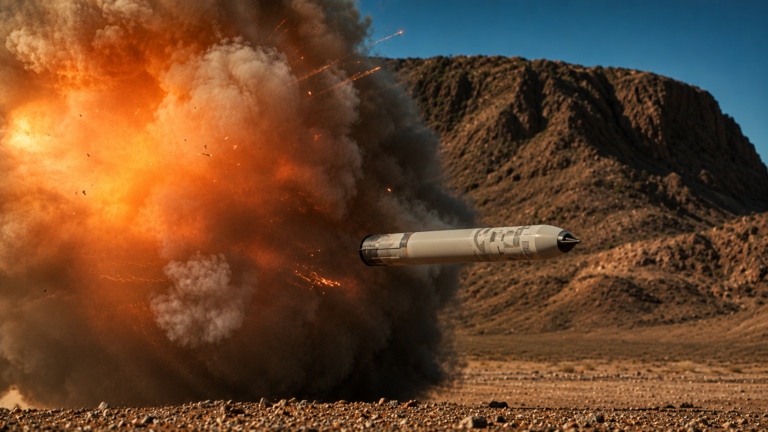
SCEPTRE is a 155mm guided munition powered by a liquid-fuelled ramjet, designed to strike targets at ranges of 150 kilometres or more. Tiberius says the system could give armed forces a way to use NATO howitzers already in service for long-range precision strikes.
Steelberg says the company demonstrated ignition of a liquid-fuelled ramjet after launch from a NATO-standard howitzer in April. Initial tests focused on ignition and the munition’s ability to withstand the extreme forces of launch. Longer-range live-fire trials, including shots beyond 150 kilometres, were due to begin in October. Tiberius aims to complete certification by year’s end and begin delivering production rounds in the first quarter of the following year.
The company says the liquid-fuel design would allow the munition to be stored without fuel and to use several types of fuel. Steelberg also says the engine can adjust its thrust profile, which could affect both the weapon’s performance and its terminal phase.
Invictus takes a modular approach
Tiberius describes Invictus as a strike missile with a range of about 200 kilometres and interchangeable components that can be configured for different missions. The company argues that this architecture could adapt the weapon to varied targets while lowering production and operating costs.
Tiberius is pitching its strategy as a way to bring weapons design, manufacturing, regulatory compliance and financing into a single operating model. Its effectiveness will depend on test results, certification and whether its partners can deliver production at scale.