Israel Aerospace Industries (IAI) unveiled three systems at the annual AUSA conference, adapting existing technologies to address emerging battlefield threats. The lineup includes a mobile aerostat-mounted radar, a counter-drone interceptor without an explosive warhead, and a drone armed with an M250 machine gun, developed with Sig Sauer.
Point@Air: a radar platform designed to move
Point@Air combines an aerostat—a balloon- or airship-like platform—with an electronically scanned array radar. Dror Bar, IAI executive vice president and CEO of its Elta Systems division, said the radar can detect a broad range of targets, including fighter aircraft, large drones, cruise missiles and maritime targets.
Aerostats have long been used for surveillance, but their static infrastructure can leave them vulnerable to drone attacks. Point@Air is designed to operate without fixed infrastructure and to be redeployed to a new location within hours. The platform is about 70 meters (230 feet) long.
Its mobility could make it harder for adversaries to locate the aerostat and target it with one-way attack drones. Bar cited a recent incident in which Hezbollah targeted a large aerostat in northern Israel. He described a scenario in which the platform is packed up at sunset and moved to another hill, leaving it somewhere else by morning.
IAI sees potential applications for the system in homeland security missions, as well as for US Central Command and other military commands. While its core technology is fully developed, Point@Air remains in the demonstration phase. IAI is working with US-based TCOM to adjust the platform’s size and configuration. TCOM is the prime contractor for the US Army’s aerostat platforms.
HawkGuard: intercepting drones without explosives
IAI also brought HawkGuard to AUSA, offering another approach to countering drones. Bar described counter-drone defense as a major challenge for defense companies searching for ultra-low-cost interceptors.
HawkGuard uses an inert interceptor fitted with a large net instead of an explosive warhead. Radar and optical sensors help guide it toward its target in what Bar described as a closed-loop system. The absence of explosives could make the system suitable for populated areas or for protecting sensitive sites, including facilities containing fuel or other explosive materials.
Bar said HawkGuard has been widely tested against a range of threats and is already deployed with several customers. It can engage different types of drones, including those that do not use communications links. The system combines radar, electro-optical sensors and command-and-control technology to detect and track targets and guide the interceptor.
HawkGuard is a relatively short-range system, though IAI has not publicly disclosed its precise range. The company views it as an additional layer of defense rather than a standalone solution. Bar said the experience of the war in Ukraine has shown that no single system can defeat every drone. IAI sees potential for HawkGuard in North America, including in the protection of US military bases.
Fire Storm 250: a drone equipped with a machine gun
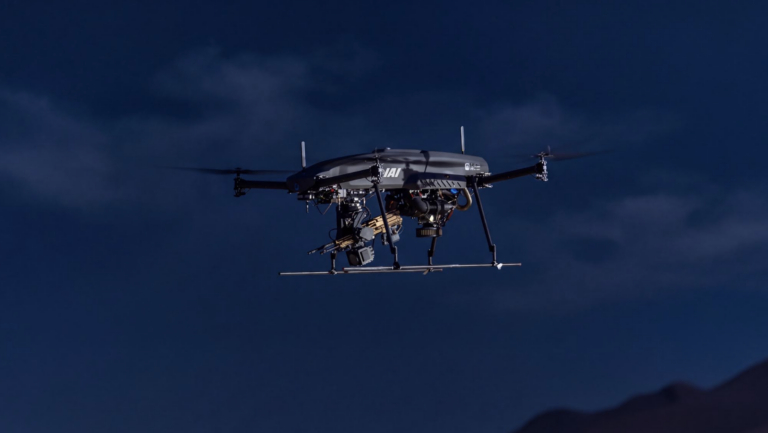
The third system, Fire Storm 250, was developed by IAI and Sig Sauer. It is a tactical configuration of IAI’s APUS drone, equipped with Sig Sauer’s Microlight Remote Controlled Weapon Station (RCWS) and an M250 machine gun.
The companies announced the completion of a firing test in which the drone hovered over a simulated battlefield and fired at targets. According to their joint statement, firing was conducted from different distances and altitudes to demonstrate the system’s operational flexibility, integrated safety and accuracy under varying conditions.
The companies did not say how much ammunition the drone can carry. The system uses a multi-fuel internal-combustion engine that can be refueled in the field with commonly available fuel. This avoids lengthy battery-charging cycles and the need for specialized infrastructure.
The companies said the test demonstrated the drone’s ability to combine airborne surveillance, target identification and precision firepower in a realistic battlefield scenario. IAI representatives described the integration of weapons with uncrewed aircraft as a capability with operational potential. They said the next generation of unmanned systems would depend not only on autonomy, but also on how effectively sensing, decision-making and action are integrated in the operational environment.
Sig Sauer, meanwhile, highlighted the M250’s belt-fed design and its range and weight advantages over legacy systems. The company said the reduced weight can benefit infantry squads and help make weapon integration on drones possible.