







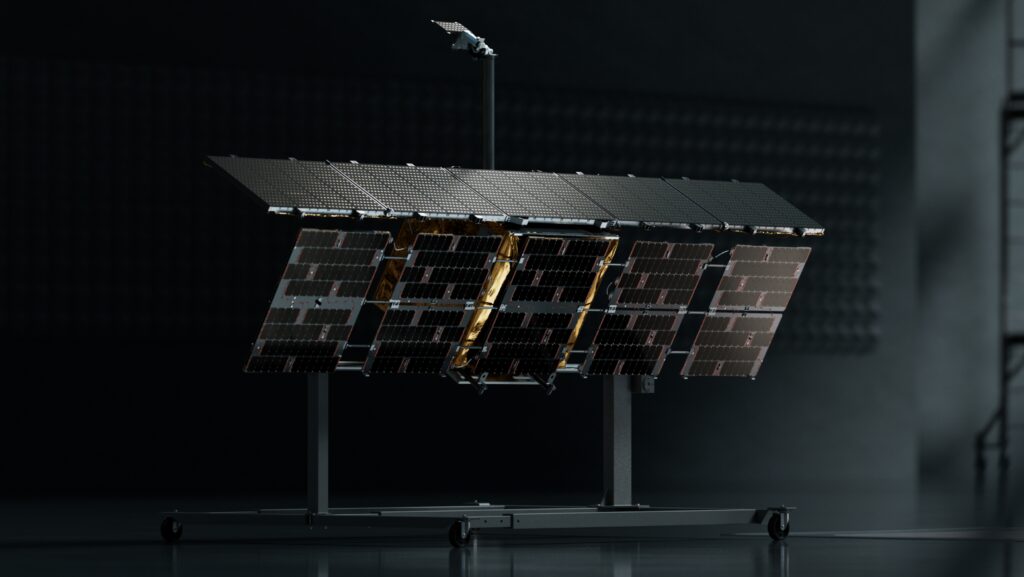
A Russian government-owned satellite reportedly came within about 500 meters of ICEYE-X36 after shadowing the spacecraft for weeks. The maneuvers, tracked by a company specializing in monitoring orbital activity, have been described by experts as among the most advanced and potentially dangerous uncoordinated proximity operations observed between satellites.
Some observers believe ICEYE-X36 may provide synthetic aperture radar (SAR) imagery to Ukraine. The company has not publicly confirmed the satellite’s customers.
Repeated maneuvers went beyond a simple close pass
Orbital analysis indicates that Cosmos 2612 carried out deliberate maneuvers near ICEYE-X36 between October 15 and 19. The Russian satellite reportedly matched the target’s orbital plane, closed the distance in a controlled manner, and adjusted its speed and altitude to manage its position relative to the spacecraft.
It then repositioned itself both ahead of and behind the ICEYE satellite, remaining nearby and making repeated small adjustments—a pattern that distinguishes the activity from a simple flyby.
Experts say such maneuvers could allow a spacecraft to inspect and characterize another satellite, shadow it at close range, or, in the most serious scenario, interfere with it.
A worrying first for commercial satellites
Space-security specialists say the incident stands out because the approach was uncoordinated and the target was a commercial satellite. In earlier cases involving close satellite tracking, the spacecraft being approached were reportedly U.S. government satellites.
ICEYE-X36 is operated by the U.S. subsidiary of Finland-based ICEYE and was launched from the United States in 2024. That makes it a U.S. satellite—or at least one for which the United States is the launching state, according to a space-security expert.
The satellite’s exact role in supporting Ukraine has not been publicly confirmed. However, analysts say ICEYE’s ties to Ukraine and Cosmos 2612’s activity add to the significance of the encounter.
Shadowing reportedly began in late September
Cosmos 2612, launched in April, reportedly began closing in on ICEYE-X36 around September 30. Its subsequent maneuvers appear to have been designed to steadily reduce the distance and bring the Russian satellite alongside the commercial spacecraft.
Analysts warn that Russia has a history of testing counterspace capabilities. They argue that the close approach should therefore be treated as a potential threat to the targeted satellite and viewed in the broader context of Russian pressure and gray-zone activity against Western interests.
Experts have also noted the U.S. government’s lack of a public response, given that the spacecraft is operated by an American company and was launched from U.S. territory.