










The company is weighing expanded sales to commercial customers as well as options that could include separating or selling the business. A Pentagon investment has not been ruled out, CEO Kathy Warden said.
“All options are on the table”
In her first major public statement since Northrop Grumman lost the Navy’s competition for the sixth-generation F/A-XX fighter, Warden signaled that the company is considering significant changes to its microelectronics business.
“For more than a decade, we’ve leveraged our expertise in cutting-edge semiconductors and our secure US boundaries to pioneer leading quantum computing technologies,” Warden told investors during an earnings call. She said the company sees a significant opportunity to scale the technology for commercial and government customers.
Asked whether the strategic review could lead to a sale or spin-off, Warden said both possibilities were under consideration, but no final decision had been made. Northrop could continue funding the business with support from current shareholders, broaden its investor base, or separate the unit.
Warden said the company expects to share more details “in the coming months.”
Pentagon investment remains possible as Northrop pursues commercial markets
The CEO also did not rule out a direct investment from the Pentagon. The Defense Department has announced a $1 billion equity stake in L3Harris’s missile solutions business, though the planned separation has been postponed until mid-2027.
Warden said Northrop does not want to be overly dependent on any single government, pointing to the technology’s commercial potential. She added that government customers are “very open” to some products being sold commercially—a change that would also allow the company to sell those products to the government as commercial items.
Three government-accredited production facilities
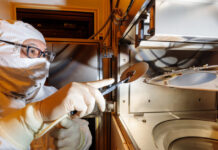
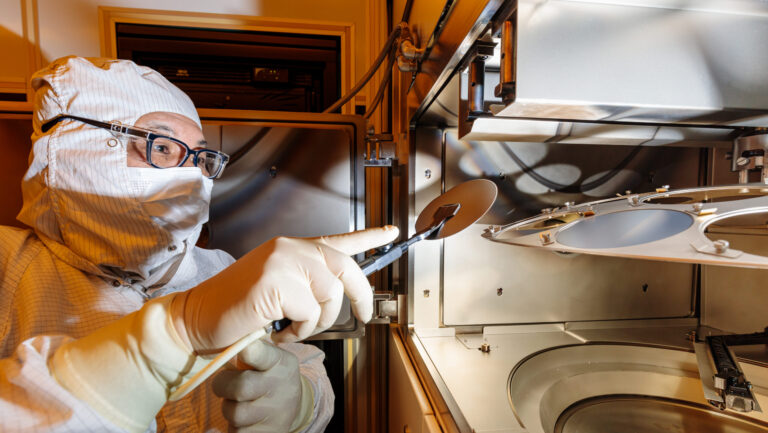
The Northrop Grumman Microelectronics Center comprises three government-accredited production facilities: semiconductor foundries in California and Maryland, and an advanced packaging facility in Florida.
Although most of the business’s current work is for the US government, the company sees opportunities to expand sales to commercial customers and other aerospace and defense firms. Last fall, Northrop said it was willing to sell dozens of components made at US-based, government-certified facilities to other companies in those industries as a merchant supplier. Previously, it produced them only for Northrop-built systems.
Fortitude chip offers a potential commercial application
One technology with potential commercial uses is the Fortitude chip, which Northrop unveiled earlier this month. The gallium nitride chip is about the size of a grain of rice and is designed to deliver three times more power and 20 times better signal quality than current chips, according to the company.
Warden cited radar, GPS and future 6G networks as potential applications. She also noted that microelectronics advances pioneered by Northrop in previous decades have found their way into commercial products, including microchips used in cell phones in the early 2000s.