












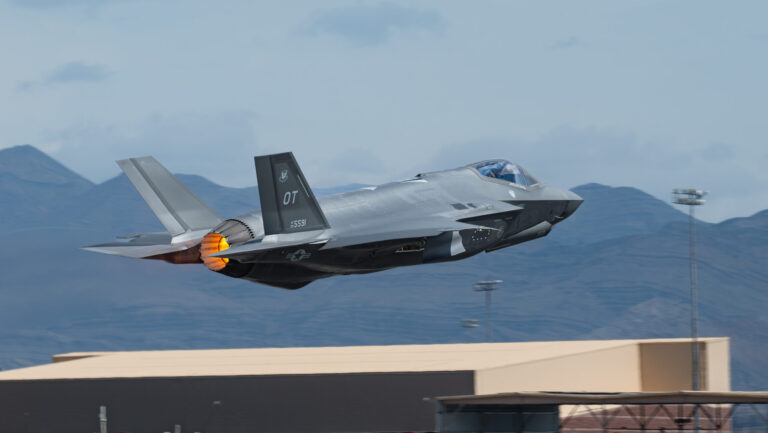
The Pentagon and Lockheed Martin have announced a framework agreement covering long-term production and sustainment of the F-35 Joint Strike Fighter. The arrangement could reshape how the program is managed, but its implementation depends on congressional approval and clarification of several key details.
The framework covers at least 850 U.S. aircraft across 10 production lots, together with initial spare parts. It also includes 10 years of sustainment and modification kits. The Pentagon said Lockheed Martin will fund $7 billion in unspecified initiatives for the F-35 program. The company said it will maintain production at 156 aircraft a year across the jet’s three variants.
A bid for stability, but no production increase
U.S. officials say the agreement ties financial incentives to performance and could strengthen the defense industrial base. Lockheed Martin CEO Jim Taiclet said the framework would give the company and its suppliers greater certainty to invest in expanded capacity, efficiency and a more resilient supply chain.
The Trump administration has promoted similar framework agreements for in-demand weapons systems, arguing that long-term commitments can support production and lower costs through economies of scale. In the case of the F-35, however, the announcement does not call for an increase in the manufacturing rate.
Two central questions also remain unanswered: how much the initiative will cost taxpayers and how much the Pentagon expects to save through multi-year procurement.
Supplier investment and performance incentives
Lockheed Martin and the F-35 Joint Program Office will work to settle contract terms, pricing and schedules before a formal award. That step can proceed only if lawmakers provide the required authority and funding.
A decade-long agreement could be worth tens of billions of dollars. A recent deal covering two F-35 production lots and nearly 300 aircraft was valued at $24.3 billion.
During an earnings call, Taiclet said the agreement could enable suppliers to invest in hiring and software, while reducing late or substandard deliveries to Lockheed’s production line in Fort Worth, Texas. He added that participating companies could benefit from a fixed-price escalation model, allowing them to earn higher profits if they meet performance targets.
The agreement would also pool parts used for production and sustainment, with the aim of securing better prices from suppliers. Investments could also support testing of new capabilities introduced through modernization programs.
Lockheed Martin executives do not expect an agreement for the next production lot, Lot 20, to be finalized before next year.
Congress may impose additional conditions
Lawmakers are considering whether to grant the Pentagon authority to enter into multi-year F-35 contracts. Both the Senate and House versions of the fiscal 2027 defense authorization bill contain provisions that would allow such agreements.
The House version, however, includes additional safeguards. Before authorizing a multi-year contract, the defense secretary would have to certify that it includes the full complement of initial spare parts and alternate mission equipment for each aircraft. The Pentagon would also have to demonstrate savings of at least 5%.
Neither version of the bill explicitly authorizes a multi-year sustainment agreement, potentially leaving a significant part of the broader proposal unresolved. Previous experience suggests that this could be a difficult hurdle: the F-35 program once considered a five-year, performance-based sustainment contract but was unable to demonstrate that it would reduce costs or improve readiness.
International customers remain part of the equation
The program’s extensive international footprint could complicate negotiations. Lockheed Martin says the agreement will not change how production slots are allocated among F-35 customers. The Joint Program Office will continue to manage orders for all customers, and the company says economies of scale could eventually lower costs for foreign operators.
The F-35 program is expected to run into the 2080s, and sustainment represents a major share of its nearly $2 trillion estimated lifecycle cost. Improving the aircraft’s mission-capable rates is a leading priority. Government watchdog reports have identified limited depot capacity, spare-parts shortages and restricted access to technical data for military maintainers as factors hampering readiness.
More than 1,300 F-35s have been delivered so far. Over the past two years, however, many newly delivered jets have been assigned to training as officials work to clear an upgrade needed for combat operations.