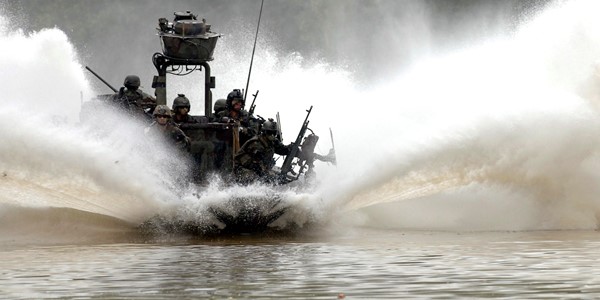
Electric power propulsion is a better solution for clandestine missions in river and near-shore environments, delivering stealth for boat teams and warfighters.
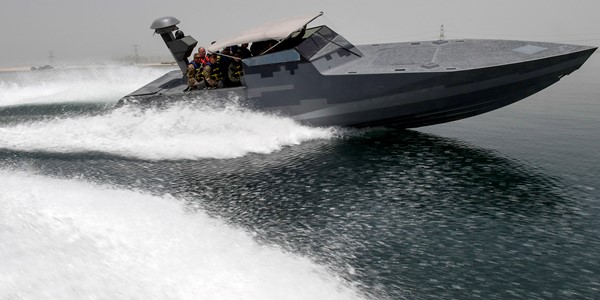
If
there’s one characteristic that these warfighters prize most it is stealth—the
ability to arrive unobserved, clandestinely conduct their mission, and then
leave as silently and undetected as they came.
The U.S. Navy shallow water and coastal craft are equipped with 440-hp diesel
engines and are propelled by water jets rather than typical screw propellers.
Jetboats use a pump and impeller system to eject streams of water, attaining
speeds not possible with propeller-driven boats. (Propeller driven vessels max
out at about 30 knots, so fast vessels like the Littoral Combat Ship classes
Freedom and Independence both employ large water jets for propulsion.)
While there has been some efforts to abate the detectability of these
boats—primarily by enclosing the engines in a compartment below deck to reduce
noise and by venting engine exhaust and heat in such ways as to reduce the
craft’s infrared signature—there is the continuing realization that better
solutions are needed to perform missions with much less noise in river and
near-shore environments, while protecting both the boat operators and the
warfighters onboard.
Mechanical-drive propulsion systems are the main source of acoustic noise while
underway or when laid up on the riverbank charging the craft’s batteries. As
such, the principle effort to quiet SOF boats today focuses on eliminating some
or all noise-making mechanical propulsion systems in favor of an all-electric
or hybrid-electric
propulsion (HED) systems that can run silent when needed.
Leonardo DRS has significant experience designing and manufacturing quiet
electric drives and motors for Navy surface and sub-surface combatants. The
company provides the highest efficiency and quietest options for electric
propulsion. The Leonardo DRS designs are modular in nature allowing them to
rapidly customize offerings to meet the specific mission requirements of special
operations forces. These solutions increase propulsion system flexibility,
redundancy, and offer better fuel efficiency for increased operational range.
How Electric/Hybrid Electric Drive Can Work for Small
Platforms
Electric boat technology is not new.
For many years, the U.S. Navy has installed HED systems for improved fuel
efficiency and maintenance on auxiliary support ships in the fleet. And in late
April, the Navy awarded the long-anticipated FFG(X) contract for a
next-generation multi-mission guided missile frigate that features a
hybrid-electric drive system.
Until recently though, miniaturized and optimized electric propulsion
technology for small boats hadn’t been fully realized. Now, development of
small-craft electric propulsion systems, led by companies like Leonardo DRS,
have matured to the point where they can play a key warfighting role.
“Leonardo DRS specializes in very power dense, small, compact, efficient
equipment that for large ships is very important and a real need for the military;
when you get to small boats it’s even more important,” said Jamie McMullin,
senior director of business development for Naval Power Systems at Leonardo
DRS. “You have far less flexibility with small boats. Adding extra weight could
limit the range or amount of mission systems the boat can carry.
“There’s also more systems engineering required to optimize the location of
equipment to maximize boat performance and survivability. A large surface
combatant has many different ways that it can survive whereas a small boat
doesn’t. Utilizing smart design of integrated electric power for propulsion can
enhance the boats survivability characteristics.”
While hybrid and electric technologies for large naval ships are generally
beneficial for increased fuel efficiency with the added benefit of quiet
operations, smaller systems for river boats are mainly aimed at stealth and
quiet operations, though they also bring the added benefit of fuel saving and
flexibility of operations for the crew.
Leonardo DRS’ HED technology incorporates a small electric propulsion motor on
the propulsion shaft powered by a battery source. This configuration can propel
the craft at patrol speeds without operating the diesel engines, the primary
source of propulsion system noise. Use of the word “hybrid” in the HED
system identifies a propulsion system configuration that includes two sources
of power to the water jets, diesel mechanical drive and battery powered
electric drive.
For an HED solution, the mechanical drive system remains but an electric motor
plus motor drive and battery are added to the system. By switching from the
mechanical drive to the electric system, the boat has the ability to run on
full silent electric mode for the length of the battery supply.
For the full electric drive technology, in addition to the propulsion motor, a
generator is incorporated on the engine and is used to directly power the
propulsion motor. Adding the generator allows the engine to be decoupled from
the propulsion system and operated at an optimum performance point. As with a
HED solution, a battery is included to support silent mode operation.
“With electric propulsion, putting the electric drive on the shaft itself means
you can turn off the diesel engine, stop operating the gearbox, and propel the
boat on electric propulsion motors, for enhanced mission performance,” said
McMullin. “It’s just the electric motor; there’s no gearbox noise nor diesel
noise. The inherent efficiency gains are immediate, enhanced further by our
ultra-efficient and ultra-quiet permanent magnet propulsion motors.”
Electric Boat Benefits
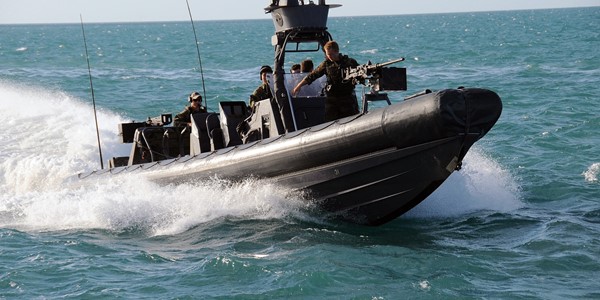
For the needs illustrated above, the future for clearly lies with integrated electric power propulsion. That also applies to naval unmanned surface vehicles and unmanned underwater vehicles, both of which need to operate silently and clandestinely.
Compared to mechanical propulsion, electric is simply superior in stealth and delivers what is required in acoustics, emissions, and detectability. Quieter operation also means that surveillance technologies can more easily detect adversaries from farther distances.
Survivability is another hallmark of Leonardo DRS’ electric solutions. Through intelligent design these systems can be installed in different areas of these boats so that they’re better protected, not directly coupled together. That enables continuous operations even in damaged situations.
In addition, condition monitoring of electric power propulsion systems is more accurate than with traditional mechanical systems, so performance with a HED propulsion system can be easily adjusted to address mission needs.
Leonardo DRS electric propulsion systems are mature, ultra-reliable, and power dense, giving special forces the confidence and capability they need to fulfill and also survive their riverine and near-shore missions.