




The collapse of the Franco-German-Spanish FCAS effort has forced European governments to rethink their plans for sixth-generation combat aircraft. At the same time, collaborative combat aircraft and drones offer another route to modernization — and sharpen questions about cost, technological sovereignty and the future role of crewed fighters.
European governments are increasing defense spending in response to Russian aggression, reassessing their reliance on American technology and support, and confronting the cost of replacing aging aircraft. Against that backdrop, the collapse of the Franco-German-Spanish effort to build a sixth-generation fighter has left Germany seeking a new direction, France potentially pursuing a national aircraft, and the UK-led Global Combat Air Programme (GCAP), involving Italy and Japan, as Europe’s principal remaining multinational effort of its kind.
Meanwhile, the emergence of collaborative combat aircraft (CCAs), designed to operate alongside crewed fighters, raises a fundamental question: How much of Europe’s future combat capability needs to depend on traditional fighter jets?
The choices made now will shape not only the continent’s air fleets for decades, but also which countries control the technology, production and sustainment of their combat aircraft. Europe’s future force is likely to combine upgraded fourth-generation fighters, F-35s, new sixth-generation aircraft and a growing range of drones. The challenge will be to fund, integrate and maintain that mix while preserving national control over critical military technologies.
Europe’s current fighters will remain in service for decades
The challenge of modernizing European air forces goes beyond designing sixth-generation aircraft. Governments must decide how much to invest in existing fleets, what new capabilities are needed to counter emerging threats, and how to bring crewed and uncrewed systems together in a strategy that meets both immediate operational needs and long-term requirements.
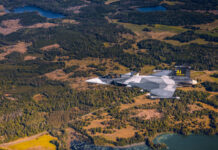
Rafale, Eurofighter Typhoon and JAS 39 Gripen aircraft are expected to remain in service into the 2040s, and in some cases beyond. At the same time, F-35s are becoming an increasingly prominent part of European air forces.
Russia’s military threat is accelerating modernization across the continent, but national priorities vary. Countries bordering Russia, including the Baltic states, are emphasizing smaller drones and expanding operator training across their armed forces. Larger European powers are investing in more sophisticated uncrewed aircraft intended to operate alongside conventional fighters.
The war in Ukraine also demonstrates that inexpensive first-person-view (FPV) drones cannot, on their own, replace traditional airpower or longer-range strike systems. Modern warfare demands a diverse mix of capabilities; no single category of weapon can meet every requirement. That approach could help expand combat mass without making every new capability dependent on additional crewed fighters. It also creates opportunities for European manufacturers to develop aircraft and mission systems as established fighter programs continue production and modernization.
FCAS falters, leaving Germany with a consequential choice
Disagreements among France, Germany and Spain over the Future Combat Air System (FCAS) have fundamentally reshaped Europe’s sixth-generation fighter landscape. Political differences and disputes over industrial responsibilities undermined the effort.
France may continue developing an aircraft of its own, while Germany must decide whether to join another partnership, pursue a national program or redirect some investment toward other capabilities. The financial resources Berlin could bring to a future effort give it considerable influence over the direction of any new initiative.
The principal remaining multinational program involving European countries is GCAP, which brings together the United Kingdom, Italy and Japan. It is targeting entry into service in 2035, a schedule driven largely by Japan’s need to replace its Mitsubishi F-2 fighters. Adding new partners has been considered, but doing so would complicate negotiations over production, financing and technology responsibilities — potentially putting the target date at risk.
Canada has become an observer, giving it a way to assess the program without immediately entering negotiations over funding and industrial workshare. Even among the existing partners, however, the division of work has yet to be settled. GCAP representatives have indicated that workshare agreements are expected after the concept phase.
Similar unresolved issues contributed to FCAS’s difficulties, alongside political changes in participating countries. Changes in national leadership made it harder for governments and manufacturers to maintain a common position.
Airbus has signaled that any future arrangement must provide meaningful industrial participation for Germany. Buying additional F-35s remains another option. Sweden, meanwhile, continues to receive new JAS 39 Gripens, while Saab explores technologies for future combat aircraft.
The choices facing Germany and Sweden illustrate Europe’s longstanding difficulty in balancing national industrial ambitions against the expense and complexity of developing advanced combat aircraft. Joining an existing program can reduce development costs, but may limit a new participant’s influence over design and manufacturing responsibilities.
Combat drones offer another path — but not a cheap one
Collaborative combat aircraft offer a way for European air forces to expand their capabilities without immediately developing an entirely new crewed fighter. Designed to fly alongside crewed platforms, CCAs could extend sensor coverage, carry weapons, support electronic warfare and allow crewed aircraft to operate farther from danger.
But CCAs are substantially more complex and expensive than the drones used extensively in Ukraine. One could cost about a quarter as much as a crewed fighter. Equipping each manned aircraft with multiple CCAs would therefore require a considerable additional investment.
Germany aims to field a CCA capability in 2029, potentially making it the first European country to operate such aircraft. The United Kingdom has also committed funding to development. Yet Luftwaffe leaders continue to emphasize the need for a crewed sixth-generation fighter, suggesting that uncrewed aircraft will initially supplement, rather than replace, traditional combat aviation.
An alternative would be for Germany and other European countries to focus their resources on developing CCAs, keep existing fighters in service and eventually buy a sixth-generation crewed aircraft developed elsewhere. Such a strategy could avoid some of the industrial and political complications of another multinational fighter program, but would require governments to reconsider the value of independently developing a crewed combat aircraft.
The importance of operational integration was highlighted during field prototype testing of a portable command-and-control system for CCAs, when members of the U.S. Air Force and the Ohio Air National Guard evaluated the system using laptops. Developing the aircraft is only part of the challenge; forces also need the systems to control and coordinate them.
Technological sovereignty also depends on software
Control over mission software and electronic systems has become central to the debate over European autonomy. Operators of American aircraft, including the F-35, may face restrictions on independently modifying certain capabilities, potentially slowing upgrades or limiting how quickly systems can be adapted to national requirements.
That concern is also shaping how American manufacturers approach Europe’s market for uncrewed aircraft. General Atomics has established a European presence through its MQ-9 family and is extending its work into CCAs and other missions traditionally carried out by crewed platforms.
Industrial cooperation is a key part of that approach. It can include manufacturing aircraft components in Europe, integrating locally developed sensors and building domestic maintenance and repair capabilities. For aircraft that could remain in service for around 40 years, the ability to maintain them at home may be as important to a customer as a role in manufacturing.
General Atomics sees growing opportunities for the MQ-9B in maritime surveillance, anti-submarine warfare and airborne early warning. Its long endurance and lower operating costs could provide an alternative to larger crewed aircraft.
European CCA requirements do not always match those driving U.S. Air Force development. Many European customers are primarily interested in air-to-ground missions, rather than air-to-air combat. General Atomics’ six-variant Gambit family is built around roles such as intelligence, surveillance and reconnaissance (ISR) or strike. The aircraft can integrate locally developed payloads instead of relying entirely on U.S.-developed mission equipment and software.
European countries could also contribute their own artificial intelligence and autonomy technologies, tailoring the platforms to national requirements. That could give European companies a role in CCA development without requiring them to build an entirely new aircraft. The Netherlands’ participation in the U.S. CCA program, intended to provide wingmen for its Royal Netherlands Air Force F-35As, is one example of this approach.