

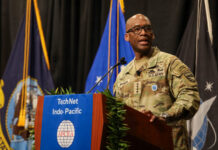






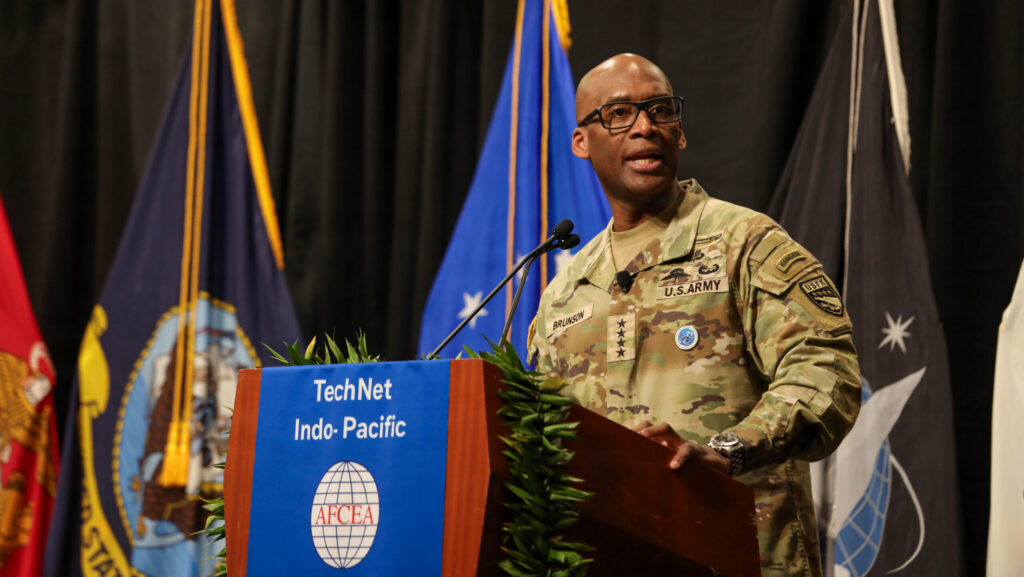
Electronic systems used by US and allied forces are jammed daily on the Korean Peninsula, an environment Gen. Xavier Brunson, commander of US Forces Korea (USFK), described as one of the most contested electromagnetic environments in the world.
Speaking at AFCEA TechNet Indo-Pacific in Hawaii, Brunson warned that adversaries seek to disrupt GPS, sensors, servers and networks. Without naming a country directly, he referred to the North Korean threat; the region is also shaped by China’s advanced electronic attack capabilities.
Communications built to withstand jamming
A system that functions only with uninterrupted satellite communications, unlimited bandwidth and a consistently available fiber-optic backbone is not suited to a contested theater. “It will not survive 48 hours on the peninsula,” Brunson said.
The answer, he argued, is to build redundant networks capable of sustaining command and control when primary links are disrupted. USFK is fielding high-frequency networks, communications through proliferated low-Earth orbit satellites and terrestrial mesh networks.
Brunson urged industry to bring lightweight, jam-resistant solutions to the peninsula, with low probability of intercept and detection. He also called for open application programming interfaces and edge sensors that can integrate into joint mission networks without vendor lock-in.
Interoperability must be designed in from the start
The general criticized the practice of building systems exclusively for US networks and adding partner interfaces later. In combined operations, interoperability cannot be a secondary feature bolted on after a contract is signed.
“We must design combined from the first line of code,” Brunson said, calling for a fundamental shift in how information security is designed.
The traditional model—closed networks protected by hardened perimeters—has often required a new “pipe” whenever information needed to be shared with partners. In a conflict where units operate in a dispersed manner, that approach can isolate formations and limit the shared operational picture.
The proposed alternative is data-centric security: protecting and tagging the information itself, rather than only the network it travels through. Brunson illustrated the stakes with a practical example: a missile track detected by a Korean radar should be verified and pushed to a coalition fires network in milliseconds, not seconds.
Industry urged to adapt products to the mission
Brunson urged companies to study military strategy documents and requirements to understand which capabilities are needed. To make his point, he used an unusual analogy: sliced pickles for hamburgers.
Vlasic, he said, recognized that consumers needed sliced pickles—not whole ones—for their burgers. The defense industry must do the same: adapt its offerings to the way forces will fight, rather than trying to force a product that does not meet operational requirements.
As an example of strategic guidance, Brunson pointed to the US Army’s recently released How the Army Fights. Companies, he said, should align their solutions with the operational concepts it describes and develop products that can function at the network’s edge.
Networks for a distributed, mobile force
Future operations will involve more widely dispersed forces, plans that may change before troops arrive in theater, and networks that remain under attack. In these conditions, capabilities must function in austere environments and adapt quickly.
Brunson’s message to industry was direct: connectivity cannot depend on perfect infrastructure, and interoperability cannot be postponed. Systems must be resilient, open and designed for combined operations from the outset—so critical information reaches the forces that need it, even when an adversary is trying to block it.