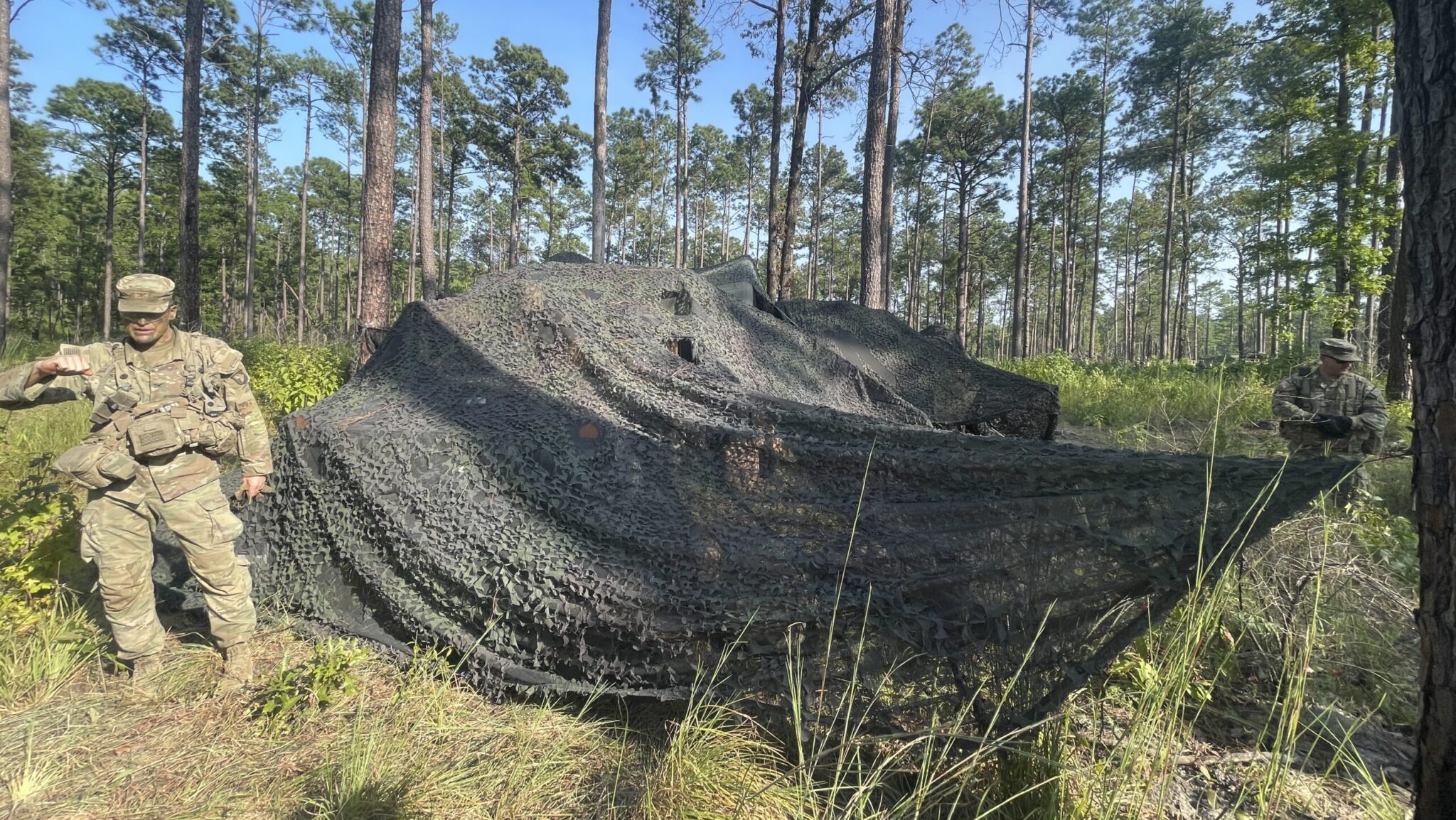
Following a 500-mile air assault from Fort Campbell, Kentucky, to a densely wooded training site in Louisiana, soldiers from the 101st Airborne Division dedicated a significant portion of August to testing new technology and formations against an opposing force known as Geronimo.
The preliminary assessment reveals a pressing need for more equipment to contend with a battlefield inundated with drones, alongside a reevaluation of the division’s logistics for potential island-hopping operations in the Indo-Pacific region.
“We just do not have the density or the quality of our counter-UAS [unmanned aerial systems] that we would really need… for the future fight,” said Maj. Gen. Brett Sylvia, the commanding general of the 101st, during a press briefing on August 22. He acknowledged that while there has been some improvement in capabilities, the current offerings are insufficient.
Sylvia also noted the importance of adjusting the distribution of forward arming and refueling points as the division prepares for long-range air assaults in areas such as the Indo-Pacific. These insights emerged nine days into a rotation at the Joint Readiness Training Center (JRTC), where the division’s 2nd Brigade Combat Team is participating in the Army’s new “transformation in contact” initiative aimed at quickly incorporating soldier feedback on new equipment and formations.
General Randy George, the Army Chief of Staff, emphasized the importance of optimizing the Army’s capabilities with available resources during a recent visit to the training exercise. He stated, “We have to provide the best Army that we can with the people we have, with the budget that we have,” acknowledging that tough decisions will need to be made regarding what priorities will be set.
As the military navigates feedback from the JRTC rotations, various new technologies and operational techniques were explored. Soldiers from the 101st tested handheld systems such as Dronebuster and DroneDefender to engage UAS threats up to 750 meters away.
“These are very new capabilities for us that we’re still integrating and learning from, and determining how we reorganize ourselves,” Sylvia remarked.
In addition to the need for improved equipment, Col. Matthew Hardman, commander of the JRTC operations group, noted the significance of maintaining operational security through dispersion, camouflage, noise and light discipline, and electromagnetic signature mitigation.
“There is no silver bullet for counter-UAS,” Sylvia stated, underscoring the necessity for a multifaceted approach rather than relying on singular solutions.
Amid the growing UAV threat, the Army is also focusing on electronic warfare (EW) capabilities and exploring how these can be leveraged for tactical advantage. A key aspect of this strategy involves utilizing smaller command posts that can be deployed and dismantled in 15 minutes. By situating “antenna farms” up to two kilometers away and connecting them with fiber cables, the Army aims to minimize the electromagnetic signature emitted from command posts, effectively redirecting potential enemy strikes away from personnel.
“Once the opposition detects emissions, the idea is to target the antenna farm instead of the camouflaged command post,” Maier explained.
During the exercise, soldiers implemented commercially available “raspberry pi” circuit boards as decoys to attract enemy fire and mask the actual operational positions, allowing the 101st to pinpoint the enemy’s location.
When opposing forces targeted these decoys, it revealed their positions within the woods, enabling a more focused response from the 101st. Soldiers also utilized the raspberry pi boards for offensive operations by attaching them to UAS platforms, flying them over enemy positions to identify electromagnetic signatures.
In efforts to enhance operational capabilities, the Army tested an AI-enabled function designed to identify enemy vehicles, generate fire missions, and communicate these back to soldiers for execution. This “intelligent” UAV can adapt to the battlefield dynamic by continuing to observe targets and adjusting mission parameters as necessary.
In conjunction with showcasing new technologies, a central theme of this month’s training exercise was evaluating the improvements to communication networks, specifically the C2 Fix initiative, aimed at ensuring robust command and control capabilities in current and future battlefields.
Alex Miller, chief technology officer, explained the importance of integrating counter-UAS measures with existing air and missile defense strategies, stating, “We’ve had bad C2 for 30 years. What comes after that to make sure that we can integrate all of our sensors, all of our effectors, so we have that combined offense and defense for fires?”
As the Army continues its commitment to enhance operational effectiveness in complex environments, the insights gained from this training exercise are seen as critical for future readiness for potential conflicts to come.