The Army is actively exploring a wide range of high-altitude platforms, including balloons, drones, and lightweight aircraft, for various applications such as deep sensing and long-range communications, according to Lt. Gen. Sean Gainey, head of the Space and Missile Defense Command (SMDC).
“I’ve always been an advocate for balloons that can provide over-the-horizon support from a missile defense perspective,” Gainey remarked during his address at the Hudson Institute. He referenced the JLENS program, which was notable for its capability to deliver over-the-horizon detection and fire control data. “The essence of utilizing diverse platforms lies not just in their physical form but in the capabilities that can be integrated with them to enhance commanders’ situational awareness and operational command,” he added, noting the excitement around using low-cost balloons as flexible solutions.
The Joint Land Attack Cruise Missile Defense Elevated Netted Sensor system, or JLENS, was an unmanned, helium-filled airship that was capable of carrying a 7,000-pound radar system at an altitude of 10,000 feet. Although the program was canceled in 2017 following an incident where one aerostat broke free and caused power outages while drifting through Maryland and Pennsylvania, there appears to be renewed interest in similar systems among Army officials.
Andrew Evans, director of the Army ISR Task Force, discussed these ideas at the Farnborough Air Show on July 22. He mentioned the establishment of a program executive office for “persistent surveillance, tethered” solutions (specifically balloons) for multi-domain operations. “Throughout the global war on terrorism, we learned valuable lessons about the importance of tethered systems for force protection,” he stated, underscoring the challenge of adapting these lessons to vast areas like the South China Sea, where distances are measured in thousands of miles.
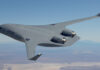
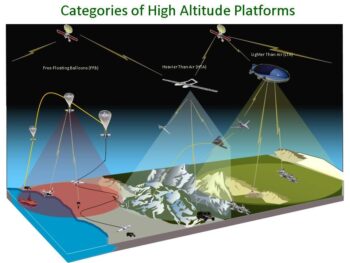
While currently studying this issue, Gainey emphasized that SMDC is considering a variety of high-altitude platforms, not limited to balloons. “Future high-altitude platforms could range from drone-like capabilities to fixed-wing designs that can loiter for extended periods. We are keeping an open mind while collaborating with industry to discover the best solutions,” he explained.
According to SMDC’s fact sheet on high-altitude platforms, the Army is investigating a variety of capabilities to meet its own needs and support joint multi-domain operations. The Army has been particularly interested in stratospheric vehicles for intelligence, surveillance, and reconnaissance (ISR) missions in recent years. “System platforms could integrate numerous technologies—communications, imaging, assured positioning, navigation, timing, and other essential Army functions. Potential platforms could include balloons, solar-powered aircraft, and airships that enhance mission support and bolster existing capabilities,” the fact sheet remarked.
Gainey also highlighted collaboration with the U.S. Army Special Operations Command (USASOC) in assessing potential high-altitude capabilities. “We are working closely with USASOC to identify the right capabilities for field deployment, whether as a formal program of record or through rapid fielding and disposal for ongoing innovation,” he said.
Gainey’s remarks contrast with earlier statements from Brig. Gen. Ed Barker, the Army’s program executive officer for intelligence, electronic warfare, and sensors, who indicated in December that the Army plans to initiate a program of record in fiscal 2025 specifically for high-altitude platforms focused on deep sensing—starting with requests for information (RFIs) to industry.
The Army has already issued RFIs under its High-Altitude Platform-Deep Sensing (HAP-DS) project to identify available radar, electronic intelligence, and communications intelligence sensors that are sufficiently small to be carried by high-altitude craft. HAP-DS marks the initial phase of the High-Altitude Extended-Range Long-Endurance Intelligence Observation System (HELIOS) development program, aimed at providing a versatile sensing suite for multi-domain operations.
As part of its multi-faceted strategy to equip troops with advanced long-range sensors, the Army is also pursuing the Multi-Domain Sensing System (MDSS). According to the details found within the HAP-DS RFIs, MDSS is a collection of capabilities geared toward addressing Army deep sensing needs by delivering airborne sensors for Multi-Domain Operations (MDO) and Large-Scale Ground Combat Operations (LSGCO).
“MDSS focuses on six primary capability areas: Platforms; Sensors; Integration of Intelligence, Fires, Electronic Warfare, Cyber, and Mission Command; Processing, Exploitation, and Dissemination (PED); Data Transport; and Cyber and Electromagnetic Spectrum (EMS) Resilience,” the documents explained.