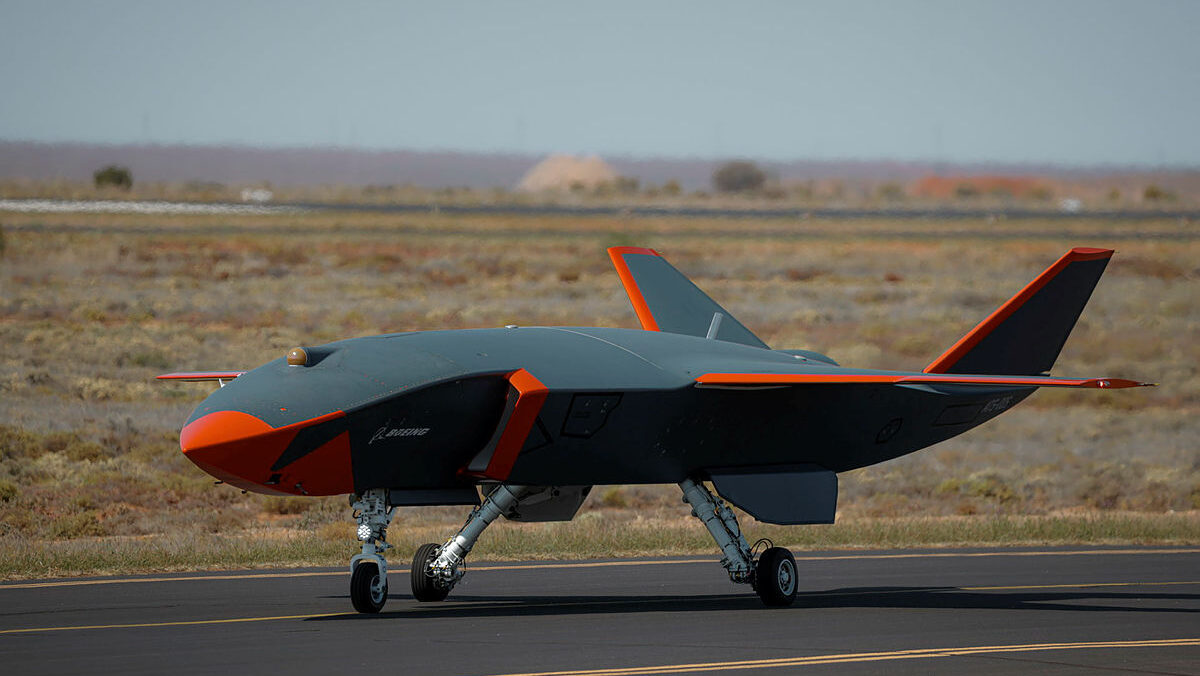
Despite conflicting reports, Australia is still contemplating the potential to arm Boeing’s Ghost Bat drone with lethal payloads, as confirmed by the country’s defense industry minister in an interview with Breaking Defense on Wednesday.
During the Indian Ocean Defense and Security Conference, Defense Minister Pat Conroy addressed a report in The Australian, which claimed that the MQ-28 drone would not be equipped with lethal munitions. Conroy clarified that while the focus for now is on Intelligence, Surveillance, and Reconnaissance (ISR) sensors, the option for combat capabilities has not been dismissed. „We are initially concentrating on ISR capability, but we have not ruled out it having combat capability. We are investigating the payload implications,” he stated.
A source from Boeing remarked, „It is up to the Royal Australian Air Force (RAAF) or other future customers to determine what payloads the aircraft will carry and the types of missions it will undertake.” The source, who spoke on condition of anonymity, emphasized that RAAF and Boeing have designed the MQ-28 with flexible, modular sensors and payloads, and affirmed that their strategic approach remains consistent.
In addition to discussions on drone capabilities, the conference coincided with an announcement from the Department of Defence regarding the approval of the first phase of its Landing Craft Medium program. This initiative will result in the construction of 18 vessels, capable of transporting HIMARS and other large artillery across waterways. The contract, potentially valued at $2 billion AUD ($1.32 billion USD), was awarded to a consortium of firms, Austral and Birdon, with the first unit expected to be delivered in 2026. While Birdon is responsible for design work, Austal will handle the construction.
Austal is also preparing for an anticipated future requirement for eight Landing Craft Heavy vessels and today announced a new joint venture with Civmec for this endeavor. The heavy craft could be worth up to $5 billion AUD ($3.3 billion USD). Austal CEO Paddy Gregg stated in a press release that the joint venture will grant the company “immediate access to a larger pool of skilled shipbuilding workers” for multiple projects.
According to a statement from the Defense Ministry, these vessels play a crucial role in the Army’s transformation and optimization for littoral maneuver, supporting a strategy of denial that includes the deployment and sustainment of modernized land forces with long-range land and maritime strike capabilities across the region.
Nevertheless, questions have been raised regarding the vulnerability of these vessels if they were to transport weapons in a combat scenario. In response to these concerns, Conroy reaffirmed the decision, pointing out that a much larger surface fleet is being developed by the Royal Australian Navy to ensure their protection. „We are constructing a surface fleet to protect them and other assets,” Conroy assured.