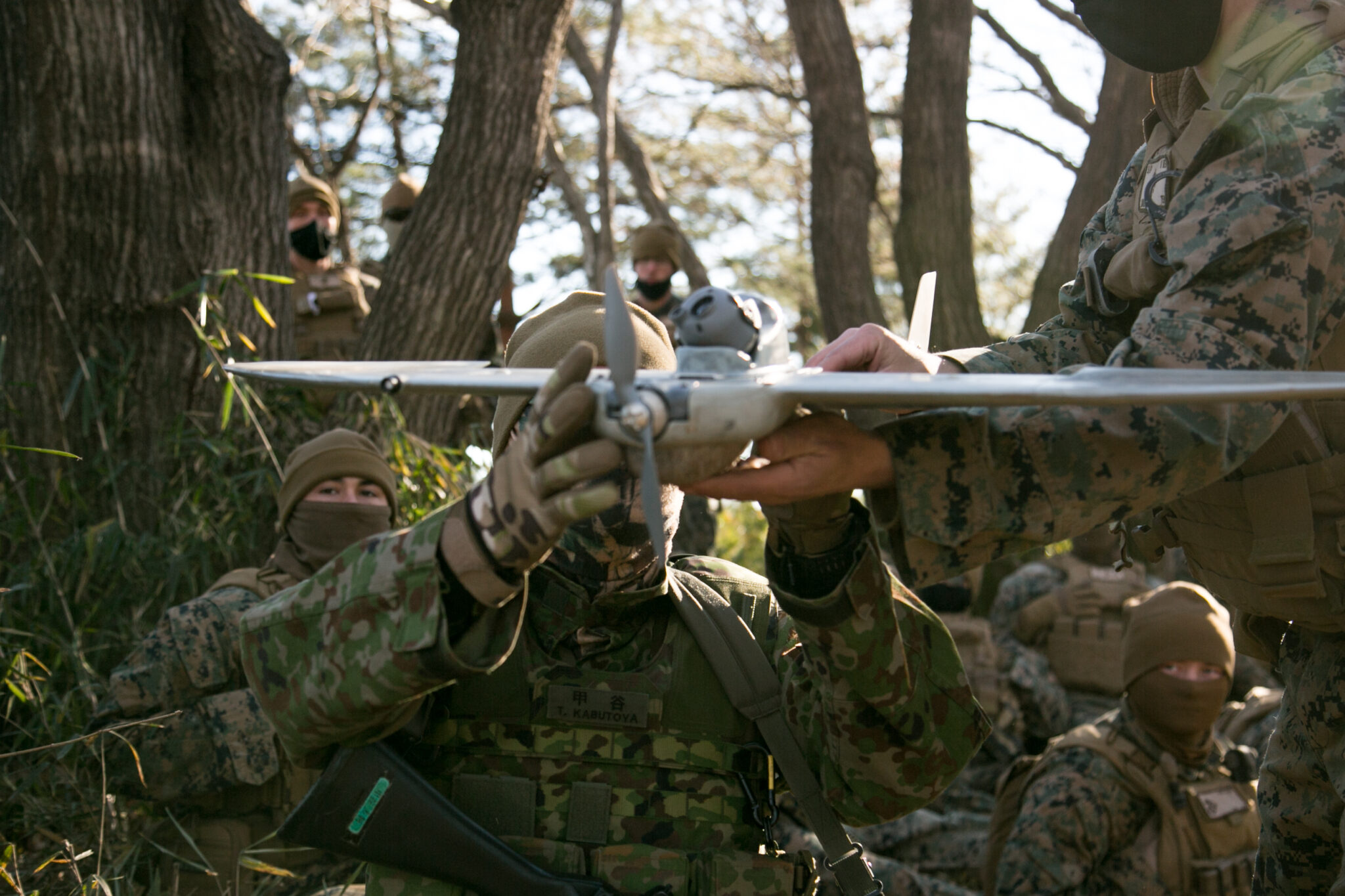
The Defense Innovation Unit (DIU) serves as the key agency for the Department of Defense’s initiatives to integrate commercial technologies, particularly small unmanned aerial systems (UAS) that have demonstrated effectiveness on the battlefield in Ukraine. Through its Blue UAS program, the DIU evaluates and certifies “secure, trusted” UAS, concentrating primarily on Group 1 and Group 2 systems, especially commercially made quadcopters designed for short-range reconnaissance missions for the Army, Marine Corps, and special operations units.
DIU compiles the Blue UAS Cleared List, which features verified platforms and components, including ground control systems, that military units can utilize for specific operations. We spoke with Trent Emeneker, Blue UAS Project Lead, about the program’s functionalities.
According to Emeneker, three pieces of legislation— the 2020 NDAA, the 2023 NDAA, and the 2024 American Security Drone Act—set specific guidelines for the hardware and components used in UAS platforms. In summary, any component that can “think, talk, or communicate” must not originate from countries deemed prohibited, such as China, Russia, North Korea, Iran, and Venezuela.
„The first step we take is to verify that the platforms we consider adding comply with these stipulations,” Emeneker explained. „We perform a physical inspection to trace the origins of the components, ensuring compliance with legal requirements.”
Next, the DIU assesses cybersecurity. They implement industry best practices based on NIST guidelines to confirm that the platforms and components listed meet the necessary cybersecurity standards. Despite the fact that no system is completely impervious to hacking, applying commercial best practices raises the difficulty for adversaries to infiltrate and compromise the systems, regardless of the source of the platforms or their components.
„What do companies typically submit for evaluation—circuit boards, radar panels, or complete platforms?” we asked Emeneker.
He clarified, „We have two tracks: the Blue UAS List, which consists of flying platforms, and the Blue UAS Framework, which encompasses components and capabilities such as cameras and radios.” For complete flying platforms, companies usually send the entire unit, but now, due to concerns about potential damage during disassembly, they request the bill of materials (BOM) listing all necessary components, which allows them to perform evaluations without full disassembly.
Emeneker acknowledged the complexity of the supply chain and noted that while they have not encountered intentional deception, errors do occur when companies mistakenly believe they are in compliance. The DIU ensures a thorough investigation to achieve the most accurate outcomes.
As for the current number of companies on the Blue UAS List, Emeneker mentioned, „We currently have 16 platforms listed, which includes two fixed-wing systems and several quadcopters. Additionally, our framework incorporates roughly 12 to 15 other companies, indicating around 30 companies total in one form or another.”
One significant aspect of the Blue UAS initiative is its responsiveness to user feedback. Emeneker noted that while the current platforms range from Group 1 to Group 2 UAS, there is a clear demand for first-person view (FPV) systems as well as longer-range ISR platforms, leading to a plan to expand these capabilities.
In November, DIU will host its first annual competitive refresh event, allowing companies on the Blue List to compete for their positions, while also inviting new entrants to present their systems.
As the Blue UAS program moves into its fifth year, the evaluation criteria will increasingly focus on meeting the needs of end-users, ensuring that platforms that fail to meet user requirements will be removed from the list. Emeneker expressed a commitment to adapting the program to better align with user demands.
When discussing the capability of the next generation of small UAS, Emeneker highlighted the need for platforms to demonstrate scalability and examine potential challenges.
“We assess a company’s viability for production and scaling,” he explained. Companies must prove they can meet part demand and have a roadmap for growth.
Moreover, the DIU has noted a pressing need to develop solutions for navigating GPS-denied environments and establishing communication in highly contested electromagnetic spectrums. Recent joint projects between the DIU and SOCOM aim to tackle these challenges, reflecting a global effort spurred by the observations made in Ukraine.
As for advancements in ground control systems, Emeneker emphasizes the importance of interoperability among various platforms. The DIU plans to require that any platform listed on the Blue List be both modular and interoperable, striving for a future where a single ground control system can manage multiple types of UAS.
Anticipating the future of tactical warfare, Emeneker stated that small UAS platforms will continue to play pivotal roles in intelligence, reconnaissance, and various combat operations. The goal is to maintain momentum in technological advancement while delivering solutions that provide essential capabilities at an accessible cost for military users.