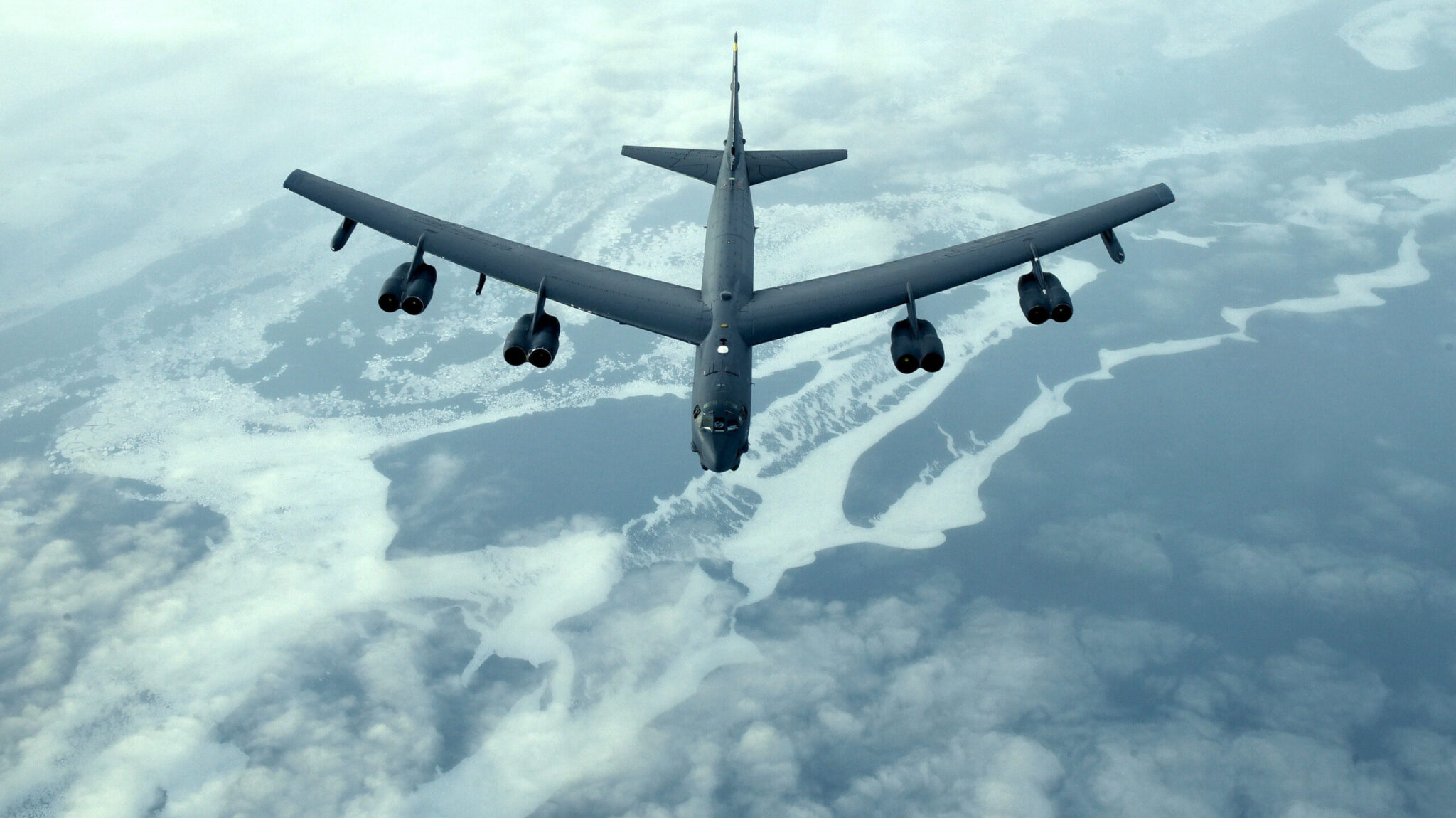
Air Force officials have recently disclosed further details regarding the delays and increasing costs associated with the multi-billion dollar modernization program of the long-range B-52 Stratofortress bombers. This situation has led the Air Force to engage a seasoned negotiator to enhance discussions with the prime contractor, Boeing.
In an effort to keep the 1950s-era bombers operational through the 2060s, the Air Force is undertaking significant upgrades to the aircraft’s engines and radar under two separate initiatives known as the Commercial Engine Replacement Program (CERP) and the Radar Modernization Program (RMP). However, during the Lifecycle Industry Days Conference, officials reported that both programs are facing schedule slips and escalating expenses.
“It’s really a no-fail mission, given the strategic importance of both the B-52 and the upcoming B-21 Raider,” stated Brig. Gen. Erik Quigley, Air Force Program Executive Officer for Bombers, regarding the long-range strike capabilities of both aircraft. Boeing has not yet responded to requests for comment.
For the CERP initiative, which will incorporate Rolls-Royce F130 engines, a new engine housing, and an updated cockpit — ultimately redesignating the aircraft as the B-52J — the Government Accountability Office (GAO) recently reported that the program’s initial operational capability may be delayed by approximately three years, potentially extending to 2033.
During a briefing with reporters, Brian Knight, Deputy Senior Materiel Leader for the B-52 Division, indicated that the program’s estimated cost has surged from $12.5 billion to around $15 billion, although this figure may fluctuate as the Air Force refines estimates for the program’s milestone B decision and awaits incoming proposals from Boeing.
Knight explained that a primary factor contributing to the disruptions in CERP is the transition of the program from a Middle Tier of Acquisition pathway to a Major Capability Acquisition. This shift required consolidating a large amount of work into a single contract, which “created, I’ll say, an opportunity for the prime contractor to raise costs.”
Quigley further noted that the project has also experienced delays due to a revised requirement for the engine inlet design, necessitating a return to wind tunnel testing — a process with limited availability.
It is crucial to find ways to extend the lifespan of the B-52’s current engines as the CERP advances, given that the existing TF33 powerplants will increasingly face diminishing manufacturing sources later this decade. Quigley stated that discussions are ongoing with the manufacturer, Pratt & Whitney, to address these concerns in light of the CERP schedule.
“If we don’t, there may be a gap. … If you look at the projections, 2027 is when some of those availability concerns will significantly affect the B-52. And if you look at the CERP schedule, it won’t come online until the early 2030s,” he remarked.
Simultaneously, the RMP, which is incorporating an existing active electronically scanned array radar from Raytheon, is also experiencing rising costs and delays. According to the GAO report, the program’s initial full cost estimate in 2021 projected expenses of $2.3 billion; this estimate has gradually increased to approximately $3.3 billion.
Moreover, Quigley mentioned that the program is currently providing acquisition chief Andrew Hunter with “a revised, suggested rebaseline schedule” for the RMP following an acquisition program baseline breach related to schedule, stating, “We did have an acquisition program baseline breach for schedule recently — not for milestone C, but for our decision points leading up to milestone C.”
Quigley emphasized that the Air Force is continuously exploring methods to reclaim schedule and costs for both RMP and CERP. For instance, with CERP, the Air Force is reassessing requirements that may be “not operationally relevant, or overly restrictive,” while also acquiring long-lead parts to expedite the RMP through an undefinitized contract action.
Regarding the LRIP phase for producing the radar, Knight pointed out that initial estimates for lead times were 18 months but have increased to around 30 months. In response, the Air Force is urging Boeing to exert pressure on Raytheon to accelerate their timelines.
Additionally, a new, experienced program manager has been recruited by Boeing to oversee both the RMP and CERP efforts and is conducting weekly schedule review meetings to identify opportunities for expediting the two programs.
The Air Force is also bringing in Shay Assad, the former Pentagon director of defense pricing known for his tough negotiations with the industry. Assad played a key role in finalizing a deal with Boeing on the E-7 Wedgetail.
“Well, I don’t want to speak disparagingly against Boeing, but the government had our own issues too,” Quigley stated when questioned about Assad’s involvement.
“It’s about efficiencies,” he added. “How we do pricing, how we do proposals, how we do contracting. […] We’re simply leveraging his experience and expertise to enhance efficiency on both sides. He has engaged in a detailed analysis with our government team as well as with Boeing to explore how we can improve our business practices.”