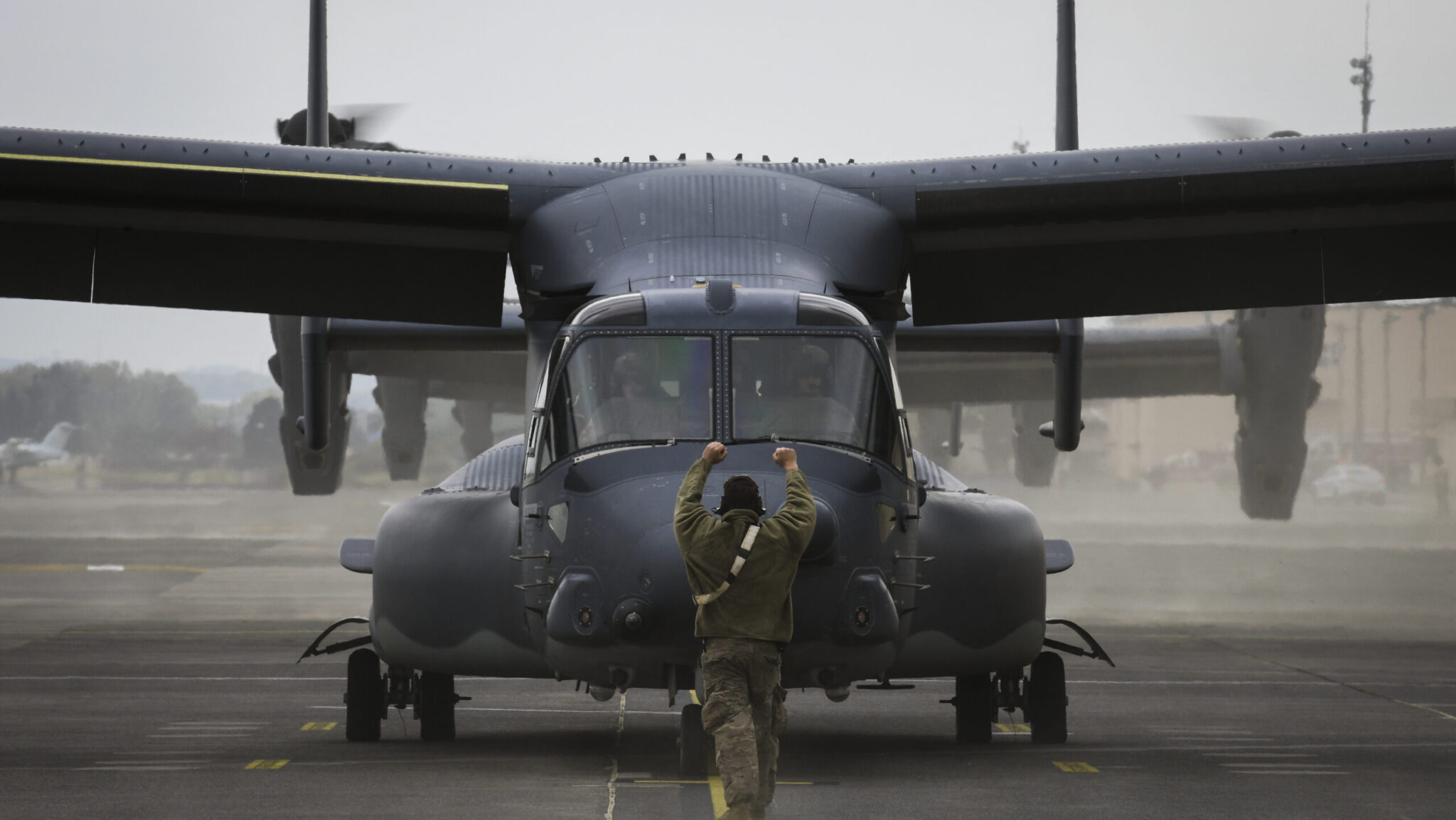
Air Force investigators have concluded that the deadly CV-22B crash off the coast of Japan in November was caused by a “catastrophic failure” of the proprotor gearbox. This mechanical failure was compounded by in-flight decisions made by the crew and a prior lack of effective communication from the Osprey program office to military services.
These findings were revealed following the completion of an Accident Investigation Board (AIB) led by Lt. Gen. Michael Conley, the current commander of Air Force Special Operations Command.
“This has been a hard eight months. We lost eight air commandos who were valued members of this command,” Conley stated during a press briefing on Wednesday. The crash resulted in the deaths of eight airmen from the 21st Special Operations Squadron, 353rd Special Operations Wing, with the remains of one individual still unaccounted for despite extensive recovery efforts.
In an executive summary detailing the timeline of the crash, investigators noted that the crew was participating in a joint exercise on November 29 and had just taken off from Marine Corps Air Station Iwakuni when they received the first of five advisories regarding left-hand proprotor gearbox (PRGB) chip burns.
According to Air Force guidance, crews are instructed to land as soon as possible after receiving three such warnings during a flight, though regulations allow for some discretion based on circumstances. The AIB determined that the crew’s management of this discretion contributed to the crash.
“The mishap crew continued their planned mission with limited discussion of divert options or the changing dynamics of the situation. … The crew never considered landing to meet up with G23,” the report stated, referencing another aircraft tasked to support maintenance.
More than an hour after taking off and after receiving five warnings regarding the gearbox, the crew diverted towards Yakushima, approximately 60 miles away, without discussing alternative landing options or conditions that would necessitate ditching the aircraft.
“While on final approach to Yakushima Airport, at approximately 800 feet above ground, the left-hand PRGB catastrophically failed,” the report indicated. “When the gearbox failure occurred, the aircraft became unrecoverable. No pilot actions could have saved it at that point.” Investigators also noted that the PRGB had caught fire, but this was ruled out as a contributing factor to the crash.
The report further explained that the mechanical failure “most likely” initiated from fatigue cracking in one of the gearbox’s components. As the cracking worsened, other gearbox components began to malfunction, causing the crew to receive multiple cockpit warnings.
Investigators stated that the pilot exacerbated the situation by continuing the mission despite the warnings and failing to communicate available options to the crew. Conley emphasized that both the gearbox failure and the pilot’s decision-making were “causal findings” in the final report, clarifying, „It doesn’t mean blame. It doesn’t mean liability. It simply means that these were the circumstances that led to the incident.”
The V-22 program office also faced scrutiny, as investigators found that it “inadequately communicated” vital information regarding the strength and reliability of the PRGB’s internal components, which are essential to the aircraft’s operation. This miscommunication “substantially contributed to the mishap,” according to the executive summary.
In response to the investigation’s findings, the Air Force has modified its policies regarding the urgency with which crews are advised to land when faced with multiple “chip burn” warnings, analogous to a “check engine” light in vehicles — a warning that is serious but not necessarily indicative of imminent failure.
While the service has adjusted training and emergency protocols related to the gearbox, it has not reduced the discretion afforded to pilots during missions. Conley remarked, “We need our aircraft commanders to be trusted; we can’t be in the cockpit with them from afar.”
He noted that the crew had spent considerable time planning for the mission and suggested that “internal pressure” may have influenced their decision to continue. Similar concerns arose during public discussions in 2017 about naval incidents involving overworked and sleep-deprived crews.
When asked if crew fatigue was a concern for Air Force Special Operations Command (AFSOC), Conley confirmed that it was considered, though investigators did not believe it was a major factor. He acknowledged the necessity to balance mission focus with the avoidance of excessive risk.
The AIB’s findings come amid escalating challenges for the Pentagon in managing V-22 Osprey fleets, used by the Navy, Air Force, Marine Corps, and Japanese military.
In a separate incident, the Marine Corps revealed in 2022 that it had known about a clutch failure phenomenon since 2010 but only recently initiated repair plans to prevent “hard clutch engagements” following a series of incidents, prompting speculation about the clutch’s role in those cases.
These problems have led to a broader grounding of the V-22 fleets, raising frustrations among lawmakers who represent the families of servicemembers affected by the accidents and who bear the financial burden of maintaining a fleet of grounded military aircraft.
Families of servicemembers killed in a previous V-22 crash are pursuing legal action against contractors linked to the aircraft.
“We seek accountability, answers, and change. Our goal isn’t to see this platform removed; it’s to know that someday we will be able to say, ‘their lives enabled others to live,’ knowing what happened to them won’t ever be repeated,” stated Amber Sax, widow of Capt. John Sax, who died in a 2022 incident.
“Finding the root cause of these mechanical failures and demanding full transparency for our military, service members, and their families is only part of our advocacy,” she added.