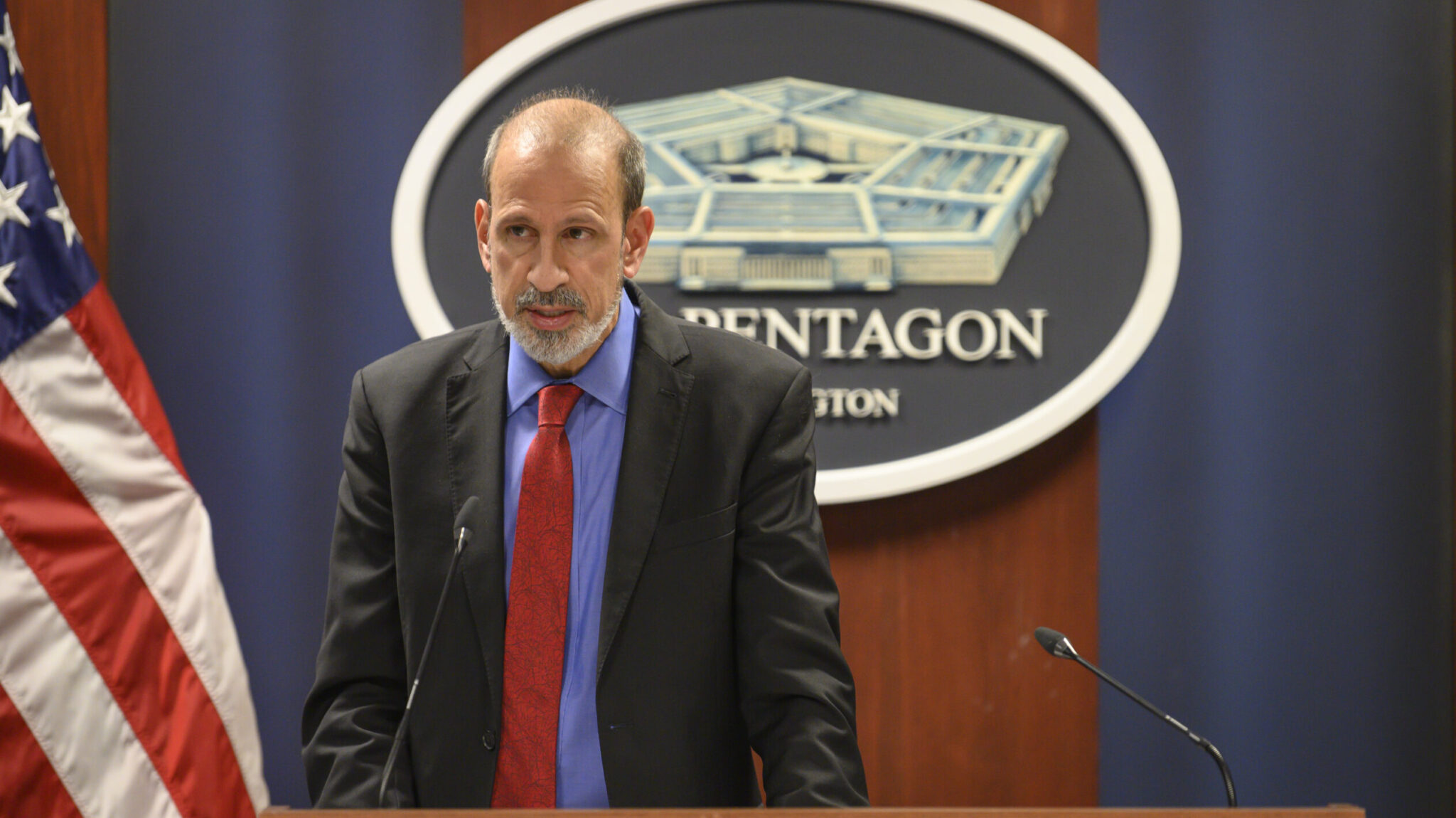
While the Pentagon is not yet ready to request a new supplemental spending bill to address funding needs in Europe and the Middle East, a senior Department of Defense (DoD) official has indicated that, barring abrupt resolutions to the conflicts in Ukraine and Israel, the department will “likely” require another funding package from Congress.
Mike McCord, the DoD Comptroller, stated during an interview at the Pentagon on August 22, “After a long, hard road we got the [previous supplemental] at the end of April, so we’re still on that. Of course, we are not, at this time, working on one for FY25, which hasn’t started yet. But if nothing changes, we will need to.”
McCord noted that officials will begin calculating the numbers for another supplemental package in the future to ensure readiness if requested. While he did not provide a specific dollar figure, he remarked that „it would definitely start with a B,” indicating a substantial amount.
The previous mega $95 billion supplemental bill passed by Congress in April provided crucial aid for Ukraine, Israel, Taiwan, and other defense priorities. McCord emphasized that this funding was vital for the DoD, which had been left “high and dry” due to a prolonged continuing resolution (CR) and congressional deadlock regarding the aid package. Notably, much of the funding allocated for Ukraine has been directed towards replenishing U.S. weapon stocks that were transferred to Kyiv, a trend that would necessitate additional funding if it continues.
“It would take a big change for us not to still be in that line of work and wanting to restock our inventories,” he commented on the ongoing aid for Ukraine. In contrast, he acknowledged that supplemental funding for Israel is less certain as developments such as a potential hostage deal could impact hostilities.
“So [Israel] could go a bunch of different ways, but with Ukraine, it’s easier to predict that, on the current trajectory, another supplemental would be likely,” McCord said.
One reason officials like McCord are not currently developing another funding package is the structure of the package passed in April. Many authorities included in that bill will expire at various dates—such as September or December of this year, or next September—meaning that lawmakers intended to cover spending through the end of this year or the first quarter of FY25. Politically, this timeline leaves the package right up to the brink of an administration transition.
With the upcoming November presidential election, the potential for a funding package hinges on the election results and the composition of the new Congress. While Vice President Kamala Harris has publicly advocated for continued support for Kyiv, the position of a potential Donald Trump administration remains uncertain, as he has suggested cutting assistance.
“It’s a future decision point,” McCord observed, adding that planning might begin so that the DoD is prepared to present a proposal if requested.
“The earliest” submission for a new supplemental would likely occur during the lame-duck session after the November election, McCord noted, cautioning that “if it goes any further than that, it’s going to be TBD, whose decision it is whether to pursue it or not.”
Continuing Resolution Threats
Meanwhile, the looming prospect of another extensive continuing resolution poses challenges for the Pentagon. Key congressional defense committees have largely completed their FY25 mark-up process, but a final agreement remains elusive, as some legislators have called for circumventing spending caps established by the Fiscal Responsibility Act.
Should an agreement not be reached by the end of September, the Pentagon will again operate under a continuing resolution, freezing spending at FY24 levels—provided a stopgap agreement is made to avert a government shutdown. This pattern has become familiar to the DoD, and officials like McCord are preparing accordingly.
“I have been sort of bludgeoned into being desensitized to [CRs] that go all the way to December in situations like this,” McCord remarked, expressing hope that any resolution might last only until shortly after the election. “But I think that would surprise me if it didn’t go straight to December. I’ve heard that there are people out there who want to have it go a good bit longer than that, which would be very discouraging.”
In a roundtable discussion with reporters, Air Force Chief of Staff Gen. David Allvin expressed concern over potentially “losing momentum” due to another CR, particularly amid various modernization efforts underway within the service.
“Now that we know where we need to go and how fast we need to get there, any sort of slowing of the momentum is harmful,” Allvin stated. “The contingency plans are to ensure that we can focus on the things that will provide us irreversible momentum sooner than others.”
According to McCord, the White House’s Office of Management and Budget is preparing to articulate the Biden administration’s stance on another continuing resolution, potentially by the end of this month. Despite having adjusted to last-minute funding negotiations, McCord noted that this uncertainty continues to present challenges.
“Every deadline now we get real close,” he said. “What else would I expect now, except waiting until the last minute to hear what it is? We’re sort of trying to not think about that, but as we approach September, we’ll be ramping up planning for worst-case scenarios.”