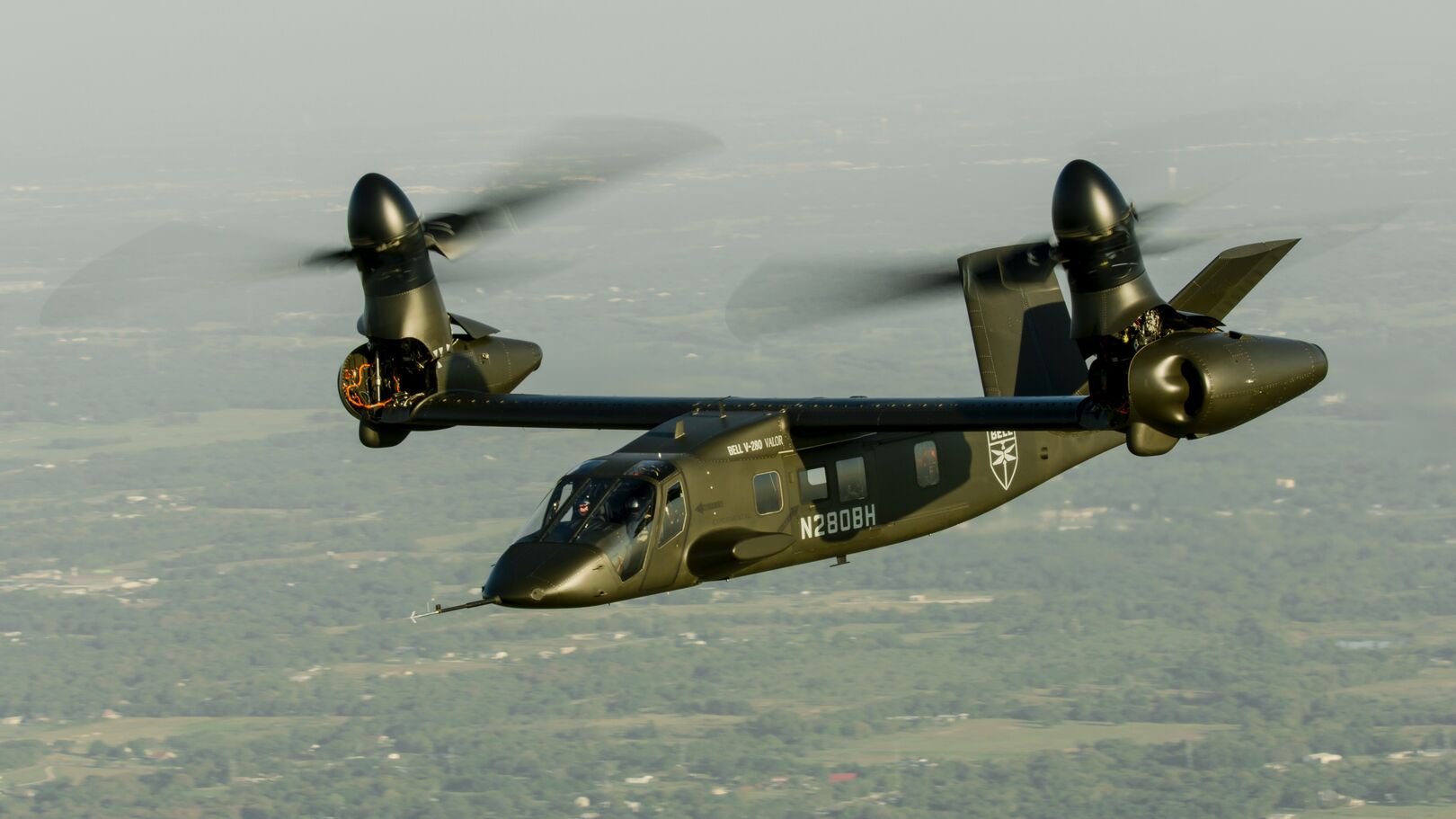
As the US Army and Bell aim to have pilots operating the Future Long Range Assault Aircraft (FLRAA) by 2030, officials are focusing on three key upgrades for the next iteration of the aircraft.
“What we don’t want to do between version one and two is redevelop the aircraft,” said Brig. Gen. Cain Baker, the Army’s director of the Future Vertical Lift Cross Functional Team. “We’re looking at how do you bring [in new] technology capabilities … in the cockpit? How do you put their ability to communicate at longer distances?”
In late 2022, the Army selected Bell’s V-280 Valor tiltrotor to eventually replace thousands of UH-60 Black Hawk helicopters, a contract that could reach up to $70 billion if the program progresses into production. Senior US Army leaders have recently approved plans to initiate the next phase of the program — engineering and manufacturing development. While work continues on the core aircraft, the Army is already considering potential enhancements.
After an event hosted by the Association of the US Army on Wednesday, Baker provided reporters with new insights into the design of the FLRAA „version two.” The Army is relying on its Modular Open Systems Approach (MOSA) to facilitate the integration of new capabilities, which are expected to include advanced sensors for improved pilotage capability, cutting-edge avionics, and expanded launched effects.
“We need that open system architecture to integrate those capabilities swiftly and affordably, ultimately maximizing the benefits for our crews,” stated Brig. Gen. David Phillips, the program executive officer for aviation. “Historically, integrating future capabilities has posed challenges; thus, our open system approach aims to lower barriers for introducing new capabilities into the aircraft.”
Currently, Phillips and the acquisition team are not actively pursuing plans to acquire these new capabilities. Baker indicated that it could take another year to finalize the requirements for FLRAA version two, which will then need to go through Army Futures Command and receive approval from higher leadership.
The focus on upgrading FLRAA comes after the Army’s decision to halt development of a manned Future Attack Reconnaissance Aircraft (FARA) earlier this year. While this decision freed up additional funding for other aviation priorities, it also resulted in a gap in capabilities that officials like Baker, Phillips, and Maj. Gen. Clair Gill — the commanding general of the Army Aviation Center of Excellence — are dedicated to addressing. One potential solution includes the integration of launched effects, which are small drones deployed mid-flight to gather intelligence or strike targets from platforms such as FLRAA.
“What we’re working through now is how to effectively deliver launched effects onto the tactical battlefield to extend our reach even further into that high edge range,” Baker explained.