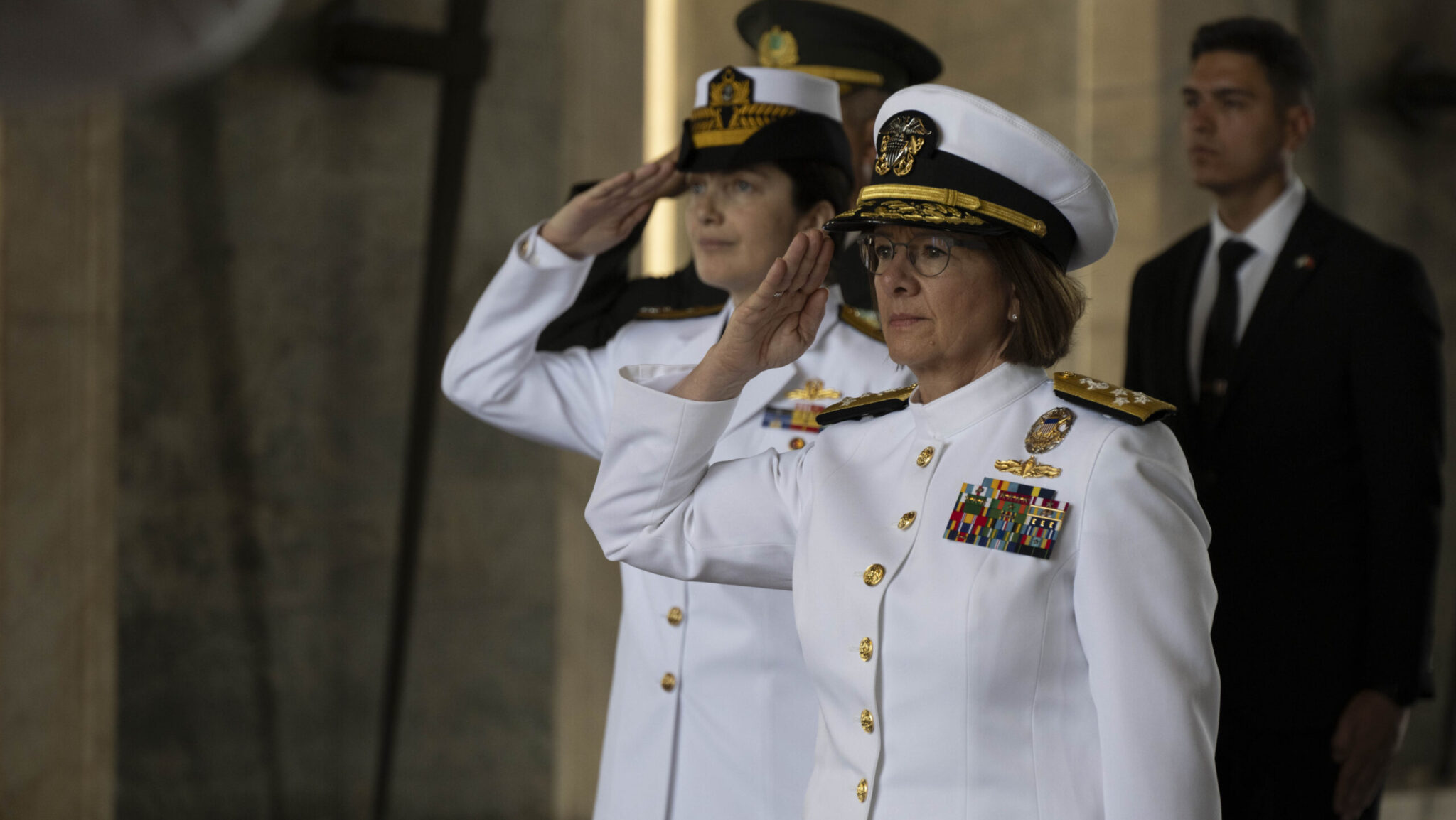
Today, the Navy’s highest-ranking officer unveiled a new Navigation Plan aimed at refocusing the service’s strategic priorities on preparing for potential conflict with China, anticipated within the next few years.
Chief of Naval Operations Adm. Lisa Franchetti emphasized in the document, released today, that “the challenge posed by the [People’s Republic of China] to our Navy now goes well beyond just the size of the PLA Navy fleet. Ships matter greatly, but gone are the days when we assessed threats based purely on the number of battle force ships or tonnage.”
The new strategy highlights that the PRC presents a multifaceted threat that includes not only the size of its naval forces but also operational concepts such as multi-domain precision warfare, grey zone operations, and economic warfare, alongside a growing nuclear arsenal.
The “Navigation Plan,” or NAVPLAN, is a strategic document regularly updated by the Navy’s top admiral. Franchetti’s latest plan places emphasis on the 2027 deadline that Chinese leadership has set for its military to prepare for potential conflict—likely centered on Taiwan—against the United States and its allies. The NAVPLAN identifies essential capabilities such as long-range strike options, non-traditional sea denial, and advanced logistics as crucial components for success.
A pivotal element of this renewed focus is “Project 33,” a reference to Franchetti being the 33rd officer to hold the position of Chief of Naval Operations. Project 33’s core objectives include reducing maintenance delays for vessels and aircraft, expanding the deployment of robotic and autonomous systems, enhancing recruitment and retention efforts, and training in a manner that reflects real-world combat scenarios.
Franchetti’s report also acknowledges the financial constraints facing the Navy, indicating that the service will ultimately confront significant strategic limitations on its capacity to conduct routine operations while investing in modernization without additional budgetary support.
“This 2024 Navigation Plan reflects our current emphasis on readiness and capability in light of immediate budgetary and industrial realities, while still advocating for the necessary resources to expand the Navy’s force structure to maintain peace, respond effectively in crises, and secure decisive victories in warfare,” she stated.
The document also briefly mentions Russia, labeling the “wounded and isolated” nation as a continued threat, alongside ongoing conflicts involving Hamas and the Houthis in the Middle East.
In a broader context, the NAVPLAN sets specific goals for the Navy as a whole, appointing a “single accountable official” to oversee the achievement of each objective with a target completion date of 2027. For instance, the vice chief of naval operations is tasked with achieving and maintaining an 80 percent combat readiness posture for all naval units, while the top requirements officer will work on integrating robotics and autonomous systems for routine operational use.
Franchetti concluded, “We must meet all the objectives in this Navigation Plan to field the personnel and capabilities needed to fight and win today, in 2027, and beyond. As we strive to accelerate our efforts, we will also continue our critical work to enhance the key capabilities outlined in previous Navy guidance.”