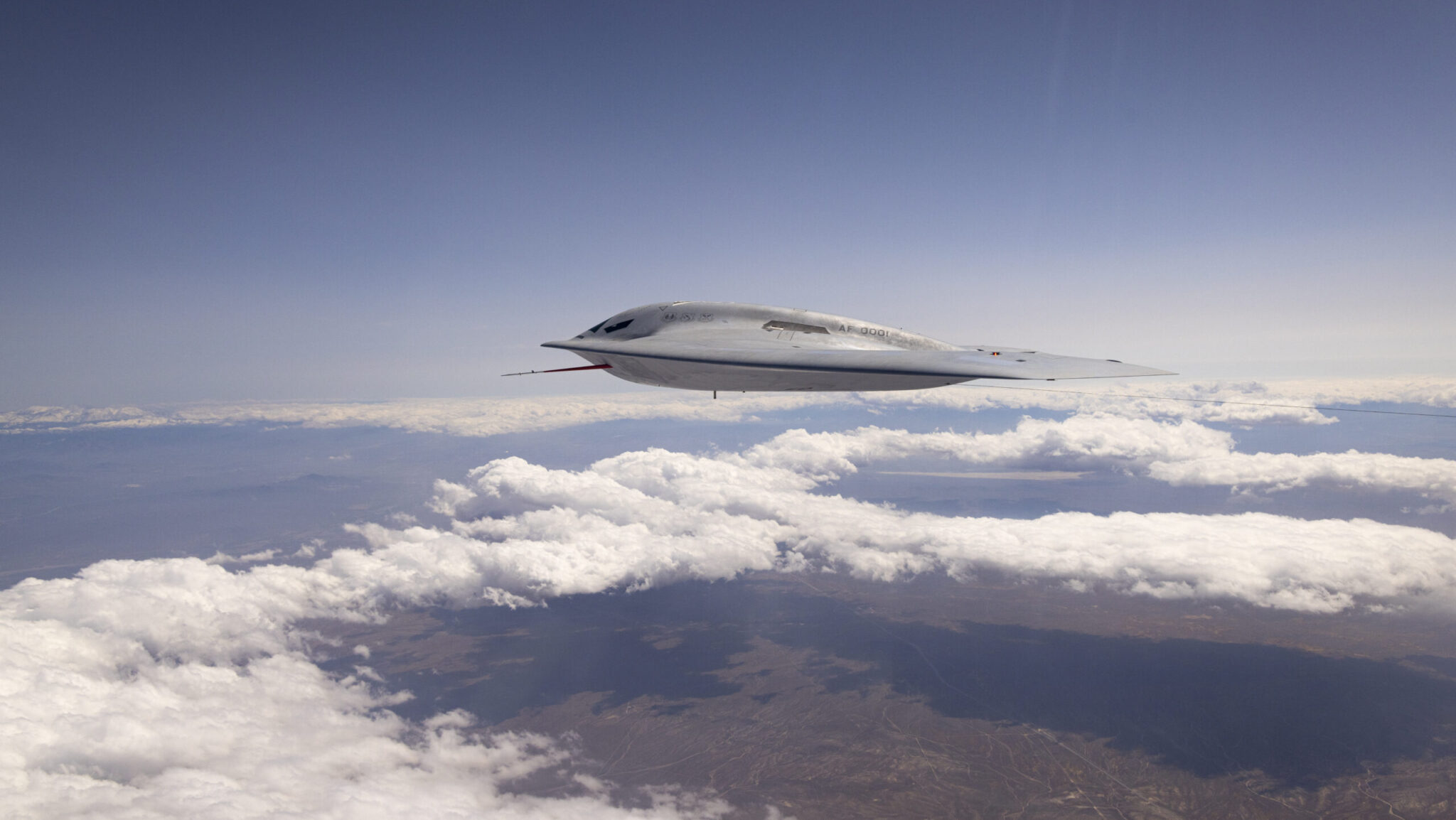
The flight test program for the Air Force’s latest stealth bomber, the Northrop Grumman-made B-21 Raider, is gaining momentum, with program officials reporting test flights occurring as frequently as twice a week.
Tom Jones, president of Northrop’s aeronautics sector, expressed enthusiasm about the bomber’s testing achievements, noting that this progress positions the aircraft to become “a daily flier” as the program advances. “We’re very pleased with how it’s going. We’re actually able to generate two test flights sometimes within a week, which, if you think about how far ahead we are, that’s great,” he stated.
Following its inaugural flight in November, the focus has shifted toward “expanding the operating envelope” of the B-21 and testing various mission systems in-flight, according to William Bailey, director of the Air Force’s Rapid Capabilities Office responsible for overseeing the B-21 program.
In addition to the flight test aircraft, two B-21s are presently undergoing ground-based evaluations. One of these has completed structural testing, providing valuable data to the Air Force and Northrop on the aircraft’s performance and helping to validate digital models of the B-21. Additionally, fatigue testing on another aircraft is ongoing, offering insights into how the bomber will age and perform over time. Bailey noted that while this process is “not as flashy” as flight testing, it is crucial for understanding long-term operational viability, especially if a large fleet is to be built and utilized over an extended period.
The B-21 Raider is set to replace the aging B-2 Spirit and B-1 Lancer bombers. The Air Force is planning to establish a minimum fleet of 100 B-21s, with Ellsworth Air Force Base in South Dakota designated as the first operational base for the aircraft. Recently, the Air Force also approved Whiteman Air Force Base in Missouri and Dyess Air Force Base in Texas as additional sites for basing the Raider.
During a panel discussion, Gen. Thomas Bussiere, commander of Air Force Global Strike Command, acknowledged the importance of considering both temporary and permanent forward basing options for the B-21 as a means of deterrence against various global threats. „Potential consideration for forward-facing, either temporary or permanent, of this weapon system to be able to deter the various actors around the globe might be of interest to senior policymakers,” he remarked.
In a significant milestone for the program, the Pentagon’s top acquisition official granted approval for the B-21 to enter low-rate production in January, marking a key step toward operational readiness