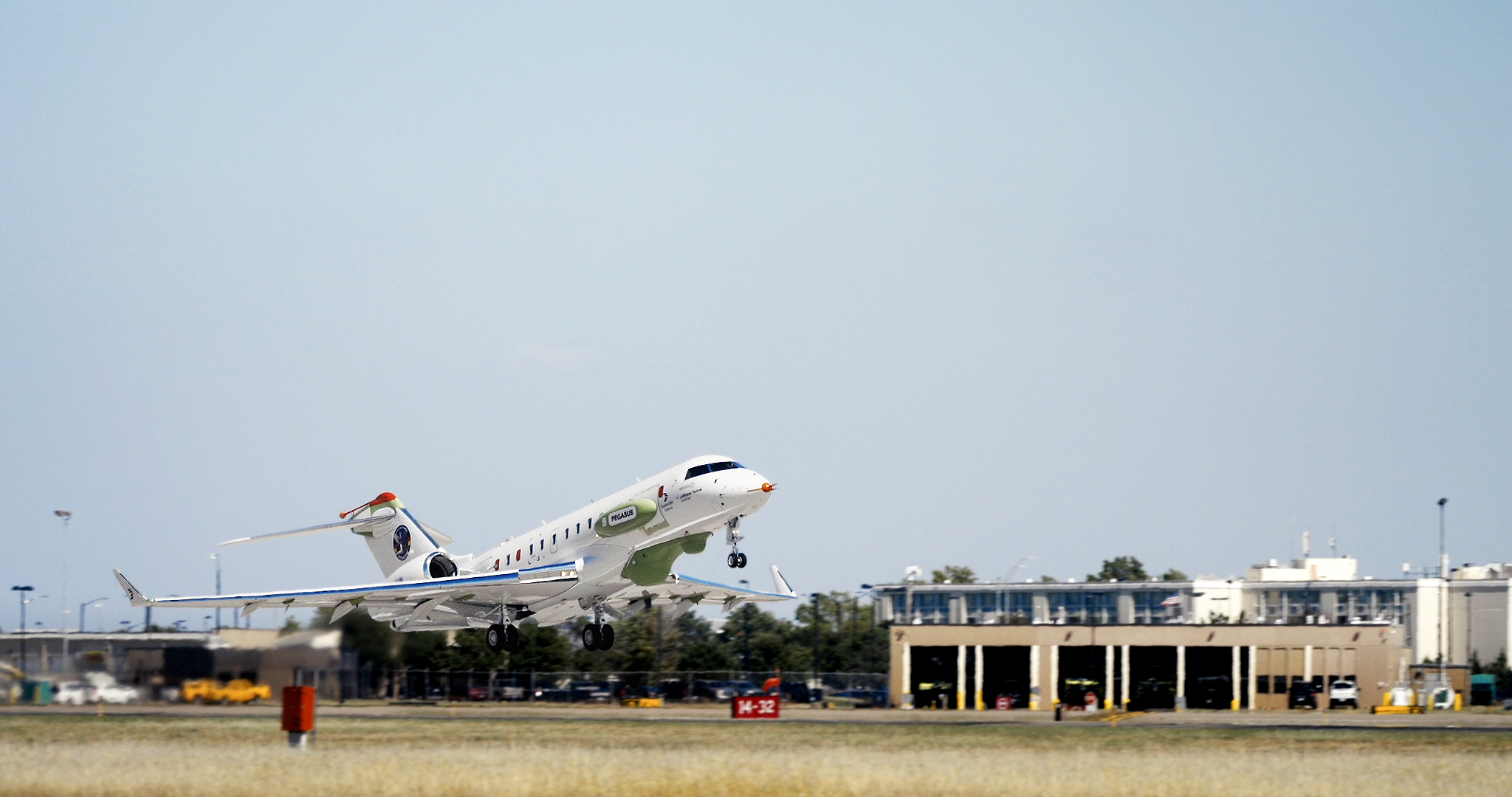
In a significant development for the $1 billion Persistent German Airborne Surveillance System (PEGASUS) program, Bombardier and its partners, Lufthansa Technik Defense and Hensoldt, announced that the first of three modified Bombardier Global 6000 business jets successfully completed its maiden flight at the manufacturer’s Flight Test Centre in Wichita, Kansas, in late September.
While the aircraft is currently without the signals intelligence (SIGINT) mission system that is essential for its airborne surveillance function, Hensoldt’s Kalaetron Integral package has been selected for future integration. The SIGINT system will be installed by Lufthansa at its special-mission center in Hamburg, Germany, next year, following the initial aircraft modification phase.
Steve Patrick, vice president of Bombardier Defense, reported that since the maiden flight, the aircraft has been flying regularly and performing well. The test pilots confirmed that it handles as expected. He mentioned that all three PEGASUS aircraft will be sent to Hamburg in the coming months to undergo mission systems integration and military certification.
According to Jürgen Halder, vice president of airborne SIGINT at Hensoldt, outfitting the airframes with the Kalaetron system is expected to take “one to two years.” Following this installation, additional flight tests involving the complete systems will be conducted before delivering the aircraft to the German Air Force.
In a statement, Bombardier highlighted that Lufthansa Technik has completed design work for integrating the mission system, avionics, and aircraft cabin modifications. The production of interior parts has already commenced to ensure readiness for installation upon the aircraft’s arrival in Hamburg.
Berlin awarded Hensoldt a contract in 2021 for the development, production, and SIGINT integration of the three Global 6000 airframes, and the electronics supplier anticipates a follow-on order from the German Air Force given the increasing geopolitical instability.
Jürgen Halder noted that the global situation presents numerous hotspots that require ongoing monitoring, suggesting that three aircraft may not be sufficient for effective surveillance. Initial discussions regarding additional orders are already underway.
Germany’s decision to pursue PEGASUS addresses a significant gap in airborne SIGINT capabilities that emerged following the 2010 retirement of a fleet of five Breguet BR1150 Atlantic aircraft. The original plan to acquire Northrop Grumman’s MQ-4C Triton unmanned systems was abandoned due to concerns about rising costs and adherence to European flight safety standards, leading to the selection of the crewed Global 6000 aircraft.