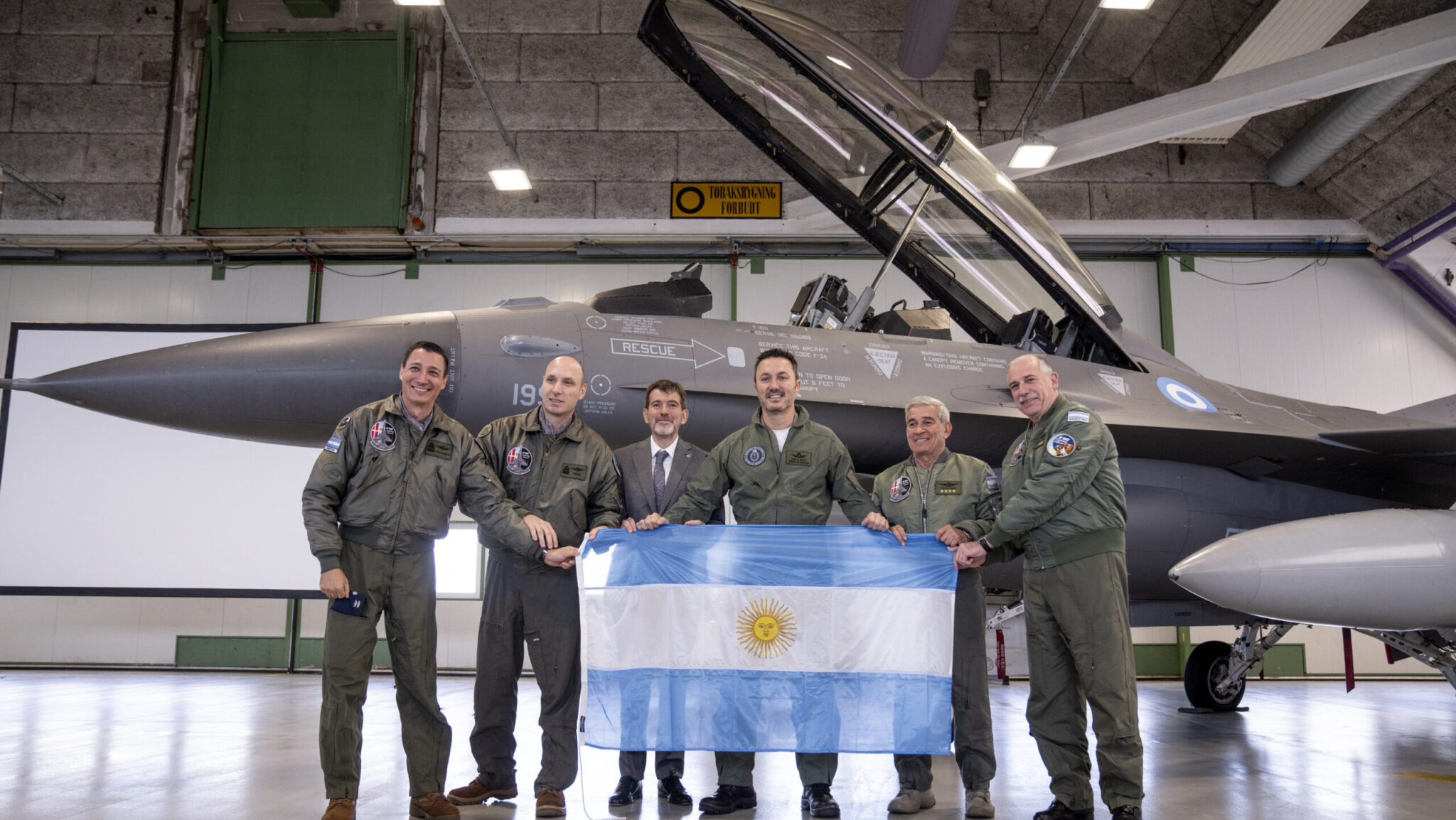
In late December, the first F-16 Block 10 aircraft arrived in Argentina, marking a significant event hailed by Minister of Defense Luis Petri as the “most important” acquisition since the nation’s return to democracy in 1982. The South American country has operated without a primary combat aircraft for nearly a decade. However, after extensive negotiations and setbacks, Buenos Aires has now received the first of 25 F-16s (including one training aircraft) that were previously operated by the Danish Air Force. The contract totals approximately $300 million, bolstered by around $40 million in Foreign Military Financing from the U.S.
Just weeks prior, Saab-made Gripens from the Brazilian Air Force (FAB) made their international exercise debut at Brazil-led CRUZEX 2024, two years after these Swedish fighters officially joined the Brazilian military. Argentina and Brazil are not alone in their quest for enhanced combat aircraft, as countries like Peru and Uruguay are also considering new deals.
However, this is not an aerial arms race in South America, which has not experienced inter-state conflict since 1995. Experts suggest it is more a race against obsolescence and is constrained by tight defense budgets for nations outside of Brazil. “Regional air forces need to modernize their inventories and also train their personnel to operate newer technologies, but only within the economic possibilities of each country,” explained retired Argentinian Brig. Gen. Jorge Antelo.
While the threat of war is low, the aircraft still serve as deterrents and are valuable for counter-drug operations. Combat aircraft symbolize a state’s hard power and underscore a government’s commitment to defending its sovereignty, according to PhD researcher Andre Carvalho at the Brazilian Army Command and General Staff College.
The first F-16 acquired by Argentina, the trainer aircraft, has been well received by the country’s air force, noted analyst Andrei Serbin Pont from the Argentine research center CRIES. He remarked that the arrival of the aircraft provides an insight into the status of the broader fleet.
Additionally, in December, Argentina signed a Letter of Agreement with the U.S. for advanced American equipment to be fitted onto the new fighter jets. Antelo, who recently served as Argentina’s secretary of national strategy, commented that these agreements represent a technological milestone for the military.
Despite this advancement, Serbin Pont cautioned that the F-16s alone would not resolve all of Argentina’s air force challenges. The air force still operates Douglas A-4 Skyhawk aircraft, which are reportedly not flying and have “no role” in current operations. The nation also utilizes domestically produced IA-63 Pampa light attack aircraft, with the manufacturer FADEA currently developing a new version called Pucará Fénix, although this is still in the prototype stage.
Similarly, Brazil is expanding its fleet of Gripens but still faces the challenge of upgrading older aircraft. „The fleet of Gripens is not enough to replace the aging F-5s and A-1s,” Serbin Pont said, referring to the light attack American F-5EM and the Brazilian-Italian AMX A-1.
Brazil is reportedly upgrading its indigenous A-29 Super Tucano light attack aircraft to operate alongside the Gripens, but Colonel Carlos Eduardo Valle Rosa, a reserve officer in the Brazilian air force, stated that studies are currently underway to find the best replacement for the F-5 and A-1.
Beyond Argentina and Brazil, smaller South American nations are also eyeing potentially expensive upgrades, depending on their financial capacity. Peru operates Dassault Mirage 2000 warplanes, originally acquired in the 1980s, and Russian-made Sukhoi Su-25s, which were controversially purchased secondhand via Belarus in the 1990s. Recently, General Carlos Enrique Chávez Cateriano, head of the Peruvian Air Force, expressed the desire to procure a fleet of 24 multi-role aircraft to protect the nation’s sovereignty for the next 30-40 years.
Meanwhile, Colombia has also indicated interest in modernizing its aging fleet of Israeli Kfir aircraft, though geopolitical tensions have complicated those plans due to Bogotá severing ties with Israel over its actions in Gaza.
Additionally, Paraguay and Uruguay signed deals for new combat aircraft in 2024, albeit with significantly smaller budgets. Each country has agreed to purchase six Super Tucano aircraft from Brazil’s Embraer. Currently, Uruguay’s only combat platform is a small fleet of aging A-37B Dragonfly aircraft. Valle Rosa noted that the decision to procure the Super Tucano was aimed at maintaining operational capabilities, particularly for aerial patrol missions.
As countries like Paraguay move to acquire their first combat aircraft, these acquisitions are significant milestones. The cost is projected to be comparable to Uruguay’s, around $96 million, according to Paraguay’s Minister of Defense Óscar González.
Valle Rosa pointed out that despite interest in new aircraft from various nations, the lack of defense cooperation, similar to Europe’s joint production endeavors like the Eurofighter Typhoon.