Reassessing Launch Economies
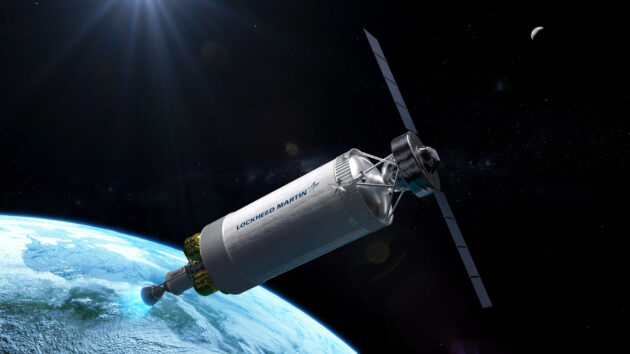
The Defense Advanced Research Projects Agency (DARPA) has decided to terminate its Demonstration Rocket for Agile Cislunar Operations (DRACO) project, aimed at developing a nuclear thermal engine for spacecraft. This decision was driven by a shift in the cost-benefit landscape, largely due to reduced launch expenses influenced by SpaceX, as explained by DARPA Deputy Director Rob McHenry.
“When DRACO was initially conceived, launch costs were significantly higher, but advancements by SpaceX, particularly with the prospective capabilities of Starship, have dramatically altered that equation,” McHenry informed the Mitchell Institute.
Weighing Nuclear Propulsion
DRACO’s initial concept, known as „Reactor on a Rocket” or ROAR, emerged in 2020 with a mission to demonstrate a nuclear thermal propulsion system using High-Assay Low-Enriched Uranium (HALEU). The potential of nuclear thermal propulsion engines (NTRs), which offer substantial thrust and efficiency advantages over chemical propulsion, was considered optimal for both national security applications and solar system exploration.
However, as launch costs declined, the relative efficiency and benefits of nuclear thermal propulsion did not justify its substantial R&D investments. “The return on investment from nuclear thermal propulsion appeared less advantageous as these assumptions weakened,” McHenry stated.
Potential Alternatives and Future Directions
The discontinuation of DRACO does not suggest the end of nuclear possibilities for space propulsion. McHenry acknowledged the growing interest in nuclear electric propulsion, which could leverage small reactors for generating electricity aboard spacecraft. This technology could potentially replace large solar panels and support electric propulsion systems, enhancing energy efficiency and operational capability in space.
NASA and other agencies suggest that nuclear electric propulsion might present a more sustainable, long-term solution. The Air Force Research Laboratory has already initiated the Joint Emergent Technology Supplying On-orbit Nuclear Power program to explore these technologies, awarding contracts for reactor and spacecraft designs.
“While the current focus is on nuclear electric options, DARPA remains open to exploring future projects in this area,” McHenry affirmed. This direction could significantly enhance national security operations and provide power solutions that are critical for future space missions.