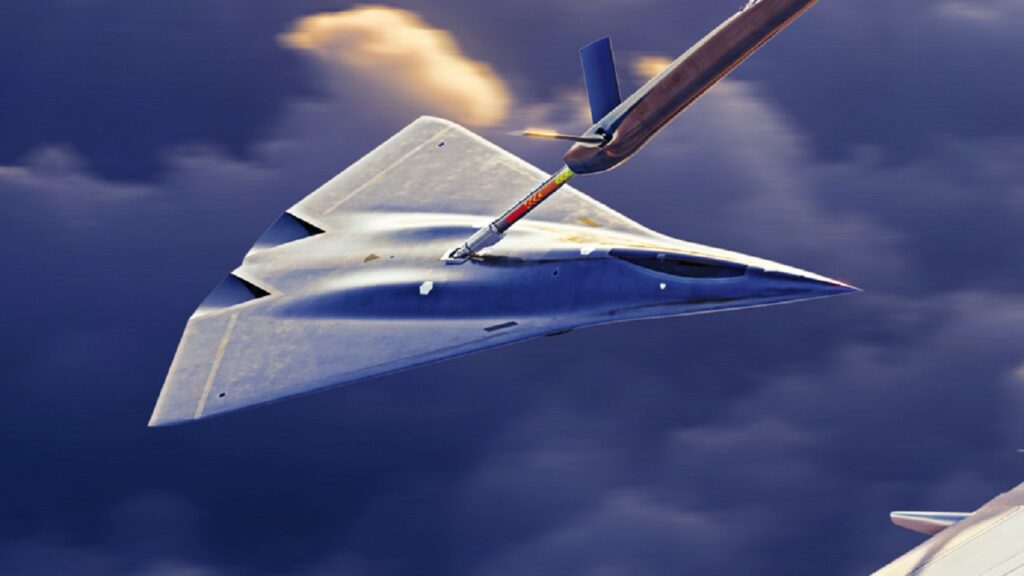
In a landmark move signaling a significant leap forward in aerospace technology, key industry players and the UK Ministry of Defence (MoD) have jointly presented the design for Britain’s future fighter demonstrator. The unveiling aligns with the ambitious target of achieving a first flight by 2027.
Flagship for Innovation: De-risking Technologies for GCAP
Described by the Royal Air Force (RAF) as the „flagship” aircraft, this demonstrator will play a pivotal role in mitigating risks associated with the advanced technologies slated for integration into the trilateral Global Combat Air Programme (GCAP). GCAP represents a collaborative effort between the UK, Italy, and Japan to develop the next-generation combat air platform.
Design Unveiled: A Blend of Stealth and Supersonic Capabilities
An artist’s rendering of the demonstrator showcases a sleek design featuring a single cockpit, twin-engine configuration, canted twin tail, and delta wing blueprint. This design suggests a focus on both stealth capabilities and supersonic performance.
Advanced Manufacturing: Pioneering Technologies at Work
According to the statement, the „main structure, wings, and tail fins” of this manned, supersonic, low-observable aircraft „are all taking shape using pioneering robotic and digital manufacturing and assembly technologies at BAE Systems’ sites in Lancashire [England], signifying the advanced stages of its development.”
Testing Ground: Validating Technologies for GCAP
The Combat Air Flying Demonstrator is „designed to test a wide range of new technologies, including the integration of stealth compatible features.” This crucial testing phase will contribute significantly to the development of manufacturing processes and de-risk the next generation combat aircraft that will be delivered under GCAP. The GCAP program aims to replace the British and Italian Eurofighter Typhoons and Japanese F-2s, with the successor aircraft expected to enter service around 2035.
Virtual Flight: Accumulating Flight Hours in the Simulator
Test pilots from BAE Systems, Rolls-Royce, and the RAF have already logged over 300 simulated flight hours in the demonstrator. This extensive simulator-based work aims to dramatically reduce the time and costs associated with producing military jets, while preserving the sovereign design, engineering, and manufacturing capabilities necessary for the UK to remain at the forefront of global aerospace innovation.
„Steaming Ahead”: GCAP Partners Progressing Rapidly
Herman Claesen, managing director of Future Combat Air Systems at BAE Systems, indicated last year that GCAP industry partners are making rapid progress with design activities for the next-generation fighter. The next engineering milestone is a systems requirements review, which will directly support plans to launch the project’s development phase later this year.