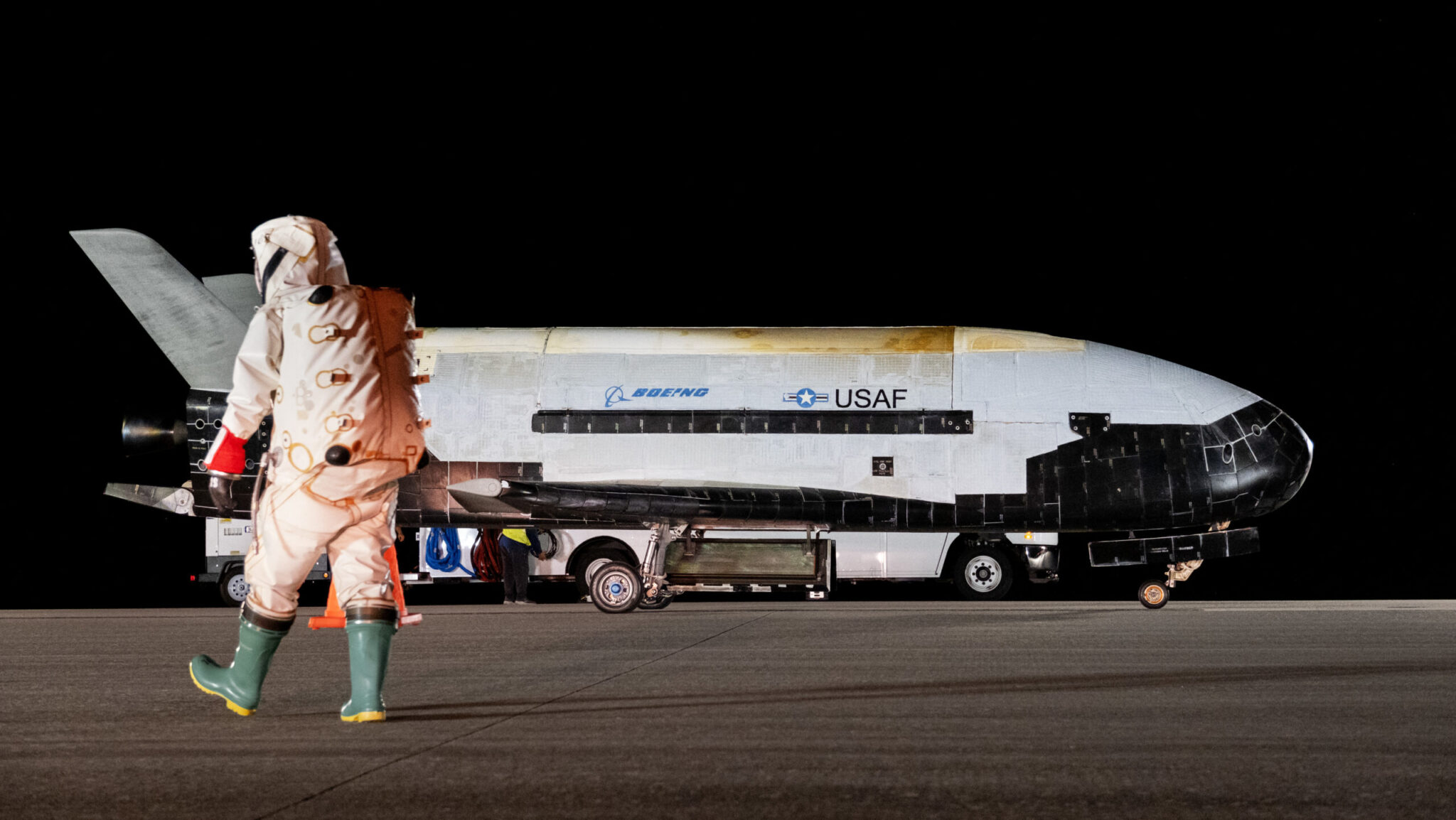
The Defense Department’s enigmatic X-37B Orbital Test Vehicle is slated for another launch in late August, carrying a quantum sensor that could revolutionize navigation in GPS-denied environments, along with a cutting-edge laser communication system, the Space Force announced today.
Eighth Mission: Unveiling the Mysteries of the X-37B
The Aug. 21 mission marks the eighth for the mysterious space plane, a collaborative effort between the Space Force and the Air Force Rapid Capabilities Office. The X-37B returned to Earth from its previous 434-day mission on March 7, during which it executed a pioneering series of aerobraking maneuvers to alter its orbit and safely dispose of service module components.
Quantum Sensors: A GPS Alternative?
Quantum sensors hold the potential to serve as the foundation for next-generation positioning, timing, and navigation (PNT) systems, offering a robust alternative to today’s Global Positioning System satellites. Military leaders, particularly in the Army, are increasingly concerned about the growing vulnerability of GPS to jamming and spoofing, as well as signal loss in challenging terrains.
Atomic Precision: How Quantum Sensors Work
Quantum sensors for PNT utilize atomic accelerometers or gyroscopes, measuring acceleration and rotation by shining lasers into small clouds of atoms contained in vacuum chambers. While the technology exists, the challenge lies in miniaturizing and ruggedizing the sensors for use on satellites, ships, aircraft, vehicles, and even soldiers’ backpacks.
Enhanced Resilience: Navigating Without GPS
The X-37B quantum inertial sensor experiment „is a welcome step forward for operational resilience in space,” according to Col. Ramsey Horn, Space Delta 9 commander. Quantum inertial sensing enables robust navigation capabilities in GPS-denied environments or beyond Earth-based orbits.
Defense Innovation Unit (DIU) Collaboration: Accelerating Innovation
The experimental quantum sensor to be tested on the X-37B was developed for the Pentagon’s Defense Innovation Unit (DIU) under a contract to Vector Atomic, a California startup specializing in atomic instruments.
Laser Communications: A Leap in Data Transmission
For its second new mission, the Space Force is also focused on leveraging optical data links for satellite-to-satellite and satellite-to-ground communications. Laser communications allow for significantly more data to be transmitted than traditional radio frequency-based systems.
Security and Efficiency: The Advantages of Laser Comms
Laser communications offer enhanced security due to the targeted nature of laser beams and enable faster and more efficient data transport.
Proliferated Space Networks: Building a Resilient Architecture
The Space Development Agency is incorporating laser communications into its LEO-based data transport and missile tracking constellations. The DIU is also collaborating with the Air Force Research Laboratory to develop a „hybrid space architecture” of commercial and military satellites for a „hack-proof” internet in space, relying on optical communications.
Strengthening Satellite Communications: A Diversified Approach
Chief of Space Operations Gen. Chance Saltzman emphasized that the X-37B’s laser demonstration „will mark an important step in the U.S. Space Force’s ability to leverage proliferated space networks as part of a diversified and redundant space architectures,” strengthening the resilience, reliability, adaptability, and data transport speeds of our satellite communications architecture.