The U.S. Air Force is facing a critical juncture as China rapidly modernizes its air force, while the USAF is becoming the oldest, smallest, and least ready in its history. To reestablish credible deterrence and reverse this downward spiral, the United States must rebuild its Air Force with a focus on acquiring at least 72 F-35A aircraft per year.
The Growing Gap with China
China’s air force is rapidly replacing its fleet with high-performance, technologically advanced aircraft. In contrast, the average U.S. Air Force fighter is nearly three times older than China’s front-line aircraft, impacting maintenance, availability, and readiness.
China’s Acquisition Rate
The CCP is believed to be acquiring over 240 new fighters annually, while the US Air Force plans to acquire just 45 in the fiscal year 2026. China is expanding its fighter fleet at a rate that rivals our own reductions.
Chinese Fighter Fleet
China’s combat-coded fighter fleet already rivals the combined inventory of the US Air Force’s active duty, Guard, and Reserve fighter jets. Of the 240 fighters China plans to add, as many as 120 are fifth-generation J-20 stealth aircraft, enhancing China’s air superiority and deep-strike capabilities.
Shortcomings in U.S. Acquisitions
The proposed budget includes only 24 F-35As for 2026, along with 21 fourth-generation F-15EXs, resulting in a net loss of 213 fighters after decommissioning 258 fighter jets. This path leads to combat irrelevance and gives China a significant edge in capacity.
Historical Context
While the U.S. has faced numbers disadvantages before, it offset those with superior systems and readiness. Today, the U.S. lags in both capability and readiness.
Ill-Prepared for Peer Fight
During the Cold War, eight of 10 fighters were mission capable. Today, that figure is closer to six in 10, reducing training sorties and pilot readiness.
Squadron and Sortie Disparity
In 1987, the active-duty Air Force had 81 fully mission-ready fighter squadrons, with pilots averaging more than three sorties a week. Today, the combined active-duty, Air National Guard, and Air Force Reserve can muster just 53 squadrons. In a crisis, the U.S. could deploy just 520 fighters across the Indo-Pacific, facing a Chinese force of over 1,100 combat-coded aircraft.
Pilot Training and Readiness
Chinese fighter pilots average more than 200 flying hours a year, compared to the U.S. pilots’ 120. By the Air Force’s own standards, they are not ready to fight, much less dominate, a high-end confrontation.
The F-35A’s Value
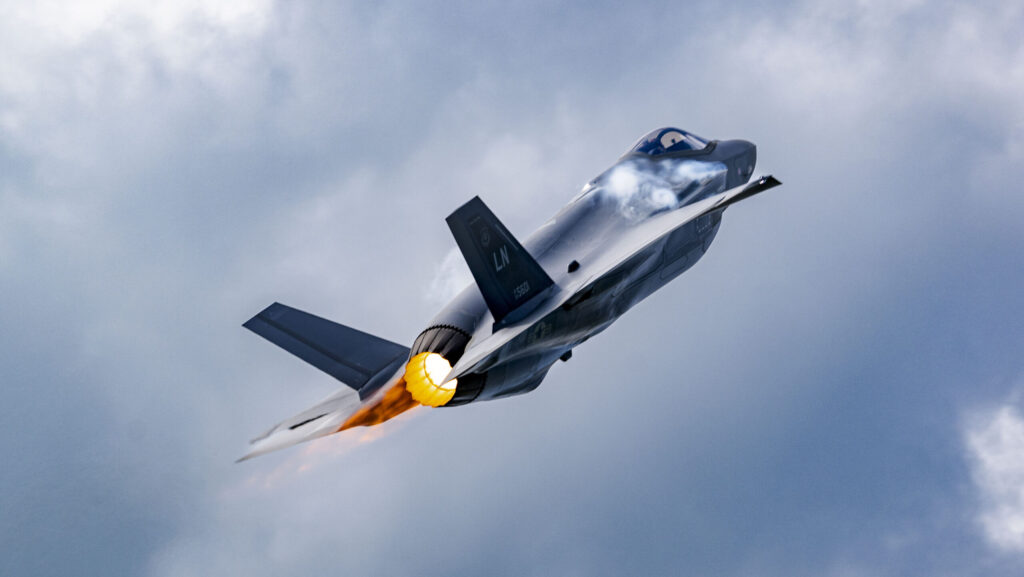
The F-35A delivers unmatched capability and value. Despite critics focusing on its unit cost, the metric of merit is cost-per-effect. A single F-35 can deliver effects that would require an entire package of fourth-generation fighters to replicate, at greater risk.
Multi-Year Procurement
Committing to 72 F-35As per year under a multiyear framework would stabilize defense production, reduce costs, and enhance industrial efficiency.
Enhanced Industrial Efficiency
Increased F-35A production would also reduce cost and availability issues surrounding spare parts, which have constrained mission capable rates. Higher volumes would likely reduce unit prices for subcomponents like engines and sensors.
Scaling the Industrial Base
Every major U.S. defense manufacturer is optimized for peacetime output. Increasing capacity now is essential, as it takes three years from funding for a jet to reach the flightline.
Deterrence Demands Action
Procuring 72 F-35As annually would strengthen the production and supply base, retain skilled labor, and ensure industrial capacity can scale to need if deterrence fails.
Congress and Air Force Must Prioritize
Congress and the Air Force must prioritize this investment by committing to a multi-year procurement contract in both the NDAA and the President’s budget for FY27 to deter China and ensure victory if deterrence fails. There is no time to waste.