Northrop Grumman has successfully completed the first test of its Deep Space Advanced Radar Capability (DARC), demonstrating the multi-antenna radar’s ability to track multiple satellites simultaneously, according to a senior company official.
„An Important Milestone”: DARC System Proves Its Capabilities
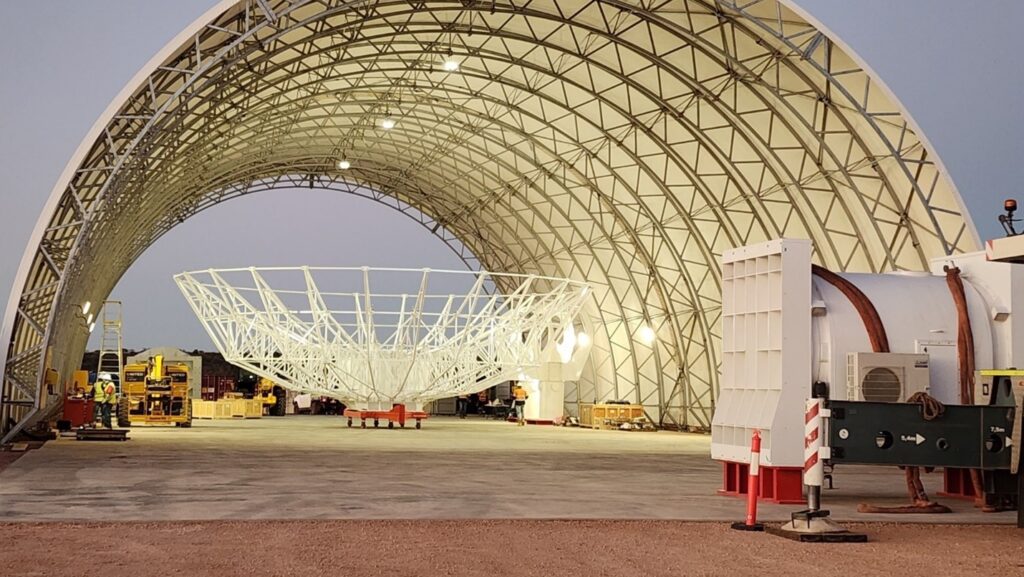
„We’re very pleased to be able to make this an announcement of the success of this first-time demonstration at the DARC site in Western Australia,” said Kevin Giammo, director of Northrop’s space surveillance and environmental intelligence organization. The test involved seven of the planned 27 parabolic dish antennas, validating the concept of „multiple antennas work[ing] together kind of like a single, larger antenna.” „[W]e’ve tracked multiple satellites doing that. And this is really an important milestone,” Giammo added.
Tracking Space Junk and Threats: DARC’s Mission
Northrop Grumman secured a $341 million Space Force contract in February 2022 to construct the first DARC array. Its mission is to track satellites, including potentially hostile spacecraft, and space debris in geosynchronous Earth orbit (GEO), approximately 22,236 miles from Earth. DARC’s key advantages include its ability to detect and track objects even in daylight, unlike traditional radar, and improved tracking over a wider field of view. „We’re going to provide unmatched, high-precision radar tracking for the deep space space domain awareness mission,” Giammo said. „And really what this gives us is higher accuracy, higher sensitivity, more capacity to track objects in space, and a lot of agility as we do this tracking.”
A „Lookout for the Lookouts”: DARC’s Potential Role in Missile Defense
Northrop Grumman envisions DARC as a valuable asset in a potential air and missile defense shield over America. „DARC is one of those systems that that really matches well with Golden Dome,” Giammo said. „DARC can be like a lookout for the lookouts … those important systems, like missile warning assets in geosynchronous orbit.”
International Collaboration: Expanding DARC’s Global Reach
The Space Force initially planned three DARC sites worldwide: one in the Indo-Pacific, one in Europe, and one in the continental United States. The United States, Australia, and the United Kingdom have committed to collaborating on DARC for the next 22 years. In August 2024, Northrop Grumman was awarded a contract worth approximately $200 million to develop a second DARC array in Pembroke, Wales.
Commercial Alternatives in Sight: Space Force Considers Other Options
However, DARC’s future is not entirely secure. In March, Space Systems Command Commander Gen. Stephen Purdy indicated that DARC is under review as a potential candidate for commercial alternatives. „We’re proceeding with DARC, although I’m going to look at: ‘Hey, are there commercial solutions at DARC? Any one of them?’ We’re looking to ask the question. We may or may not find anything,” Purdy said.
Troubled Timeline: Delays Plague DARC’s Development
DARC has faced delays since its inception, according to Government Accountability Office (GAO) reports. The initial operating capability (IOC) for the Australian site has been repeatedly postponed, now projected for January 2027. Delays at Site 1 have impacted the construction timelines for Sites 2 and 3. „Program officials acknowledged that Site 1 delays have caused cascading delays to the construction of Sites 2 and 3,” the GAO noted. The Space Systems Command did not respond to inquiries regarding the current schedule and the status of the commercial alternatives review.