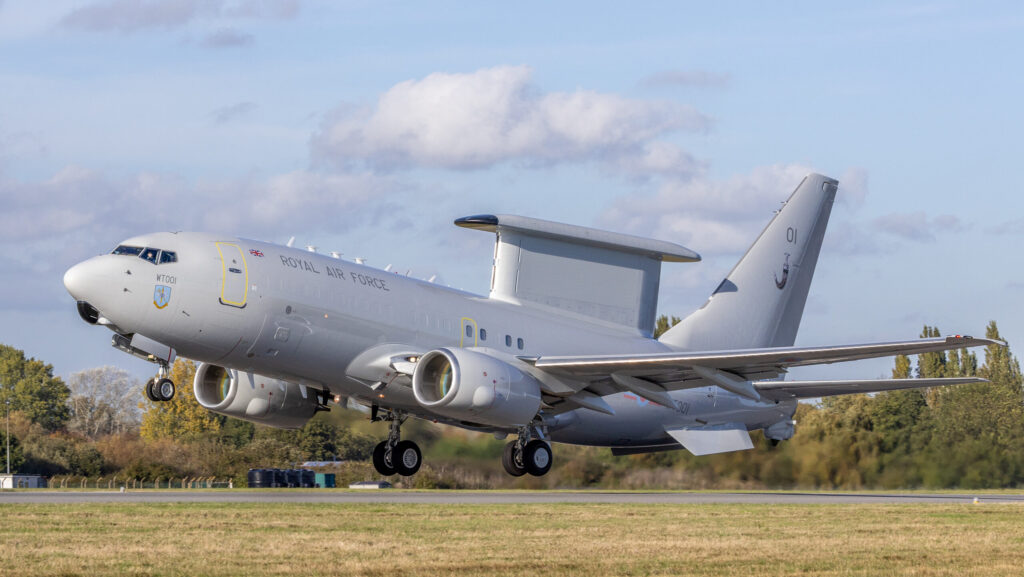
Equating Airborne Moving Target Indicator (AMTI) data with the orchestration of air battle management is a dangerous misconception threatening US air superiority, especially against adversaries like China. While AMTI informs, only human-led air battle management, supported by platforms like the Boeing E-7 AEW&C, can direct fighters, deconflict lethal effects, and secure the skies.
The E-7: A Critical Platform for Air Battle Management
Canceling the E-7 program in favor of an unproven space-based AMTI capability is a strategic misstep. AMTI, whether from AWACS or satellites, provides situational awareness, but air battle management requires skilled personnel to interpret that data and direct assets in real-time.
History’s Lessons: Data Alone Doesn’t Win Wars
In Operation Desert Storm, E-3 AWACS provided AMTI data, but air battle managers orchestrated 85 percent of the sorties, enabling 38 of 41 air-to-air kills. Similarly, during the Battle of Britain, radar data was useless without controllers directing Spitfires. Even advanced F-35s or F-22s can’t handle theater-wide air battle management while fighting.
Why the E-7 Matters: Superior Capabilities and Coalition Integration
The E-7, with its advanced multirole electronically scanned array (MESA) radar, offers superior detection, jamming resistance, and coalition integration. Canceling its acquisition in the fiscal 2026 budget, citing cost increases and survivability concerns, is a flawed approach.
Challenging the Critics: Cost Comparisons and Capability Gaps
Critics argue that Navy E-2D Hawkeyes can substitute for the E-7 until space-based AMTI is deployed. However, the cost comparison mixes current and future dollars, inflating E-7 expenses. The E-2D, with its smaller crew and limited radar range, is less capable and more vulnerable than the E-7. And crucially, space-based AMTI only addresses a portion of the air battle management mission.
Space Is No Panacea: Vulnerabilities and Limitations
Space is vulnerable to anti-satellite weapons, lasers, and cyberattacks. A single nuclear detonation in low-Earth orbit could cripple entire constellations. Relying solely on space-based AMTI risks leaving US forces without real-time direction in dynamic conflicts. Even Space Force leaders advocate for a layered approach combining space, air, and ground assets. Battlefield Control Centers and emerging C2BM systems do not have organic sensors, relying solely on ingesting feeds from outside sources that could be disrupted.
The Air Force’s Unique Role: Dynamic Mobility and Theater Air Superiority
The Air Force specializes in air battle management to achieve air superiority, requiring dynamic mobility in a near-peer conflict. Ground-based equivalents are limited in supporting forward operations. Without an E-7, no USAF C2BM entity could sustain theater air superiority pursuits.
The Solution: Restore E-7 Funding and Embrace a Layered Approach
Congress must restore E-7 funding, and the DoD must prioritize its rapid fielding while developing space-based AMTI as a complement, not a replacement. A layered sensing architecture that integrates satellites for persistent coverage, E-7s for flexible management, and ground nodes for backup will ensure resilience. The E-7 bridges a critical gap against rising threats, with possible space-based capabilities not maturing until the 2030s.
AMTI Is Not Air Battle Management: The Human Element Matters
AMTI is the raw data that skilled air battle managers shape into victory. The US cannot afford to gamble on unproven space solutions. Congress and the DoD must act now to reinstate the E-7 program and commit to layered sensing to secure air superiority.