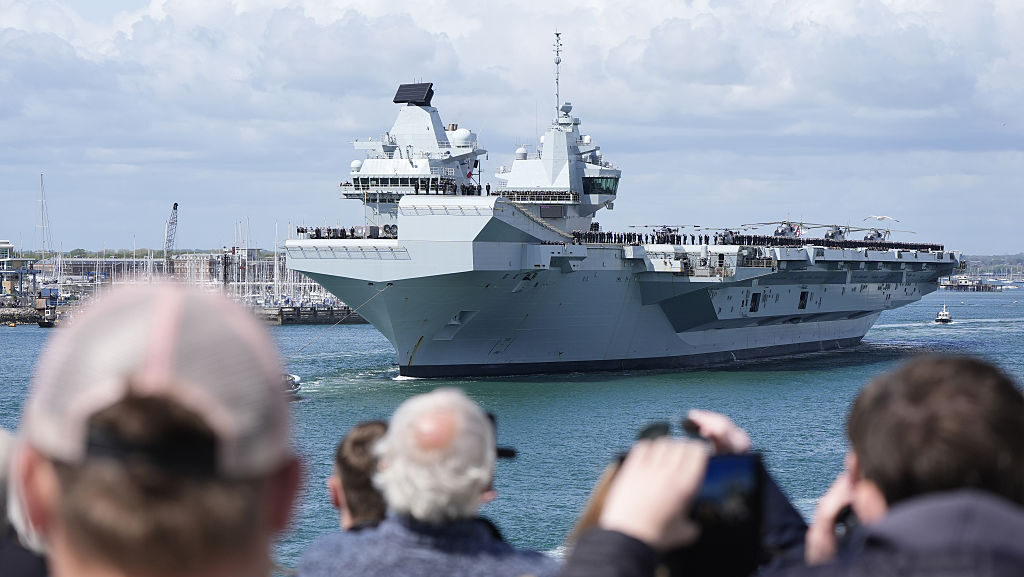
Japan is set to rejoin the ranks of nations with aircraft carriers for the first time since World War II, retrofitting two helicopter-destroyers to accommodate F-35 stealth fighters. This move adds to the growing presence of aircraft carriers in the Indo-Pacific, both large and small, from various nations.
A Powerful Gathering: Carriers Converge in the North Philippine Sea
A recent photo showcased the HMS Prince of Wales, USS George Washington, JS Kaga, and USS America sailing together in the North Philippine Sea, highlighting the diverse mix of carrier capabilities in the region.
Debate Amidst Deployment: Are Carriers Obsolete or Still Essential?
Amidst ongoing debates about the utility and vulnerability of aircraft carriers, analysts suggest that their increasing deployments and acquisitions indicate they remain relevant, at least for now, in the Indo-Pacific.
Rising Global Interest: Factors Driving the Carrier Push
Bryan Clark of the Hudson Institute notes that „militaries see the value they provided the US in the Middle East” and „governments see how China is growing its carrier fleet and the threat it may pose to a country’s sea lanes and interests.”
Smaller Tactical Carriers: A Regional Trend
Jennifer Parker of the University of New South Wales points to „a push towards carriers globally” but notes that most countries in the Indo-Pacific, aside from China, are pursuing „smaller tactical carriers.”
A Carrier-Rich Region: The US, China, India, and Others
The US operates 11 full-sized aircraft carriers globally, with six in the Indo-Pacific, including one based in Japan. China has three carriers, and India has two. Additionally, the US sails amphibious assault ships that serve as smaller carriers.
Hybrid Carriers and Drone Carriers: The Future of Naval Aviation?
South Korea may pursue a drone carrier after its traditional carrier plans stalled. China may be developing a small carrier dedicated to drones. Carriers from Britain, France, and Italy have also visited the Indo-Pacific, signaling a shared commitment to a free and open Pacific.
The Carrier Debate: Vulnerability vs. Adaptability
While some argue that drones and hypersonic missiles render carriers obsolete, experts contend that their defenses, including subs, surface ships, aircraft, and speed, make them challenging targets. Parker argues that developments in offensive capabilities necessitate a greater focus on protective capabilities, tactics, and doctrine.
Sea Control: The Carrier’s Key Role
Carriers are „critical to the achievement of sea control. You can’t have sea control, for any degree of time, without air control.”
Strategic Vulnerabilities: Concealment and Sortie Rates
Felix Chang acknowledges that carriers are difficult to conceal, and their electronic signatures can reveal their presence. Light carriers may have limited effectiveness in contested environments.
Effective Deployment: Open Ocean and Power Projection
Clark suggests that countries „continue to see value in carriers because they would operate them in open ocean away from major threats but in places where the country lacks land bases.” US carriers may be too vulnerable in the Western Pacific during a war with China but useful in other regions.
Cost Considerations: Balancing Capabilities and Budgets
Maintaining a carrier fleet is expensive, and even the US is struggling to sustain its current numbers. China’s plans for a fourth carrier, especially if nuclear-powered, could strain its resources.
A Nuclear Inflection Point: China’s Potential Game-Changer
Chang suggests that „a key inflection point would be if China accelerates the development and construction of nuclear-powered aircraft carriers,” which could prompt other regional powers to recalibrate their naval aviation requirements.