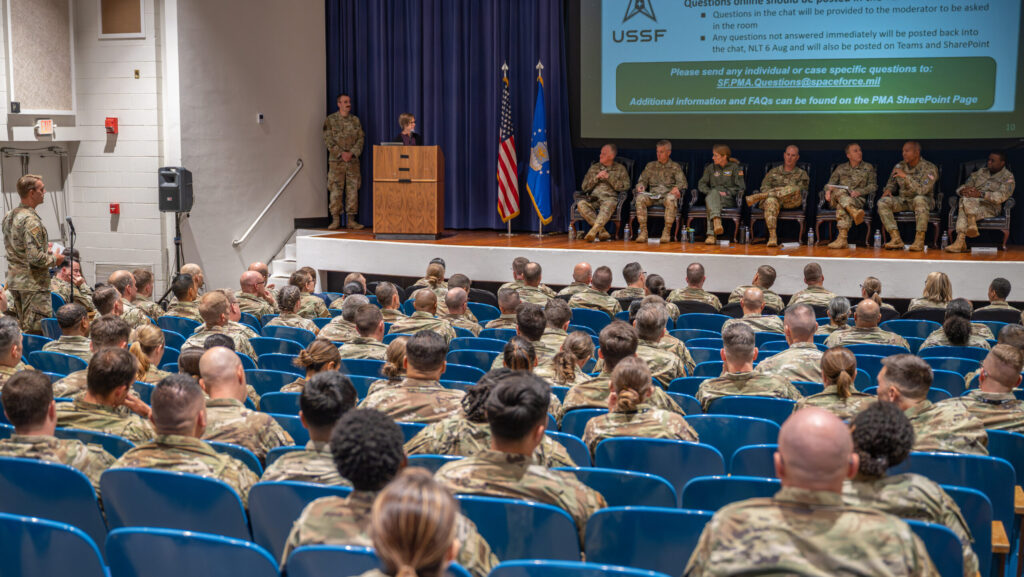
Despite opposition, Air Force plan to move Guard members to Space Force proceeds, prompting a desperate plea for presidential intervention.
NGAUS Seeks Trump’s Intervention
With the Department of the Air Force (DAF) poised to begin transferring Air National Guard members with space specialities to the Space Force on Oct. 1, National Guard officials are making a last-ditch effort to sway former President Donald Trump to intervene. Frank McGinn, president of the National Guard Association of the United States (NGAUS), revealed that they are actively trying to engage Trump, reminding him of his „campaign promise” to create a dedicated Space National Guard.
Trump’s Previous Support for Space National Guard
During NGAUS’s annual conference in August 2024, Trump expressed his support for establishing a Space National Guard as the primary combat reserve of the US Space Force. Now, with the DAF’s transfer plan moving forward, NGAUS hopes Trump will either reaffirm his commitment or acknowledge a change of heart.
DAF Defends Transfer Plan
In response to inquiries, a DAF spokesperson cited Section 514 of the fiscal 2025 National Defense Authorization Act, which authorizes the transfer of space functions from the Air National Guard to the Space Force, effective Oct. 1, 2025. The Space Force plans to open a voluntary application window for eligible Guardsmen interested in joining full-time, with transfers anticipated to begin in mid-2026. Those who opt out of full-time service will have opportunities for part-time roles, retraining, or retirement. The transfer is limited to 578 billets, with 224 full-time and 354 part-time positions.
Rationale for the Transfer
Senior Space Force and Air Force officials argue that integrating space-related roles in the Air National Guard with the Space Force’s mission will enhance effectiveness and avoid duplicative administrative costs. Former Air Force Secretary Frank Kendall dismissed concerns that the transfer posed an „existential threat” to the Guard, emphasizing that it was a necessary exception to ensure the Space Force’s capabilities.
Widespread Opposition
Despite the DAF’s rationale, the transfer plan has faced strong opposition from NGAUS, senior National Guard officers, all 55 state and territorial governors, and a bipartisan group of 125 members of Congress. Critics argue that the plan was approved in a legislative package that bypassed state governors’ input, breaking with tradition. Furthermore, a survey of Colorado Air National Guard space operators revealed that only a small fraction were willing to transfer full-time.
Concerns about Part-Time Opportunities
The emerging DAF plan for part-time Air Guards and Reservists to join the active-duty Space Force has also drawn criticism. The plan emphasizes role-specific, episodic opportunities rather than traditional Reserve models with fixed monthly training assemblies. The requirement for a minimum of 36 days of participation, with potential for Monday-through-Friday work schedules, has raised concerns about compatibility with Guardsmen and Reservists’ full-time civilian jobs. Additionally, the recompetition of part-time jobs every three years and the lack of operational roles have been cited as potential deterrents.
Impact on Surge Capacity
Critics argue that the part-time scheme will negatively impact the Space Force by eliminating its ability to surge capacity through Reservists during crises. NGAUS maintains that the transfer plan is a „huge mistake” that undermines the predictability, community focus, and surge capabilities that Guardsmen and Reservists value.