Defense technology firm Anduril Industries and propulsion startup Impulse Space have announced a collaboration to develop and launch a jointly funded demonstration satellite for rendezvous and proximity operations (RPO), driven by the increasing demand for such capabilities from the Space Force.
Addressing On-Orbit Threats with Maneuverability
Senior officials from both companies expressed confidence that the Space Force will be interested in commercially available satellites with low cost and high thrust maneuverability, especially in the face of growing on-orbit threats.
Gokul Subramanian, Anduril’s senior vice president of engineering, emphasized the importance of maneuverability for future space missions, stating, „Freedom of maneuver is going to be the enabler for every space mission going forward.” Eric Romo, president and COO of Impulse, echoed this sentiment, noting that the Space Force has clearly expressed a need for high thrust, high maneuverability spacecraft at a reasonable price.
RPO Capabilities: A Key Element for Space Domain Awareness
RPO capabilities are crucial to the Space Force’s plans to enhance space domain awareness as adversaries increasingly deploy satellites that could pose a threat to US spacecraft and terrestrial forces. The need for „maneuver without regret” has also been a long-standing priority for US Space Command, which views RPO as essential for orbital warfare.
Impulse’s Mira Spacecraft and Anduril’s Payloads
Under the agreement, Impulse is providing its Mira spacecraft, which will be integrated on the firm’s Helios kick stage featuring the Deneb engine. This engine is designed to provide rapid insertion into geosynchronous Earth orbit (GEO), approximately 36,000 miles above the Earth. Anduril will contribute the payloads, including a new long-wave infrared (LWIR) imager, a mission data processor based on its Lattice software, and third-party sensors. Anduril already supplies its Lattice software to the Space Force, linking together various elements of the Space Surveillance Network.
Long-Wave Infrared Imager for Enhanced Target Acquisition
Subramanian highlighted the benefits of the long-wave infrared imager, stating that it „provides significant benefits on orbit, particularly the ability to see very dim targets and the ability to see targets when they are not made visible by the Sun.” This capability will enable long-range acquisition and guide RPO activities.
Targeting GEO with Potential for LEO Missions
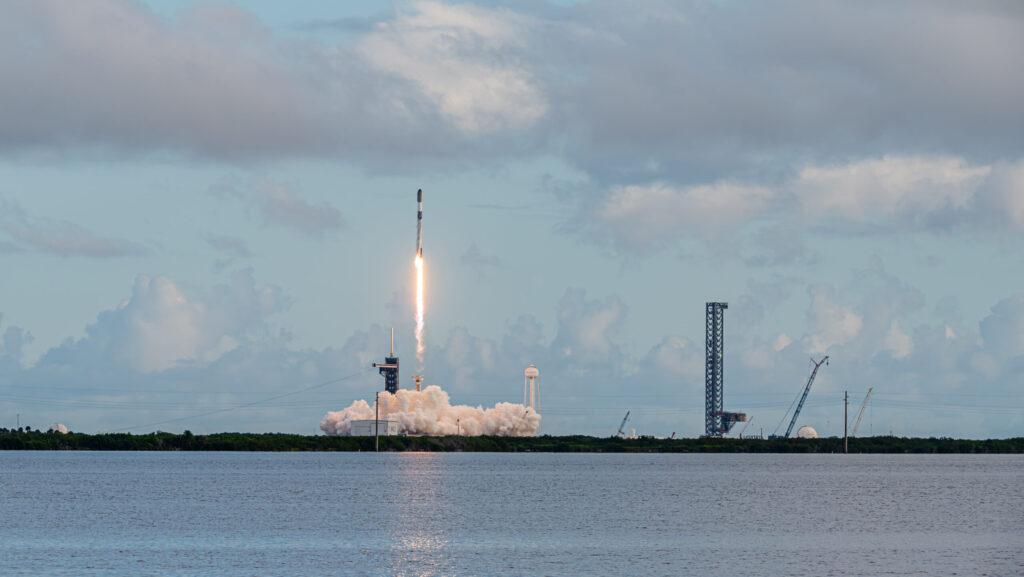
Anduril and Impulse plan to launch their Mira spacecraft, with a mass of approximately 300 kilograms without payloads, in late 2026 aboard a SpaceX Falcon 9 rocket launch of the company’s first Helios mission. The mission will target GEO due to the „strong demand signal” observed in that orbit. However, Romo noted that reconfiguring the design for low Earth orbit (LEO) missions would be relatively straightforward and potentially more cost-effective.