New „Umbrella” Policy to Drive Army Space Strategy
The US Army is rewriting its space policy, Army Regulation 900.1, to serve as the overarching framework for a new space strategy, doctrine, and future acquisitions, according to Brig. Gen. Donald Brooks, deputy commanding general for operations at Space and Missile Defense Command (SMDC).
Addressing Evolving Threats in Space
The update is crucial due to the changing operational environment in space, particularly the increasing threats posed by adversaries, Brooks told Breaking Defense. The previous policy, written in 2011, no longer reflects the current realities. The Army spokesperson anticipates „a major revision” of the current policy, „which will likely result in a publication summer 2026.”
Theater Strike Effects Group Activation on Track
Despite the policy overhaul, the Army is actively expanding and modernizing its space operations. The first Theater Strike Effects Group (TSEG), embedded with Indo-Pacific Command (INDOPACOM), is slated for activation on October 15, 2027. The service is competing for the 06 command this coming fall, signaling a concrete step toward the Army’s space ambitions.
Counterspace Operations Focus
The TSEG’s mission is to safeguard Army access to space and conduct counterspace operations to deny adversaries the same advantage. SMDC is working with INDOPACOM and US Space Command to deactivate two space control companies in the 1st Space Brigade and activate two in the TSEG.
Counter-Communications as a Priority
The Army’s counterspace efforts are focused on terrestrial fights, prioritizing space control and electronic warfare. The emphasis is currently on counter-communications, with the Army moving on a „well-defined path.”
Concepts for Other Counterspace Operations Taking Shape
Besides counter-communications, the Army has developed concepts for disrupting adversary space capabilities in counter-surveillance, reconnaissance, navigation warfare, and high-altitude operations. The service is now seeking existing technologies that can be adapted for these purposes.
Repurposing Existing Technology
For example, a laser-equipped weapon designed to neutralize mortars could be modified to „dazzle reconnaissance satellites,” Brooks suggested. The concept of employment is driving the approval of the TSEG, with concepts of operation being fleshed out.
TIGS V2 Jammers Fielded
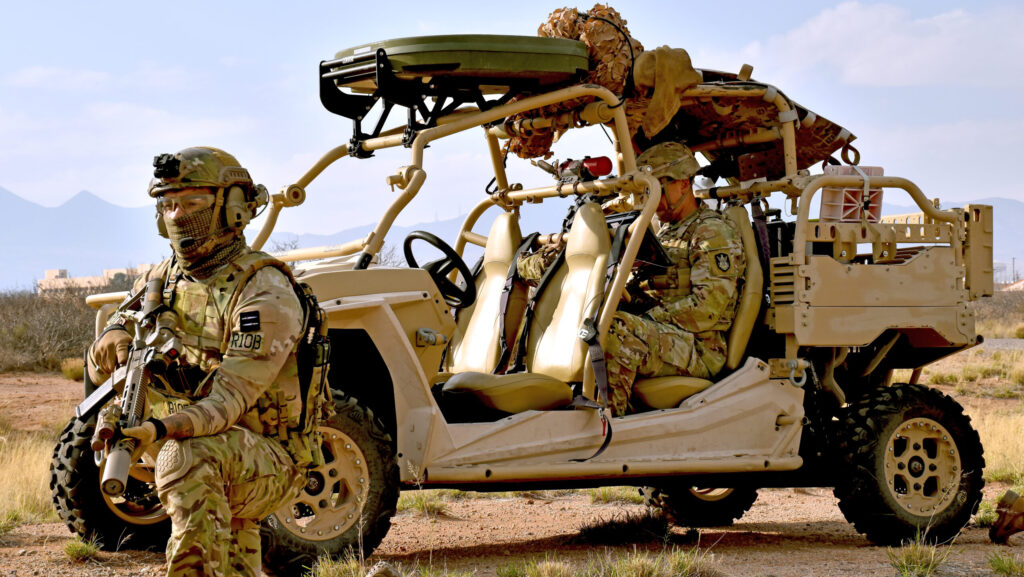
The Army has already fielded five „Tactical Integrated Ground Suite Version 2” (TIGS V2) jammers, which are smaller, more mobile versions of the original TIGS. TIGS V2 can be dismounted and carried by soldiers, allowing for deployment closer to enemy emitters.
Multi-Form Factor Capabilities
The Army is developing „multi-form factor capabilities” to allow commanders to choose from a „menu of options” based on the situation. The goal is to make counterspace weapons „as small as possible” while maintaining effectiveness.