Two JASDF fighter squadrons shoulder the majority of scrambles against unidentified aircraft, primarily from China, highlighting the strategic importance of Naha Air Base.
Two squadrons within the Japan Air Self Defense Force (JASDF) are at the forefront of Japan’s response to unidentified aircraft entering its Air Defense Identification Zone (ADIZ), primarily originating from China. According to the chief of staff of the regional air defense command, these squadrons account for an average of 60 to 70 percent of Japan’s scramble missions in recent years, a figure they nearly reached this year.
Naha Air Base: A Strategic Outpost
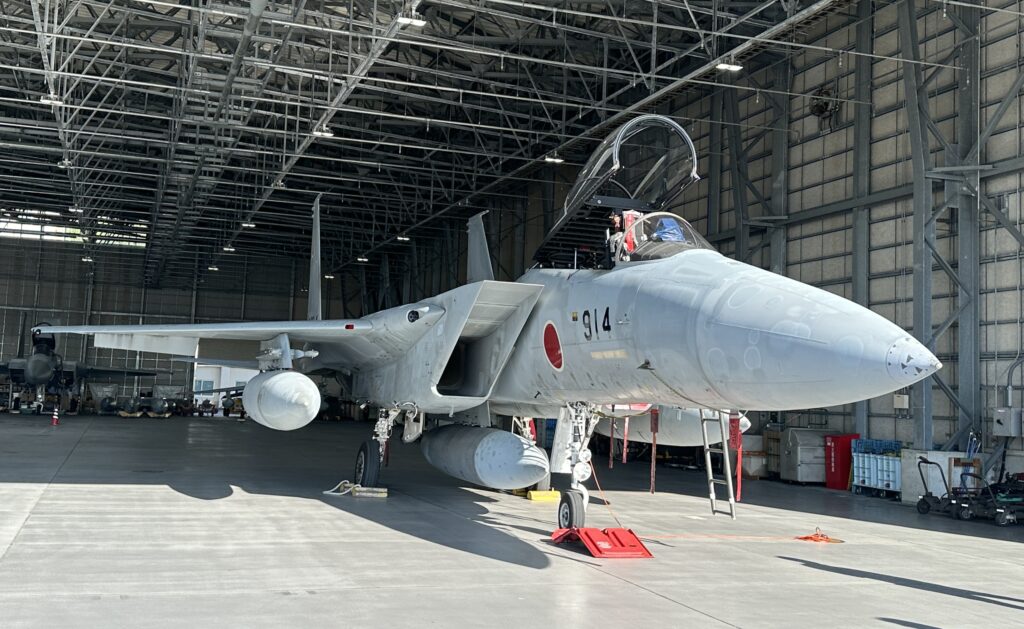
The 204th and 304th Hikōtai, operate from Naha Air Base on Okinawa. Okinawa’s location makes it a critical node in the JASDF’s Southwestern Air Defense Force. Both units are equipped with Mitsubishi F-15J Eagle interceptors, visually similar to the US Air Force’s F-15C, along with a few F-15DJ twin-seaters and Kawasaki T-4 trainers. Each unit has approximately 20 aircraft in its inventory.
Col. Hideo Kiyonaga, chief of staff at the headquarters of the Southwestern Air Defense Force, explained to Breaking Defense that his command is responsible for securing a vast area of Japan’s ADIZ.
Beyond its fighter squadrons, Naha Air Base also hosts a squadron of Northrop Grumman E-2C/D Hawkeye Airborne Early Warning and Control (AEW&C) aircraft, as well as CH-47J Chinook helicopters and U-125 aircraft belonging to its Air Rescue Wing.
Responding to Increased Activity
Naha has been the primary base for JASDF responses to increased Chinese military air activity for over a decade. During the last Japanese fiscal year, the base’s F-15s scrambled on 411 occasions, representing 58 percent of the 704 scrambles undertaken by the JASDF. Of those 704 scrambles, 464 were activated in response to Chinese aircraft.
In addition to air assets, the Southwestern Air Defense Force has five ground-based radar stations and four ground-based air defense system sites within its area of responsibility. Kiyonaga emphasized that air policing is the fundamental mission of the command.
„We conduct surveillance of Japan’s airspace in the area on a 24/7 basis and maintain readiness for any situation by utilizing all the systems and assets available to us,” he stated.
Contested Airspace Over the Senkakus
The command’s area of responsibility includes airspace over the Senkaku Islands in the East China Sea, a territory claimed by China. The ADIZ declared by China overlaps with Japan’s in this area. It’s important to note that an ADIZ is not territorial airspace but rather a self-declared zone where a country monitors and identifies aircraft for national security purposes.
The JASDF requires its Quick Reaction Alert (QRA) fighters to be airborne within five minutes of activation during a scramble. Despite its operational demands, the Southwestern Air Defense Force is the smallest of the JASDF’s four regional commands in terms of air strength and airbases, according to Kiyonaga.
A Surge in Scrambles
Data from Japan’s Ministry of Defense reveals that JASDF scrambles against Chinese aircraft began to increase significantly in 2012, surpassing those against Russian aircraft.
Initially, the 204th Hikōtai was the sole JASDF fighter squadron at Naha and bore the brunt of these scrambles. In 2016, the 304th was reassigned to Naha from Tsuiki to distribute the workload.
That same year saw a peak in overall JASDF scrambles, with 851 out of 1,168 scrambles conducted against Chinese aircraft. Kiyonaga noted that approximately 80 percent of those were flown out of Naha.
„Conducting scrambles requires a lot of effort, but it is important to show our strong intention to protect Japan’s airspace,” Kiyonaga stated. He added that the volume of scrambles became so high that „we had to rotate F-15 crews from elsewhere to Naha to fly some of the scramble missions.”
Around this time, Japan revised its scramble triggers to reduce strain on aircraft and personnel. The new approach relies more on monitoring unidentified aircraft in the ADIZ and only scrambling fighters when an imminent threat is perceived.
Modernization and Upgrades
The JASDF currently operates nearly 200 F-15s, built by Mitsubishi under license from McDonnell-Douglas between 1980 and 1998. Japan has begun replacing some of the older F-15s with Lockheed-Martin F-35A Lightning II Joint Strike Fighters. An F-15 squadron at Komatsu is currently transitioning to the fifth-generation fighter.
Japan also plans to upgrade some of its newer F-15s, built to the Multi-Stage Improvement Program (MSIP) standard. These upgrades include new avionics, BAE Systems’ Eagle Passive Active Warning Survivability System (EPAWSS) electronic warfare suite, and Raytheon AN/APG-82(V)1 Active Electronically Scanned Array (AESA) radar.
However, the program has faced cost overruns, leading to a reduction in the number of aircraft slated for upgrade from 68 to 54, according to the country’s latest Defense White Paper.
Col. Kiyonaga declined to comment on whether the Naha squadrons would receive F-35s or upgraded F-15s, referring inquiries to Japan’s defense ministry.