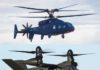
Defense tech startup Shield AI has made a strategic announcement, revealing that its X-BAT drone wingman will be propelled by GE’s F110 fighter engine. This decision bestows upon the recently unveiled drone concept the same firepower and mechanical agility found in legendary aircraft like the F-15 and F-16, according to an exclusive disclosure made by the two companies to Breaking Defense.
Under a memorandum of understanding signed by the two firms, GE will supply its F110-GE-129 powerplant and integrate a thrust vectoring nozzle, a critical component for the X-BAT platform’s vertical takeoff-and-landing (VTOL) operations. GE will also assist Shield AI in the process of integrating the F110 with the X-BAT aircraft itself, marking the engine manufacturer’s first announced partnership for a specific drone wingman platform.
The Driving Force Behind the Future „Wingman”
The choice of the F110 engine is no coincidence. „The F110 provides the performance that we need” to operate the X-BAT, particularly in its vertical setup, Armor Harris, senior vice president and general manager of aircraft at Shield AI, ahead of the engine’s official announcement. Harris highlighted key distinguishing criteria that underpinned the selection, including sufficient thrust, the availability of a thrust vectoring nozzle, and GE’s „hot production line,” capable of rapidly scaling up volume, as the F110 engine is already in active use by the US Air Force.
Disruptive Innovation and Strategic Vision
„We saw right away that [the X-BAT] really is a disruptive approach to putting these dilemmas in front of” potential adversaries, commented Steve Russell, vice president and general manager of Edison Works at GE, in a virtual call with Harris. Shield AI unveiled the X-BAT at an event in Washington on October 21, asserting that the aircraft promised a forward leap for efforts like the Air Force’s Collaborative Combat Aircraft (CCA) program, which seeks to pair drone wingmen with manned aircraft. The company aims to offer the drone as a complete package, integrated with its in-house Hivemind autonomy software.
Speed of Deployment and the Secret to Vertical Takeoff
While military acquisitions often involve separate competition for an aircraft’s engine, treated as government-furnished equipment, Harris stated that Shield AI is striving to field the X-BAT „as quickly as possible.” This follows the lead of more recent programs that „have the engine wrapped up with the vehicle provider” to reduce the time needed for a separate competition.
Harris specified that Shield AI has been working on the X-BAT for about the last 18 months, with GE joining the project about six months ago to refine the aircraft’s propulsion. He added that „engine development is now beginning in earnest” to achieve a first vertical takeoff and landing (VTOL) demonstrator flight by the second half of next year, with production then expected around the 2029 timeframe.
The thrust vectoring nozzle is integral to the X-BAT’s VTOL concept, helping balance the aircraft by changing the angle of its thrust. Harris likened this principle to keeping an upside-down broom steady in the palm of one’s hand. The nozzle for the X-BAT is adapted from the Axisymmetric Vectoring Exhaust Nozzle (AVEN) system, developed in the 1990s and demonstrated on an F-16.
„There may be some modifications” to the nozzle to integrate it with the X-BAT vehicle, Mark Rettig, vice president and general manager of advanced programs at GE’s Edison Works, said during the call. „Integrating the nozzle and the control of the nozzle with the vehicle will be part of the first thing that the teams will be working to do. But, relative to our experience with the nozzle on the F-16, [we] don’t anticipate any challenges with being able to provide the level of control that the vehicle needs.”
A Strategic Race for Air Superiority
Although the Air Force has not yet settled on requirements for a next round of its CCA program, industry appears to have started placing its bets. Companies like Lockheed Martin, Shield AI, and reportedly Northrop Grumman, are working on increasingly sophisticated drone wingman concepts. GE, for its part, has launched a partnership with Kratos to manufacture smaller engines.
„We’re doing a lot of things to bring more capability to the same cost box,” Harris explained when asked why the firm selected a high-performance fighter engine, which would seemingly entail higher costs for the platform. He added that Shield AI plans to „assemble and integrate the aircraft in-house,” while also noting that more partnerships will be announced in „the next couple of months.” This strategic approach underscores Shield AI’s ambition to redefine cost-efficiency standards in military aviation.