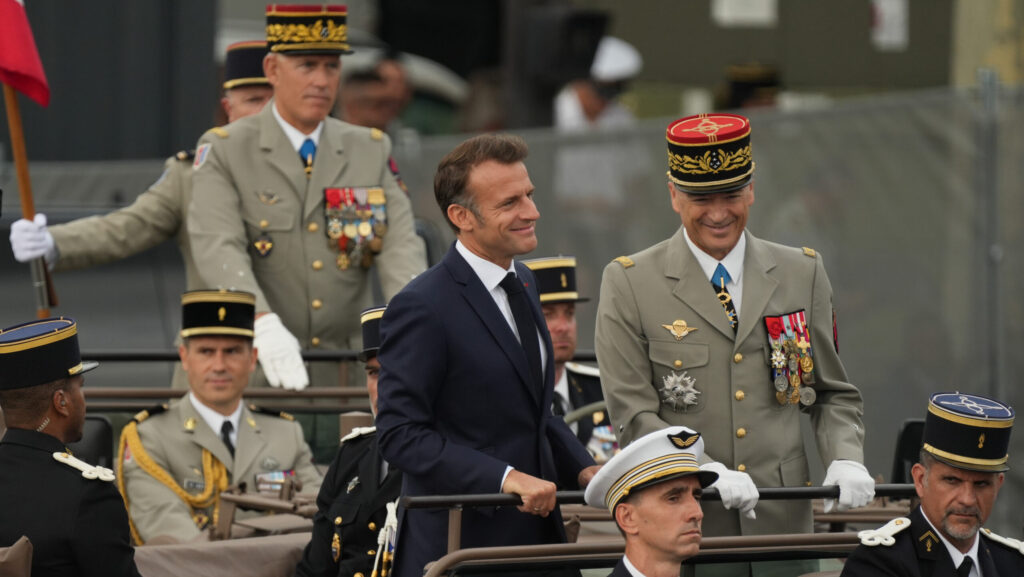
French President Emmanuel Macron unveiled a massive increase in military space investments, with an additional €4.2 billion (approximately $4.9 billion) allocated for the period 2026-2030. The announcement, made during a ceremony in Toulouse marking the operational capability of France’s Space Command, underlines a dramatic paradigm shift: space is no longer a sanctuary, but a new battlefield essential for national and European security.
Space, the New Front: Why France is Investing Heavily
„We must fight to preserve this precious asset; indeed, space is no longer a sanctuary, it has become a battlefield,” Macron declared (source: French Presidency). His blunt statement continued: „Today’s war is already being fought in space, and tomorrow’s war will begin in space. Let us be ready. This will be a condition for the success of military operations on land, in the air, and at sea.”
This strategic vision positions space as a critical dimension of security, justifying the substantial investments needed to protect French and European interests against emerging threats.
France’s „Star Wars”: Cutting-Edge Technologies for Space Security
The new funds will support, among other things, the 2027 launch of counter-space satellites, a long-planned project by the Ministry of Defense. Macron detailed the plans: „In addition to what was already planned for active defense, we will deploy our first patrol satellites… starting in 2027 to monitor, inspect, and, if necessary, counter threats in orbit. These will be complemented by our first space-based action capabilities based on lasers and jammers.”
Since 2024, the French military has been developing two maneuverable microsatellites, under the TOUTATIS (In-Orbit Test of Action Techniques against Attempted Spatial Interference) program, capable of identifying and intervening against hostile satellites in low Earth orbit. These efforts are complementary to the YODA (Yeux en Orbite pour un Démonstrateur Agile) project, an experimental „patrol” nanosatellite in geosynchronous orbit, initiated in 2019, and the FLAMHE project, focused on developing on-board lasers to blind threatening satellites. All these initiatives fall under the umbrella of the Ministry of Defense’s overarching ARES (Action et Résilience Spatiale) program.
Strategic Alliances: With Germany on the Space Defense Axis
The investments will also support „accelerating the development of our early warning capabilities in cooperation with Germany,” the French President specified. In October, the two countries announced the JEWEL (Joint Early Warning for European Lookout) initiative, dedicated to developing, detecting, and tracking missiles, designed to contribute to NATO’s Integrated Air and Missile Defence effort. For its part, Germany pledged in September to invest $41 billion in military space systems over the next five years.
In addition to orbital capabilities, Macron also mentioned support for the French military’s AURORE ground-based space surveillance radar. French defense firm Thales (now set to create a joint space-focused entity with Airbus and Leonardo) on October 25 announced a contract with the French Defense Procurement Agency to develop a new UHF radar to monitor low Earth orbit. AURORE is projected to be „the largest surveillance radar deployed in Europe” (source: Thales).
Macron’s Vision: The Five Pillars of French Space Strategy
The new funds represent a fundamental pillar of France’s new national space strategy, which defines „Strategic and Defense” capabilities as the third of five key axes, Macron explained. The other four are:
- Access to Space: „Having autonomous access to space is a collective responsibility for France and for Europe. Depending on a major third-party power or any kind of space magnate is out of the question,” Macron stated, in a veiled allusion to concerns about America’s reliability as a security partner. „This means we must guarantee the maintenance and development of our launch base, the Guiana Space Center, and the control of our launchers, with Ariane today and our future launchers tomorrow, which are the main levers for our independent access.”
- Industry and Skills: „The French space sector can only be credible, and even sovereign, with a competitive industry. The industrial and commercial model must be rethought from the ground up,” Macron argued. „The battle for skills is also a decisive battle.”
- Science and Exploration: „Climate change is a framework for many programs undertaken by CNES [the French space agency] in conjunction with others, especially at a time when some are withdrawing to understand the origin of the universe and so many other key elements,” the President noted. „Therefore, continuing to defend science and exploration in space is also an element of sovereignty and independence.”
- Cooperation: While citing a wide range of partner countries for France’s space programs, Macron emphasized the need for Europe to create a strong, unified regional presence in the heavens. „Our European space program is fragile. It is under attack by those who would like to fragment it to prevent us from being stronger together,” he affirmed. This includes supporting the development of „European champions so that they are competitive on the global market” and applying a policy of „European preference” when granting space-related government contracts, arguing that it would be „naive” to think that China and America do not do the same. „This European preference is not a dirty word and it is not protectionism,” Macron concluded.
These strategic measures and massive investments underscore France’s determination to ensure its autonomy and consolidate its position as a major space power in an increasingly competitive and militarized geostrategic environment.