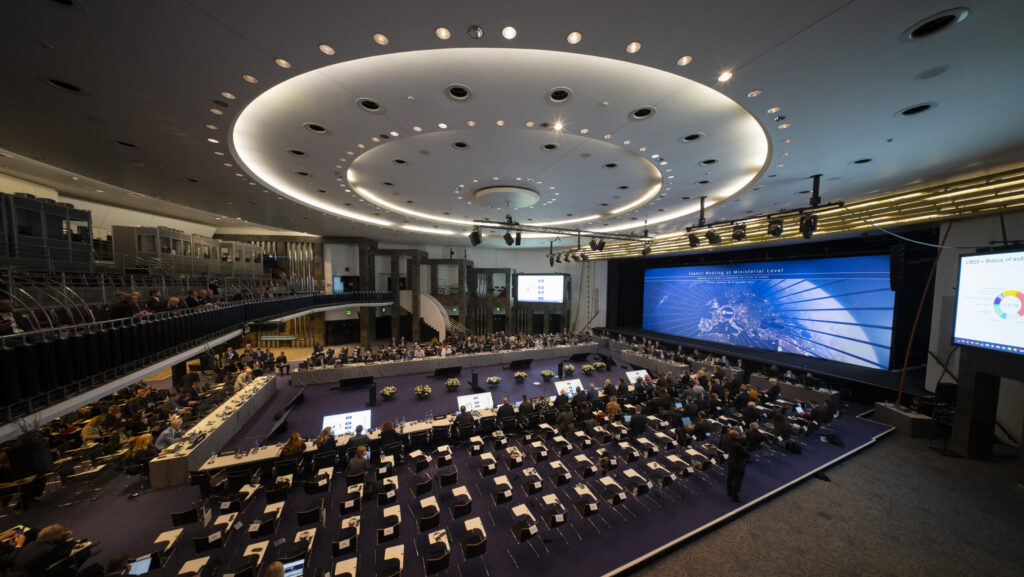
The European Space Agency (ESA) has approved a groundbreaking three-year, €1.35 billion ($1.6 billion) spending plan, marking a fundamental departure from its half-century-long history. For the first time, the agency will fund initiatives directly supporting space defense programs across its 23 member states. This transformative decision, ratified in late November by its ruling Council of Ministers in Bremen, signals a new era for Europe’s space ambitions, emphasizing resilience, technological independence, and strategic autonomy.
A Historic Pivot: Embracing Space Defense
The clear mandate for using space applications for non-aggressive defense purposes represents an historic change for ESA. The agency’s statement underscored that „non-dependence in technology is key to advancing Europe’s ambitions in space, alongside its guaranteed access to space.” For its initial 50 years, ESA steadfastly presented itself as a purely civil-focused space agency, akin to NASA, disavowing any connection to European or member state defense activities. However, over the past year, this stance has significantly evolved. Growing concerns among European governments regarding threats to their space systems, particularly from Russia, and their reliance on a less-reliable United States for key military space capabilities, have precipitated this strategic reorientation.
Forging Resilience: The ERS Initiative
The European Resilience from Space (ERS) effort will initially concentrate on developing dual-use technologies. These are intended to underpin a proposed new network of Earth observation satellites—dubbed the Earth Observation Governmental Service and championed by the European Commission—as well as a new program to provide „navigation services” from satellites in low Earth orbit. Critically, the ERS initiative could expand over time to support additional space security and defense capabilities, with member states granted a year to determine what further contributions they might wish to allocate to this burgeoning budget pot.
A Staggering Budget for a New Era
The ERS funding, totaling €1.35 billion, constitutes just a fraction of the whopping €22 billion ($27 billion) three-year budget greenlit by the ESA Council of Ministers. While slightly less than the €22.3 billion initially proposed by Director Josef Aschbacher, he noted that it still represents a substantial 32 percent jump from the previous 2022 budget, or 17 percent when adjusted for inflation. „This is amazing,” Aschbacher remarked during the post-meeting press conference. It is important to note that ESA operates independently from the 27-member European Union, with distinct memberships and a funding model based on both mandatory and voluntary contributions.
Rocketing Towards Autonomy: The Launch Sector’s Strategic Push
Space Transportation continues to be the largest expenditure category within ESA’s 2025-2027 budget, with a significant €4.4 billion ($5.1 billion) earmarked for its flagship programs: the Ariane 6 heavy-lift and Vega-C medium-lift launch vehicles. A strategic new initiative, the „European Launcher Challenge,” aims to foster a robust pool of EU-based commercial launch service providers. This move comes as European leaders have, for several years, lamented the dominance of the global launch market by Elon Musk’s SpaceX, pushing for greater efforts to build up the continent’s domestic industry, including the crucial development of reusable rocket technologies to compete effectively with SpaceX’s ubiquitous Falcon 9. Ariane 6 is manufactured by the Franco-German aerospace behemoth ArianeGroup, while Vega-C is built by the Italian firm Avio. In July, ESA selected five companies—German firms Isar Aerospace and Rocket Factory Augsburg; Spanish firm PLD Space; MaiaSpace, a subsidiary of Ariane Group; and British firm Orbex—to compete in the European Launcher Challenge, with initial flight demonstrations slated for 2027.
These pivotal budgetary and strategic decisions underscore Europe’s unwavering resolve to solidify its standing in space, not merely as a scientific trailblazer, but as an autonomous technological power, fully capable of safeguarding its strategic interests in the terrestrial orbit.