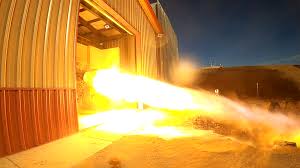
In a fierce race for hypersonic technological dominance, the United States faces a significant challenge, given the rapid advancements of competitors like Russia and China. Current propulsion methods, from solid-fuel rockets to air-breathing engines, exhibit considerable limitations. However, an innovation from Ursa Major, through its storable liquid rocket engine technology, promises to radically shift the paradigm, offering crucial advantages in maneuverability, longevity, and operation across diverse environments.
The Hypersonic Race: Is America Falling Behind?
The current state of hypersonic propulsion in the United States shows it lagging behind peer and near-peer adversaries. Existing systems are often prohibitively expensive, and numerous prior development programs have failed to deliver as expected. Solid-fuel engines, while reliable and simplistic in design, are difficult and costly to build at larger scales, and their very high initial thrust can impede engagement at lower altitudes and limit maneuverability. Air-breathing engines, such as scramjets and ramjets, have experienced delays, possess altitude limitations, and have proven to be expensive configurations, with nothing yet widely fielded.
Ursa Major: Pioneering Liquid Hypersonic Propulsion
Ursa Major positions itself as a leader in liquid hypersonic propulsion. Their Hadley engine has already flown multiple times at Mach 5+, demonstrating vehicle recovery capability – a key feature for test targets and test beds, though irrelevant for offensive or defensive weapons. For target applications, liquid hypersonics unlock vast possibilities for a deep portfolio of reusable advanced threat trajectories, essential for wargames, exercises, radar/sensor calibration, and ultimately, precise interception.
The ability to start, stop, and throttle the engine is fundamental for improved maneuverability and survivability. Furthermore, Ursa Major’s liquid propellants are easier to handle than cryogenic or toxic fuels and can be stored for years, operating both endo- and exo-atmospherically. The modular and affordable design, leveraging advanced 3D printing techniques, significantly accelerates development cycles and reduces costs.
„Draper”: The Storable Liquid Engine Revolution
What exactly constitutes a storable liquid engine? Traditionally, liquid engines have employed cryogenic or hypergolic materials. Cryogenic fuels offer high energy density but require complex launch-base operations and are unsuitable for tactical field applications. They are often „one-start” configurations and impractical for soldiers in the field.
Ursa Major’s system, named Draper, is designed for storability for up to, or even longer than, 10 years, whether on a ship, an air base, in space, or at a forward-based operation. The liquids can be stored within the system itself or easily fueled into it. This engine operates akin to a solid – a button press initiates it instantly – and can be stored under similar conditions, including in space. However, unlike a solid engine, it provides the flexibility of a liquid system: throttling, starting, stopping, and a higher level of maneuverability even at very high speeds. Moreover, unlike air-breathing systems, Draper can operate at very high altitudes where oxygen density is insufficient, or even in the vacuum of space.
A Strategic Advantage for Air and Space Forces
Liquid engines, and specifically the Draper engine, can bring two major advantages to the Air Force. First, a liquid system with these density and maneuverability characteristics, when used as an upper stage, can achieve long distances comparable to Tomahawk-type systems, but at speeds unmatched by current air-breathing systems – from hypersonic to even greater velocities. This capability is crucial for countering adversaries who can strike faster and at longer ranges. The Draper system, part of the „Angry Tortoise” program, offers an optimal balance of low cost and a high-speed weapon system.
Second, the modular Draper system is ideally suited for Space Force objectives related to long-range space capabilities, rapid deployment in space, and space-based missile defense, with virtually no changes required.
3D Printing: Accelerating Development Cycles and Reducing Costs
Ursa Major is also a leader in additive manufacturing processes. Utilizing extremely high-temperature alloys, the company produces combustion chambers capable of withstanding 5,000-6,000 degrees Fahrenheit and turbomachinery with shafts rotating at over 50,000 RPM. Approximately 60% of the Draper engine is additively manufactured. This approach significantly shortens development cycles, as it bypasses complex forging, casting, and machining processes. New configurations can reach test facilities in mere days or weeks, accelerating innovation and the rapid delivery of high-performing solutions for the warfighter.