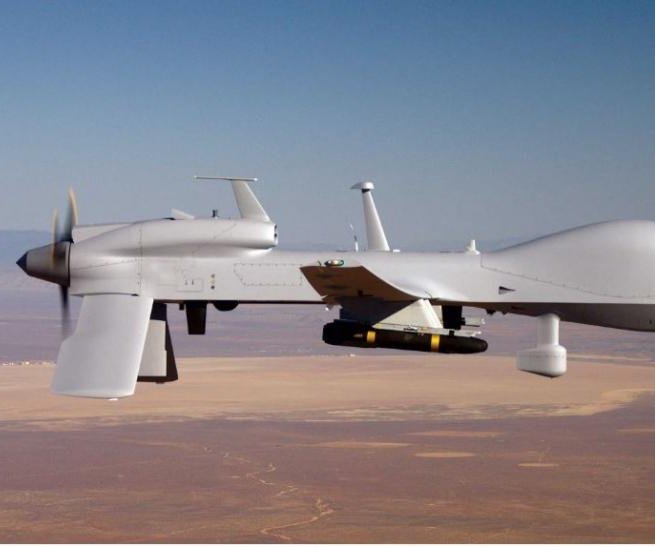
As militaries worldwide race for more affordable and effective air defense solutions, the US Army is setting an ambitious goal: equipping at least some of its next large drone fleet with high-energy lasers (HEL). This initiative, recently revealed by an Army official, marks a major strategic shift in how ground forces intend to counter aerial threats.
Modular Systems: Adaptability on the Battlefield
The new Group 4/5 unmanned aerial systems (UAS) – categorized as large and very large – will be designed to integrate modular payloads, configurable to the specific operational environment, threat, and mission. The official clarified that not every drone in this category will carry HEL, but rather it will serve as an additive, theater-specific payload. Flexibility and adaptability are the cornerstones of this new approach.
Farewell „Gray Eagle”: A New Drone Generation Rises
The Army is poised to officially launch a competition for a new fleet of Group 4 or 5 UAS, intended to replace its current fleet of General Atomics-made Gray Eagle drones. The Army Requirements Oversights Council recently approved the Capability Development Document, outlining the requirements and acquisition plan for these new short takeoff and landing (STOL) or vertical take-off and landing (VTOL) drones. This decision stems, in part, from concerns regarding the survivability of current Gray Eagle drones in modern conflicts.
High-Energy Lasers: Not Just a Desire, But a Strategic Imperative
While it remains unclear if HEL capability was formally included in the requirements document, Army officials emphasize that it will „absolutely” be a capability the service desires. Furthermore, it is suggested that lasers could play a crucial role in the broader air defense plan, known as „Golden Dome.” This initiative underscores the increasing importance of directed energy technologies in future military strategies.
Defense Market on Alert: Competition on the Horizon
A request for information (RFI) for the new drone fleet is expected soon, offering interested companies a „quick response time” before a formal request for proposal (RFP) is released and an industry day is hosted. This fleet, with each airframe weighing at least 1,320 pounds, is designed to fill the gap created by the Army’s decision to halt future buys of General Atomics’ Gray Eagle drone.
Overcoming Challenges: Airborne Lasers Become Reality
Military development of high-energy lasers has been underway for decades, with some reported successes, but it has often encountered issues related to size, weight, and power, especially on airborne platforms. Despite these challenges, efforts have persisted, and the Pentagon recently announced that scalable directed energy is one of six key technological priorities.
Industry Ready for Innovation: From General Atomics to Startups
This push and the Army’s plans to request large, laser-firing drones do not catch the industry flat-footed. Companies like General Atomics, which could seek to reclaim the contract with its STOL Mojave variant, are already prepared. A GA spokesperson stated that their STOL solution will have been „tested, tweaked, and tested again” by the time of an actual solicitation. Regarding HEL integration, they mentioned that GA is working on its own laser projects and collaborating with other industry and government teams on integrating solutions onto GA aircraft.
„Imagine an unlimited magazine, able to knock down these flying trashcans,” the GA representative said. They added, „You don’t have to burn holes through metal to defeat a lot of these systems. We’re not trying to blow up the Death Star. You can blind the optics, start fires, melt plastic, disrupt targeting, overheat electronics. All of that is possible now.”
Archimedes: Aurelius Systems’ Innovative Solution
Smaller, laser-focused firms are also taking note of this need. Aurelius Systems, a startup, is pitching its sub-10-kilowatt class laser, named Archimedes, which they claim can be integrated onto a Gray Eagle. Dustin Hicks, Aurelius’s head of growth, confirmed that „the current form factor — weight and size — can be carried easily by an outer pylon of a Gray Eagle.” The weight could be even lighter if it uses power from the drone instead of its own power supply. Aurelius recently received $62,000 from the Army’s FUZE initiative, a new venture-capital-like acquisition model, demonstrating Archimedes’ ability to down an unspecified number of small Group 1 and 2 drones from the ground.
The Future of Air Defense is Here
The vision of a more agile, cheaper, and adaptable air defense, reliant on laser-equipped drones, is taking shape. The integration of this technology promises to fundamentally alter conflict dynamics, providing a significant strategic advantage.