In a coordinated effort to modernize defense capabilities, Berlin and The Hague have signed off on additional orders for wheeled infantry fighting vehicles, solidifying their strategic partnership through collaborative armament programs.
A multi-billion dollar investment for tactical supremacy on the ground
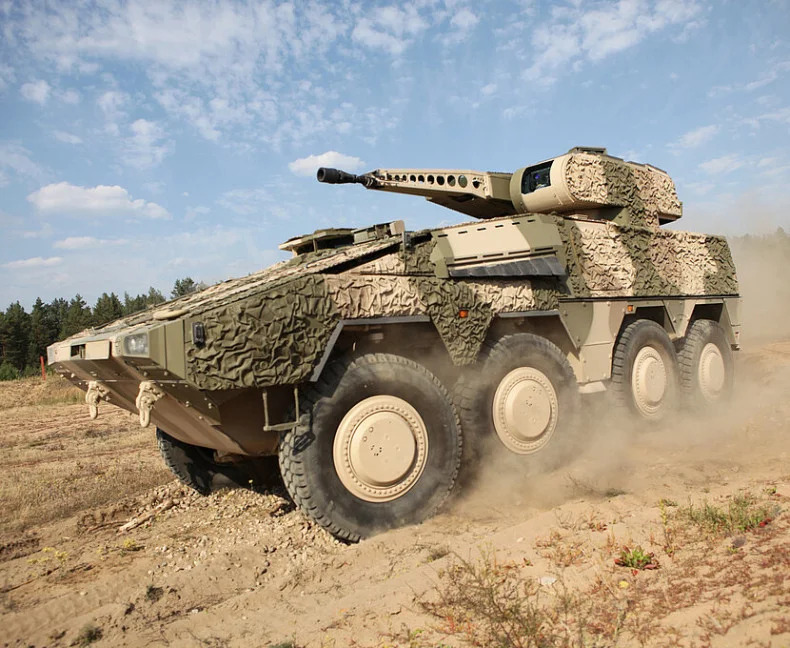
Germany and the Netherlands are set to acquire scores of additional RCT30 infantry fighting vehicles, produced by the joint venture between KNDS Deutschland and Rheinmetall. Berlin is slated to receive 35 new units on top of the 150 already on order, while The Hague is increasing its fleet by 34 vehicles, bringing its total to 106.
This top-up exercises an option under a major 2025 contract valued at €4.7 billion for 222 systems. The entire procurement process is managed by the Organisation for Joint Armament Cooperation (OCCAR), the central pillar of European collaborative defense programs. With this latest move, total investment in the Boxer program has surged to nearly €6.5 billion within the last 12 months alone.
The „Schakal”: Firepower redefining the modern virtual battlespace
Officially dubbed the „Schakal” (Jackal) in German service, the RCT30 vehicle represents a technological fusion of the Boxer’s versatile wheeled chassis and the Puma’s 30mm turret. Designed to serve as the backbone of Germany’s new „Medium Forces,” this vehicle bridges the strategic gap between light infantry and heavy armored units.
Its capabilities are tailored to contemporary threats: the „Schakal” is equipped to counter drones and other aerial targets, while also featuring the MELLS (Eurospike) anti-tank guided missile system, capable of neutralizing main battle tanks. This fleet modernization aligns with the vision of transforming the Bundeswehr into Europe’s strongest conventional army.
Interoperability and efficiency through mass production
Beyond raw firepower, joint procurement offers significant logistical advantages. High production volumes not only accelerate delivery timelines but also guarantee full interoperability between the German and Dutch armed forces. Equipment standardization facilitates joint training and simplifies the supply chain.
The equipment drive is further supported by significant auxiliary contracts, such as the recent €290 million deal awarded to Hensoldt to equip the vehicles with 288 state-of-the-art digital optronics sets. This technological leap underscores OCCAR’s crucial role in streamlining defense production and enhancing operational readiness across participating European nations.