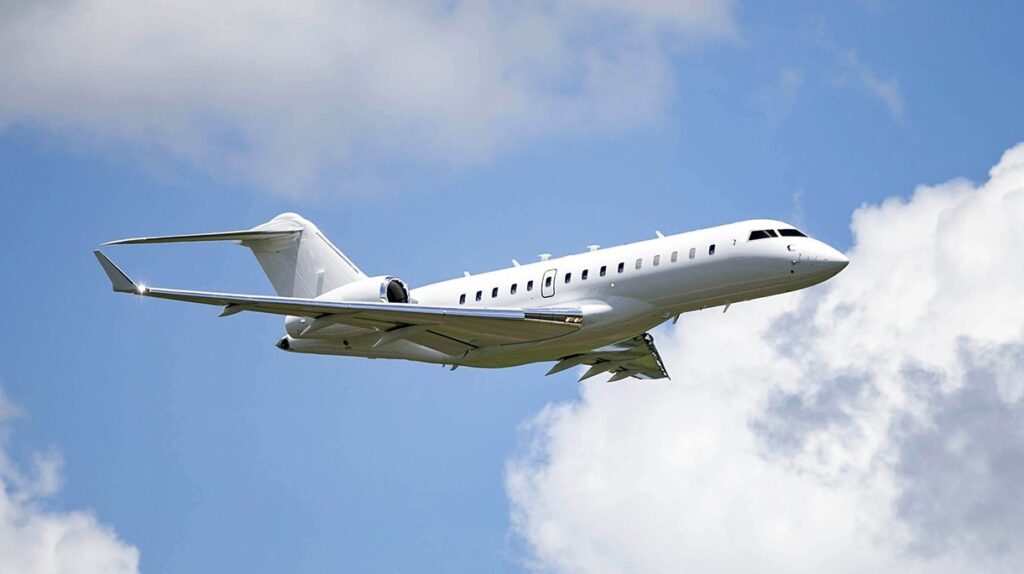
A recent Request for Information (RFI) issued by the United States Army, aiming to acquire up to 11 business jets, has sparked considerable interest, being hailed as a „good signal” for its High Altitude Detection and Exploitation System (HADES) program. However, a service spokesperson tempered initial enthusiasm, stressing that this does not necessarily imply full program approval, but rather signifies an evolving stage in a crucial project.
Draconian Requirements for Future Spy Aircraft
The RFI, published on January 22, outlines rigorous specifications for the desired aircraft. These platforms must operate at altitudes between 41,000 and 51,000 feet (approximately 12,500 – 15,500 meters) above sea level. Beyond the high-altitude flight requirement, the jets must be capable of carrying a useful load of at least 14,000 pounds (about 6,350 kg) and remaining airborne for 12 hours or more without requiring refueling. The Army’s long-term objective for the HADES program is to ultimately establish a fleet of up to 14 aircraft.
The Numbers Game: A Constantly Transforming Fleet
The exact number of aircraft destined for the HADES program has been a subject of ongoing discussion and revision. Initially, a fleet of 12 aircraft was envisioned, followed by considerations for a reduction to just six, aligning with broader Army transformation initiatives. Currently, an Army spokesperson has stated that the present plan entails the acquisition of six production aircraft and three prototypes. Sierra Nevada Corporation has already procured three Bombardier Global 6500 jets for HADES prototypes, with a fourth intended for conversion into a non-prototype variant. Discrepancies between the RFI’s stated number (up to 11) and the Army’s currently communicated figure (6 + 3) are not uncommon, as the RFI provides maximum flexibility for future procurements. An Indefinite Delivery, Indefinite Quantity (IDIQ) contract ceiling allows the Army to acquire additional aircraft as evolving threats and available funding dictate.
Beyond Numbers: Prioritizing Capability and Flexibility
More than a fixed count of aircraft, the Army is intensely focused on the advancements that the HADES program will introduce to its suite of intelligence, surveillance, and reconnaissance (ISR) capabilities. Andrew Evans, director of the Strategy & Transformation Office within the Army’s G-2 (Deputy Chief of Staff for Intelligence), emphasized that in a landscape characterized by rapid technological shifts, a fixed number represents a static target. „With HADES, we are prioritizing investments in open architectures to ensure this acquisition generates value for the Army, whether it’s 4 systems or 400 systems,” Evans declared. The acquisition objective remains directly tethered to emerging threats, warfighter demand, and leadership decisions regarding how broadly this critical capability must be proliferated to meet the demands of the 2026 National Defense Strategy.
Market Opens Up: New Opportunities for Industry
While Sierra Nevada Corporation has already acquired and adapted four Bombardier jets with advanced, deep-sensing tools for multi-domain operations as part of its contract with the Army, the recent RFI is explicitly not a „sole-source” notification. This indicates that, theoretically, the Army is open to considering other providers, signaling potential competition for future phases of the HADES program and broader industrial engagement.