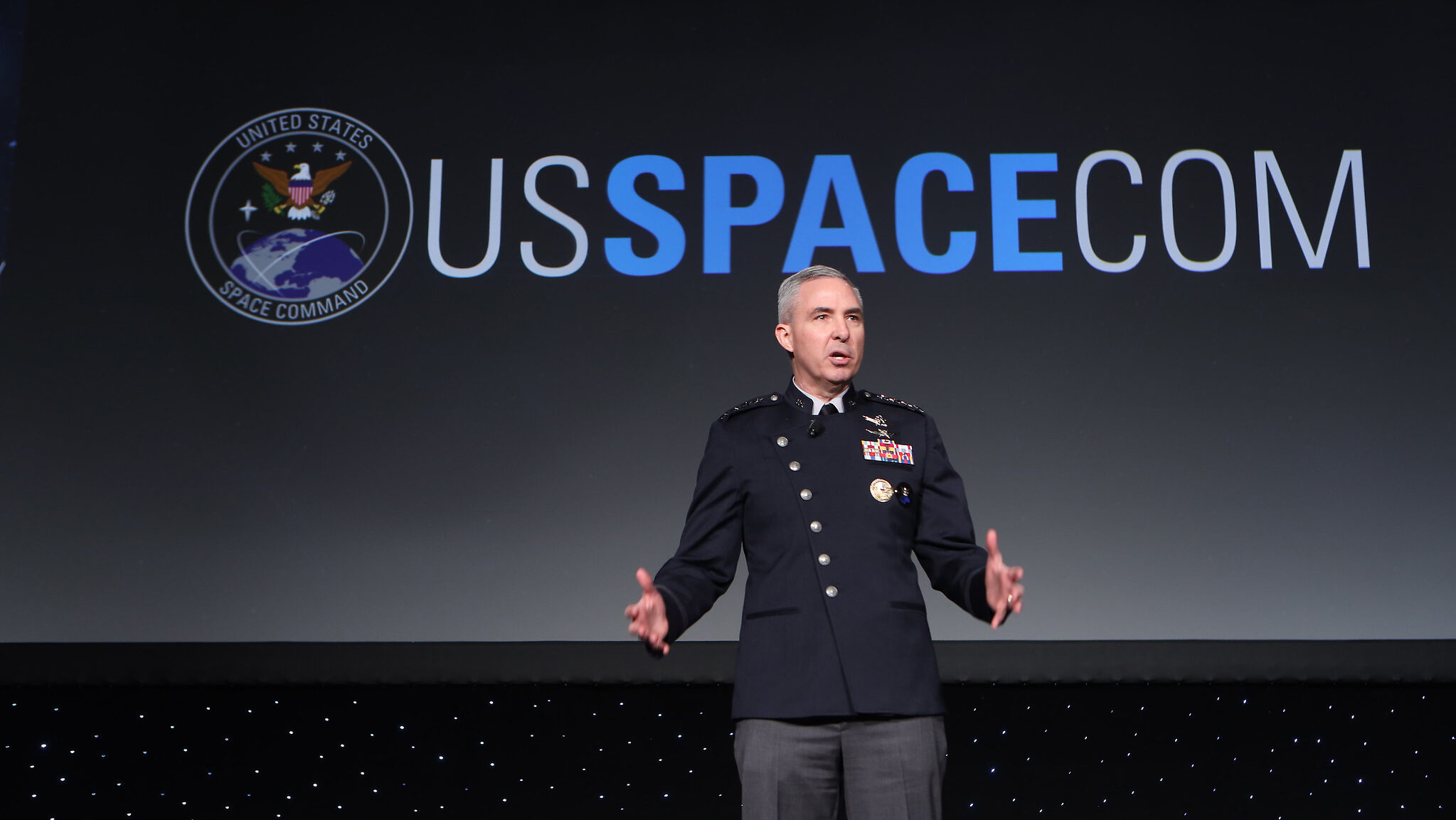
US Space Command is assisting the Space Force in determining when firms participating in the service’s new Commercial Augmentation Space Reserve (CASR) program would be activated, according to SPACECOM Commander Gen. Stephen Whiting.
“We’re excited about the Space Force’s work on the CASR. I think that’s going to come online starting next year and into ’26, and we’re working with the Space Force to define the triggers for when we would want to activate the CASR to bring us additional capacity,” Whiting stated during the Spacepower 2024 conference hosted by the Space Force Association in Orlando, Florida.
Later, while addressing reporters, Whiting detailed that the approach is modeled after the Civil Reserve Air Fleet (CRAF) managed by US Transportation Command (TRANSCOM), which utilizes commercial airlines to support military logistics operations as needed.
“There are various trigger points based on threat scenarios or global events that would prompt TRANSCOM to activate different stages of the CRAF to mobilize aircraft to assist the US Air Force in transporting personnel and equipment,” he explained.
“As the Space Force contracts for CASR, we will gain the ability to acquire more satellite communications during crises or enhance space domain awareness, or utilize other space-related capabilities like ISR (intelligence, surveillance, and reconnaissance). At various points during a global crisis, we will be able to approach the Space Force and say, ‘There’s an unfolding situation. We need that additional capacity to activate the initial phase of CASR,’” Whiting elaborated.
This would enhance operational capacity, “which we can then leverage for missions. Depending on how the situation evolves, there could be additional phases of CASR, allowing us to secure more capacity,” he added.
Col. Richard Kniseley, director of the Space Force’s Commercial Space Office, previously indicated that the service aims to award its first CASR contracts by early next year. However, he emphasized that these initial agreements would be baseline models, as they do not yet address complex issues like compensation for participants whose satellites may become casualties of war.
In his presentation, Whiting noted that SPACECOM recently updated its “commercial integration strategy.” The initial version published in 2022 was described as “very aspirational,” offering a broad overview of the national security space community’s engagement with commercial vendors. In contrast, the new version focuses on „the real, core US Space Command tasks.”
Whiting outlined three key action items in the updated strategy. First is SPACECOM’s goal to “identify and advocate” for commercial capabilities, which involves understanding industry offerings and advocating for those capabilities within military services.
“Secondly, we aim to incorporate and operationalize” commercial capabilities, he stated. “As the Space Force develops CASR, we need to figure out the triggers and mechanisms for integrating that added capacity into our operations, allowing the joint force to leverage it effectively.”
Lastly, Whiting emphasized the importance of the “third line of effort,” which is to “inform and protect” commercial partners. This is the primary purpose of the Commercial Integration Cell located at Vandenberg Space Force Base in California, where space operators and industry representatives exchange threat information.