The Defense Department’s focus on joint and multi-domain operations is rapidly accelerating the pace of technology development—encompassing everything from tactical radios and hand-held controllers for first-person-view quadcopters to command and control consoles for ISR platforms.
To be most effective, these systems and many others must be designed to expedite decision-making for multi-domain operations, rather than hinder it. This requires well-designed visual elements, such as buttons and screens (User Interface or UI), coupled with thoughtful system processes to support problem-solving (User Experience or UX).
We discussed the role of UX/UI in enabling future military operations with Tim Heiser, director of defense programs, and Matt McElvogue, vice president of design, at Teague—a firm with 98 years of experience pioneering human-centered design within complex systems and emerging technologies.
Breaking Defense: How is UX/UI defined through a military lens?
Heiser: Military customers commonly emphasize two needs: capacity and capability, and they need it immediately. At Teague, we consider good UX design as the ability to translate technology for the user, facilitating prioritized and simplified decision-making in stressful and demanding scenarios.
The military is adopting this perspective. The practice of training with a three-inch thick binder is becoming obsolete. While there’s still a role for manuals, intuitive systems and designs can deploy capabilities more quickly.
McElvogue: Usability issues arise with automation and the immense data generated by new sensing technology. Users now face more information than ever before. Software must evolve to grant human users a sense of agency—to comprehend situations, recognize when to intervene, and understand the consequences of their actions.
The DoD is reaching out to non-traditional defense companies. What role does UX/UI play in this shift?
Heiser: The breadth of technology entering the military is remarkable—spanning research labs across private and government sectors to commercial companies. There’s no longer a reliance on just three to five large primes to develop new technology.
Innovation now emerges from various market segments within the defense arena, which is a new paradigm for the military. Technology is being developed and procured more rapidly than before—aimed at equipping warfighters with the best tools more efficiently.
McElvogue: Prioritizing decision-making has never been more critical. A new generation, raised in the post-Internet era with smartphones, is entering military command structures. They are accustomed to user-friendly products backed by extensive UX investment.
This expectation for better UX is influencing how they evaluate new equipment and interfaces, prompting traditional defense contractors to seek new partnerships to meet military needs and enhance their offerings.
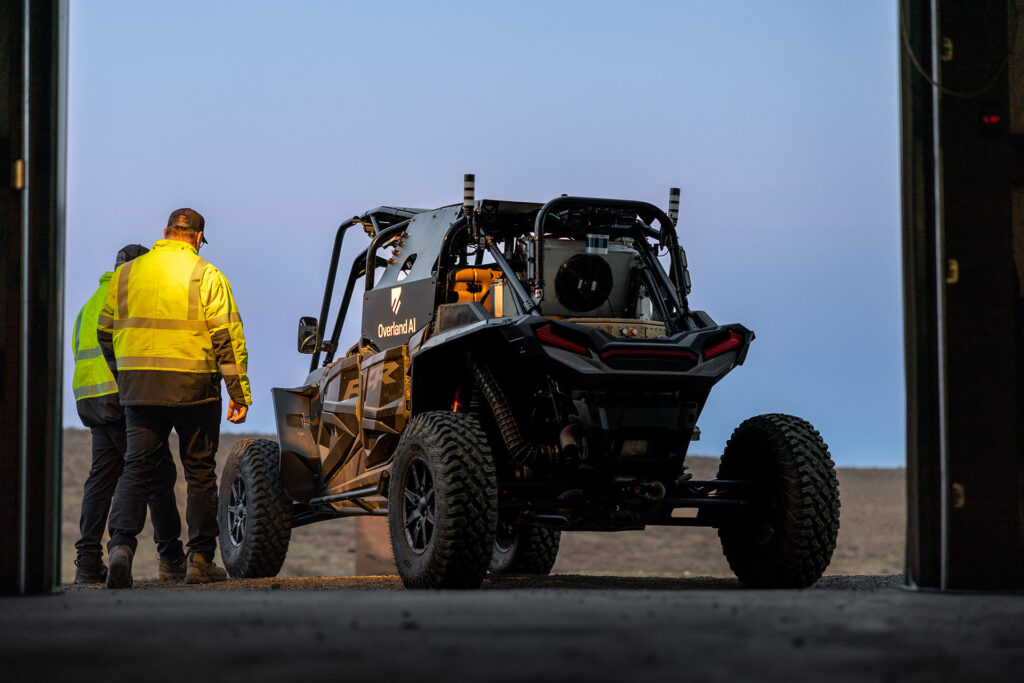
Teague collaborates with various partners, including Overland AI, a leader in autonomous land systems. Their technology navigates complex off-road terrain at operationally relevant speeds.
We’re assisting them in demonstrating their autonomy stack, OverDrive, via a custom UI that allows warfighters to intuitively engage with the platform—planning routes, executing missions, and providing user feedback when input is required. The designed UI facilitates visualization and demonstrates unique capabilities to senior military stakeholders, accelerating product adoption.
Which military systems would most benefit from improved UX/UI?
Heiser: Traditional military systems increasingly need to connect with newer systems designed for specific tasks. This presents a significant challenge to engage with and make decisions based on interconnected systems across various platforms.
The challenge lies in upgrading legacy systems already certified and trained on for years. One approach to avoid extensive rebuilding is to develop an interface that overlays the legacy system, allowing seamless interconnectivity without requiring profound changes for the user.
This topic has gained traction, as many companies we collaborate with look to ensure their systems adapt to emerging technologies.
McElvogue: Introducing new technology is an optimal moment to incorporate a human-centered design perspective. Focusing on UX early on—before finalizing technical requirements—ensures that both aspects inform one another.
Consider a day in the life of a Joint Terminal Attack Controller (JTAC) managing tasks across multiple systems and products, from mission planning to execution to intelligence discussions and debriefing. They must navigate varying user experiences from diverse sources.
The military is recognizing its procurement of products from multiple vendors and the need to unify these experiences to prevent inefficiencies and errors. Human-centered design provides a verifiable advantage for users (in this case, the warfighter) and can serve as a competitive edge for defense sector products.
When planning and executing missions, the mission planning phase often requires days to analyze information, create battle management strategies, and disseminate plans to battalions. Given the velocity and volume of incoming information during execution, an effective strategy to process and utilize this data quickly is essential.
Now the question becomes whether to keep the human in or out of the decision-making loop regarding such information. By segmenting and synthesizing data for the individual responsible for decision-making, the entire information loop can become tighter and more efficient.
In systems where multiple data sources converge for a ‘go button’ to be activated, we observe hesitancy among users.